
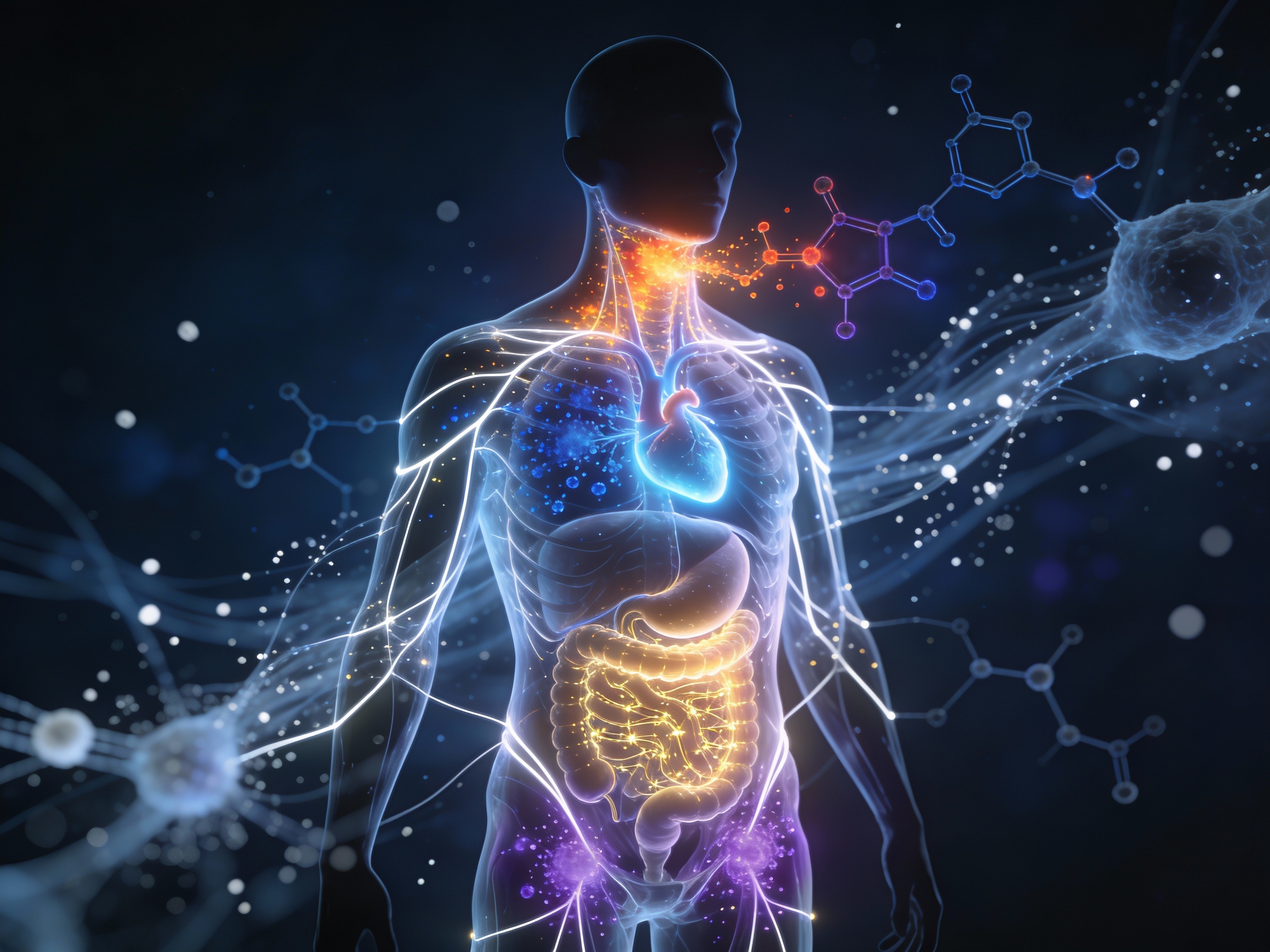
Blog Summary: Science reveals that unresolved emotions don’t disappear they embed themselves in your muscles, fascia, and organs, triggering chronic inflammation and illness. Discover the revolutionary neuroscience proving emotions are real chemicals in your body and what happens when you finally release them.
The Chemical Truth: Emotions Aren’t Just Feelings
Here’s what your high school biology teacher never told you: Every emotion you feel is a chemical event. The moment you experience fear, anger, grief, or joy, your brain is ALREADY in motion, manufacturing specific molecules called neuropeptides the body’s emotional messengers. These are real, measurable chemicals with real, measurable effects.[1][2][3]
Back in the 1970s, Dr. Candace Pert made a discovery at Johns Hopkins that shook neuroscience. She was the first Harvard-trained medical physician to scientifically prove that emotions aren’t just thoughts they’re chemistry. While studying opioid receptors in the brain, Pert realized the brain produced its own version of opiates: endorphins and dozens of other neuropeptides. But here’s the plot twist: these emotion-chemicals weren’t just in your head. They were EVERYWHERE in your organs, your immune cells, your gut, even in the walls of your arteries.[2][3]
Pert called them the “Molecules of Emotion,” the title of her groundbreaking 1997 book. And what she discovered changed everything about how we understand health.[4]
The core science is staggering: Your body produces 50 to 60 different neuropeptides, each one creating a distinct emotional tone. When you feel anger, your brain floods your system with one chemical cocktail. When you feel grief, it’s a completely different formula. When you feel joy, yet another. The body is speaking a chemical language all day long and for the most part, you have NO IDEA it’s happening.[3]
Normally, This Works Beautifully (Here’s What Should Happen)
In a healthy, emotionally well-processed human, this system is ELEGANT. You feel an emotion. Your brain releases neuropeptides. These chemicals travel through your bloodstream, deliver their message to your organs and tissues, and then here’s the important part they metabolize away. The emotion comes, registers in your body, and then it LEAVES.[5][3]
This is supposed to take minutes to a couple of hours. Your body is designed to CYCLE through emotions. Not dwell in them. Not store them.
But then trauma happens. Or chronic stress. Or you suppress an emotion because it wasn’t “safe” to feel it. Or you experience something so overwhelming, your nervous system gets stuck in shock.
And THIS is where the whole system breaks down.
When Emotions Don’t Leave: How Your Body Becomes a Storage Unit
Here’s the uncomfortable truth: When you DON’T resolve an emotion, your body doesn’t delete it. It stores it.[6]
Specifically, neuropeptides accumulate in your muscles and fascia the sticky connective tissue that wraps around your organs, muscles, and nerves like a second skin. Think of fascia as the body’s filing system. And unresolved emotions are documents that get stuffed into folders and shoved into a cabinet that nobody opens.[7][6]
The problem? Fascia has MEMORY. A fascial cell isn’t just structural material it’s conscious. It remembers trauma, stress, and emotional overwhelm at the cellular level. Under chronic emotional stress, this tissue becomes thick, dehydrated, and densified. And get this: a 20% decrease in collagen hydration in your fascia can slow energy flow through your body by 5,000-fold.[8][7]
You’re literally sealing yourself shut.
Your Body’s Emotional Geography: Where Feelings Live
Where does your body store these trapped emotions? Everywhere. But research shows specific PATTERNS.[9]
A Finnish study mapping where people FEEL emotions found striking consistency across cultures:[9]
| Emotion | Where It Lives in Your Body |
| Fear | Heart center & chest |
| Anger | Surge through head, face, arms, shoulders |
| Grief | Throat and chest |
| Sadness | Diminished throughout, especially extremities |
| Anxiety | Chest and gut |
| Shame | Face and chest |
| Love | Entire body, especially heart and genitals |
| Happiness | Everywhere—full-body activation |
But here’s what’s disturbing: Most of us aren’t feeling these emotions—we’re STORING them. The hips are notorious for holding unexpressed sadness. The jaw clenches with swallowed anger. The throat tightens with unspoken truth. The back carries the weight of burdens nobody knows you’re carrying.[6]
And the longer these emotions stay trapped, the more your body treats them as THREATS.
The Downward Spiral: How Stored Emotions Become Chronic Disease
This is where the real danger begins.
Your nervous system isn’t sophisticated enough to distinguish between a real threat and a psychological one. When emotions stay trapped in your tissues, your nervous system CONTINUES to treat those areas as under siege. It stays in a low-grade state of emergency what scientists call “survival mode.”[10][11]
This chronic activation triggers inflammation at the cellular level. Stress hormones like cortisol flood your system constantly. Your immune response stays revved up, attacking not just real threats but sometimes your own tissues (autoimmune cascade). Blood vessels constrict. Digestion shuts down. Sleep becomes impossible. And your brain starved of proper signaling starts creating anxiety and depression.[10]
The statistics are grim:[10]
- Depression affects 14.8% of people with arthritis, 26% with psoriasis
- Anxiety affects 19% of arthritis sufferers, 48% of psoriasis sufferers
- Co-occurring anxiety and depression appear in 27.7% of arthritis cases, 55% of psoriasis cases
These aren’t separate diseases. They’re the BODY SPEAKING. It’s saying, “I’m still holding trauma. I still don’t feel safe.”
The Pill Problem: Why Medications Fail (And Make It Worse)
Now we get to the uncomfortable part of the conversation: Why your doctor’s prescription doesn’t actually solve this.
Here’s the fundamental problem: Medications mask symptoms. They don’t address root causes.[12][13]
Take an antidepressant for chronic anxiety rooted in stored trauma. The medication suppresses the anxiety signal for a few hours. Your nervous system feels artificially calmer. But THE TRAPPED EMOTION IS STILL THERE in your tissues. The neuropeptides are STILL sequestered in your muscles and fascia. The infection hasn’t been treated—just numbed.[12]
And so what happens? You take more. Higher doses. Different medications. Your body develops tolerance. Side effects multiply. New problems emerge. And the original issue the unresolved emotion locked in your body continues its slow work of destruction.[13][12]
This is called the symptom-suppression trap. You’re treating the messenger, not the message. And your body has to scream louder and louder to get your attention.
Some people don’t just take pills they discover that pills work AGAINST their healing. The neuropeptides that need to move, to be felt, to be processed, are chemically frozen in place by medications that “stabilize” them. Your body wanted to CRY those emotions out. Your medication prevented it. Your body needed to SHAKE them loose. Your medication locked them down further.[12]
What Science Says About Recovery (It Takes Time—But It Works)
Here’s the good news: Your body CAN release stored trauma. And when it does, POWERFUL things happen.
The research on trauma release shows a predictable pattern:[14]
Phase 1: Stabilization and Safety (Weeks to Months)
During this phase, you’re creating enough stability in your life and nervous system that the body FEELS SAFE to process. Signs are subtle maybe slightly better sleep, moments of being more grounded.[14]
Phase 2: Processing and Integration (Months to Years)
THIS is when the dramatic releases happen. Your body goes through intense periods of somatic activation (shaking, trembling, spontaneous movement) alternating with integration phases.[14]
What you might experience:
- Sudden waves of emotion—crying, laughing, or intense anger WITHOUT an obvious trigger[14]
- Tears during routine activities (showering, driving, eating)[14]
- Vivid, intense dreams[14]
- Unexpected waves of fatigue after therapy sessions[14]
- Grief for losses you thought you’d already processed[14]
- Anger about situations surfacing unexpectedly[14]
This is not a sign something is WRONG. It’s a sign something is being MADE RIGHT. Your nervous system is finally saying, “I’m safe enough now to let this go.”[15][14]
The Fascia Can Heal (Here’s the Actual Path Forward)
The good news? Fascia is PLASTIC. It can be remodeled.[7]
Unlike your bones (which harden) or your muscles (which have limited adaptation), your fascia is designed to CHANGE. When you release chronic tension, the fascia can return to its supple, hydrated state. And when fascia begins to soften and flow again, something remarkable happens: emotions that were locked away for YEARS suddenly become accessible for processing and release.[7]
The methods that work:
1. Somatic Therapy & Trauma-Informed Bodywork
Practitioners who understand that emotion lives in the BODY, not just the mind.[16][14]
2. Myofascial Release
Sustained pressure on fascial restrictions for 5+ minutes allows what practitioners call “phase transition and resonance” the fascia’s way of releasing held trauma.[17]
3. Deep Stretching & Yoga
Especially restorative and trauma-informed styles that honor the nervous system’s need for safety.[6]
4. Breath Work
The vagus nerve (which connects your gut to your brain) responds powerfully to deliberate breathing. Yogis, athletes, and laboring women have used this for centuries.[3][7]
5. Dance, Shaking, Spontaneous Movement
Your body WANTS to move trauma out. Many cultures understood this; modern medicine forgot.[15][14]
6. Cold Water Immersion, Sauna
These stimulate the parasympathetic nervous system and help the body cycle through frozen states.[14]
7. Sound & Vocalization
Humming, chanting, crying, screaming all help dislodge neuropeptides from tissue.[7]
The Real Timeline: What to Expect
Let’s be honest about something: The “70 years” claim in pop culture discussions of emotion storage is OVERSIMPLIFIED.
The science doesn’t support a fixed timeline. What research DOES show is that unresolved trauma can persist for DECADES without proper intervention. Intrusive memories of PTSD can return for years. The nervous system remains dysregulated. The body keeps defending against old threats.[18][11][14]
But the timeline for RECOVERY depends entirely on:[14]
- The severity of the original trauma
- Your current capacity to feel safe
- Whether you’re using methods that address the NERVOUS SYSTEM, not just the mind
- How consistently you engage in release work
Some people release years of stored emotion in weeks of intensive somatic work. Others take months or years. There’s no standardized formula only YOUR body’s intelligence about what it can handle.
The Mind-Body Proof (It’s Not Mystical It’s Physics)
If you’re skeptical that emotions genuinely live in the body (and not just the mind), consider this:
Same neuropeptide receptors exist in your BRAIN and in your ORGANS. Your amygdala (fear center) and your gut lining both respond to identical chemical signals. Your immune cells manufacture the SAME emotional chemicals that regulate your mood in your brain.[3]
This isn’t metaphor. This is anatomy.[3]
That’s why grief can physically HURT. Why anxiety makes your stomach churn. Why shame makes your skin flush. Your organs are literally FEELING emotions at the cellular level.[19]
And that’s why when you finally release them when you cry, shake, move, and let your body PURGE these chemicals you don’t just feel psychologically better. You feel PHYSICALLY lighter. Clearer. More alive.
The Bottom Line: Your Body Is Waiting for You to Listen
Every sensation you’re having RIGHT NOW that tightness in your chest, that ache in your lower back, that knot in your throat, that flutter in your stomach might not be a medical problem requiring a diagnosis.
It might be your body speaking.
It’s saying: I remember. I’m holding this. I need help releasing it.
And here’s the beautiful, liberating truth: Your body isn’t punishing you for feeling. It’s WAITING for you to feel completely. To stop halfway. To let these chemicals move through and OUT instead of getting trapped inside.
The emotions don’t kill you. The suppression does.
What You Can Do Starting TODAY
- Notice where you FEEL emotions in your body. Not think about them FEEL them. Sadness in your hips? Fear in your chest? Anger in your jaw? Your body is showing you where it’s holding.
- Give yourself permission to CRY. Not the polite, controlled kind. The full-body, messy, heaving kind. This is how neuropeptides LEAVE the tissue.
- Move your body in ways that feel good. Dance, stretch, shake, swim it doesn’t matter WHAT, only that you’re giving your nervous system permission to express what’s trapped inside.
- Find a trauma-informed therapist or somatic practitioner. Not someone who just wants to TALK about your trauma. Someone who understands the BODY remembers.
- Breathe deliberately. Even 5 minutes a day of conscious breathing shifts your nervous system from sympathetic (fight-or-flight) to parasympathetic (rest-and-digest).
- Stop expecting pills to do the work your BODY is designed to do. Medications can create safety. But only YOU can release what’s trapped inside.
Share This With Someone You Love
If you’ve ever felt like your body was holding something you couldn’t quite name SHARE THIS. Tag someone in the comments who needs permission to cry, move, shake, and FEEL.
What emotion do YOU think your body might be holding? Comment below. I read every single message and I’ll respond to yours personally.
Want more on this topic? Subscribe for deep-dive research-backed content on healing trauma, reclaiming your nervous system, and understanding the science of emotions. New posts every week none of the pop psychology fluff, only the REAL stuff that actually works.
Follow for updates on neuroscience, trauma, fascia, and the revolutionary science proving your body and mind aren’t separate.
Candace Pert’s neuropeptide research, National Institutes of Health[1]
Frontiers in Molecular Neuroscience editorial on Pert’s legacy (2023)[2]
Candace Pert, “The Wisdom of the Receptors” (1988)[3]
Neuropeptide research overview (2025)[4]
Emotion storage in muscles and fascia research[6]
Finnish emotion mapping study (2013)[9]
Neuropeptide metabolism and tissue repair[5]
Temporal dynamics of trauma memory persistence research[18]
Signs your body is releasing trauma (healing science)[14]
Chronic stress and inflammation research[10]
How trauma changes nervous system regulation[11]
Physical signs of trauma release[15]
Fascia and emotional health research[7]
Myofascial release mechanism studies[17]
Trauma storage in nervous system and organs[16]
Fascial cell awareness and memory[8]
Organ-level emotional response research[19]
⁂
- 1. https://www.semanticscholar.org/paper/bb68202b94eec6c64af475b2eeae8d9cc23b2562
- 2. https://pmc.ncbi.nlm.nih.gov/articles/PMC10579933/
- 3. http://candacepert.com/articles/the-wisdom-of-the-receptors-neuropeptides-the-emotions-and-the-bodymind/
- 4. https://thesublimeblog.org/2025/01/21/molecules-of-emotion-an-unsung-hero-called-neuropeptides/
- 5. https://jamanetwork.com/journals/jamasurgery/fullarticle/211732
- 6. https://bethrowles.com/how-the-body-stores-emotions/
- 7. https://rev6.fit/why-the-fascia-is-key-to-emotional-healing/
- 8. https://pmc.ncbi.nlm.nih.gov/articles/PMC6281443/
- 9. https://www.medicalnewstoday.com/articles/emotions-trapped-in-the-body
- 10. https://www.sciencedirect.com/science/article/abs/pii/S1567576923013723
- 11. https://www.lukecoutinho.com/blogs/emotional-wellness/stored-trauma-in-the-body/
- 12. https://charlestonchirostudio.com/blog/addressing-the-root-cause-of-pain-vs-masking-symptoms-charlestons-revolutionary-approach-to-true-healing/
- 13. https://painconsults.com/why-is-it-important-to-target-the-source-and-not-just-the-symptom-pain-management-in-aventura-hollywood-and-pembroke-pines/
- 14. https://healingspringswellness.com/signs-your-body-is-releasing-trauma/
- 15. https://dmhbh.org/blog/8-physical-signs-your-body-is-releasing-trauma/
- 16. https://mymind.org/advice/2025/archive/unresolved-trauma-and-the-body-how-trauma-is-stored-in-our-muscles-fascia-and-nervous-system/
- 17. https://www.stress.org/news/myofascial-release-for-stress-reduction/
- 18. https://pmc.ncbi.nlm.nih.gov/articles/PMC10244962/
- 19. https://www.embodiedwellnessandrecovery.com/blog/span-classsqsrte-text-color-whitewhen-the-body-speaks-understanding-how-organs-emotions-and-the-nervous-system-communicatespan-mbgzd
- 20. https://www.semanticscholar.org/paper/ebddb539452f5440c1727b335db1ffdb3f68a3d4
- 21. https://www.nature.com/articles/npp2013269
- 22. https://www.semanticscholar.org/paper/7a41110aa36dea992776378b0d11bfefd17c19d2
- 23. https://www.semanticscholar.org/paper/b09667a48d5cee98d52546cee2ff338a5af5a868
- 24. https://www.semanticscholar.org/paper/1b9fc53c7f2cc375174f5533ccc14080c5935d3a
- 25. http://link.springer.com/10.1057/9781137287557_5
- 26. https://www.semanticscholar.org/paper/bbf39c7cc8c4652085981f2584ccfad532911ff5
- 27. http://link.springer.com/10.1007/978-1-4612-3514-9_19
- 28. http://www.tandfonline.com/doi/abs/10.1080/15294145.2004.10773463
- 29. https://pmc.ncbi.nlm.nih.gov/articles/PMC9714608/
- 30. https://pmc.ncbi.nlm.nih.gov/articles/PMC6596824/
- 31. https://pmc.ncbi.nlm.nih.gov/articles/PMC5179628/
- 32. https://pmc.ncbi.nlm.nih.gov/articles/PMC8476281/
- 33. https://pmc.ncbi.nlm.nih.gov/articles/PMC4015729/
- 34. https://www.frontiersin.org/articles/10.3389/fpsyt.2024.1419574/full
- 35. https://www.mdpi.com/2306-5354/10/2/258
- 36. https://pmc.ncbi.nlm.nih.gov/articles/PMC3896150/
- 37. https://pmc.ncbi.nlm.nih.gov/articles/PMC4749915/
- 38. https://pmc.ncbi.nlm.nih.gov/articles/PMC12505535/
- 39. https://candacepert.com/wp-content/uploads/2017/07/Advances-v8-1988-Wisdom-of-the-Receptors1.pdf
- 40. https://www.6seconds.org/2007/01/26/the-physics-of-emotion-candace-pert-on-feeling-good/
- 41. https://www.termedia.pl/doi/10.5114/kitp.2024.141144
- 42. https://studia.reviste.ubbcluj.ro/index.php/subbtheologiaorthodoxa/article/view/9201
- 43. https://www.sciedupress.com/journal/index.php/wjel/article/view/25066
- 44. https://mds.marshall.edu/adsp/vol24/iss1/3
- 45. https://link.springer.com/10.1007/s10995-024-03927-1
- 46. https://journals.lww.com/00023727-199401000-00001
- 47. https://ijmpo.com/article-details/6784
- 48. https://dx.plos.org/10.1371/journal.pone.0186712
- 49. https://www.mdpi.com/2076-0787/14/12/226
- 50. https://scholar.kyobobook.co.kr/article/detail/4050070989798
- 51. https://pmc.ncbi.nlm.nih.gov/articles/PMC3818726/
- 52. https://pmc.ncbi.nlm.nih.gov/articles/PMC10691918/
- 53. https://www.frontiersin.org/articles/10.3389/fnhum.2013.00201/pdf
- 54. https://pmc.ncbi.nlm.nih.gov/articles/PMC3659338/
- 55. https://pmc.ncbi.nlm.nih.gov/articles/PMC2800360/
- 56. https://pmc.ncbi.nlm.nih.gov/articles/PMC10693746/
- 57. https://cris.maastrichtuniversity.nl/ws/files/76029421/Dibbets_2014_induced_trauma_real_emotions_call.pdf
- 58. https://onlinelibrary.wiley.com/doi/10.1002/med.21323
- 59. https://pmc.ncbi.nlm.nih.gov/articles/PMC4761674/
- 60. https://pmc.ncbi.nlm.nih.gov/articles/PMC8299562/
- 61. https://pmc.ncbi.nlm.nih.gov/articles/PMC5476783/
- 62. https://www.ncbi.nlm.nih.gov/books/NBK28247/
- 63. https://ca4wellbeing.com/signs-your-body-is-releasing-trauma/
- 64. https://www.cureus.com/articles/228126-a-growing-concern-the-prevalence-of-self-medication-in-pediatric-healthcare-in-india
- 65. http://doi.wiley.com/10.1002/14651858.CD008003.pub3
- 66. https://link.springer.com/10.1007/s10072-020-04504-4
- 67. https://www.semanticscholar.org/paper/2a6a5fef9b1184b53e3dc9422f1491fe81f38f25
- 68. https://www.semanticscholar.org/paper/db419785d50298652f0cbed4cd97b6353b94b25c
- 69. https://journals.lww.com/10.1097/SCS.0000000000006934
- 70. https://pmc.ncbi.nlm.nih.gov/articles/PMC4478904/
- 71. https://pmc.ncbi.nlm.nih.gov/articles/PMC2791537/
- 72. https://pmc.ncbi.nlm.nih.gov/articles/PMC10848493/
- 73. https://pmc.ncbi.nlm.nih.gov/articles/PMC9120280/
- 74. https://pmc.ncbi.nlm.nih.gov/articles/PMC4620711/
- 75. https://www.cambridge.org/core/services/aop-cambridge-core/content/view/8E40FF081C2A03CF9F7B1D3F2213AB74/S2056469400000577a.pdf/div-class-title-neglect-of-the-complex-why-psychotherapy-for-post-traumatic-clinical-presentations-is-often-ineffective-div.pdf
- 76. https://pmc.ncbi.nlm.nih.gov/articles/PMC10845104/
- 77. https://pmc.ncbi.nlm.nih.gov/articles/PMC2525822/
- 78. https://www.reddit.com/r/therapists/comments/10oe15o/emotions_stay_trapped_in_your_body_and_in_your/
- 79. https://www.hdlawpartners.com/blogs/7852/otc-drugs-could-hide-symptoms-of-larger-issue/
- 80. https://healthcorephysicaltherapyfl.com/dont-mask-the-symptoms-with-meds-treat-the-root-of-your-problem-with-physical-therapy/
Leave a Reply