
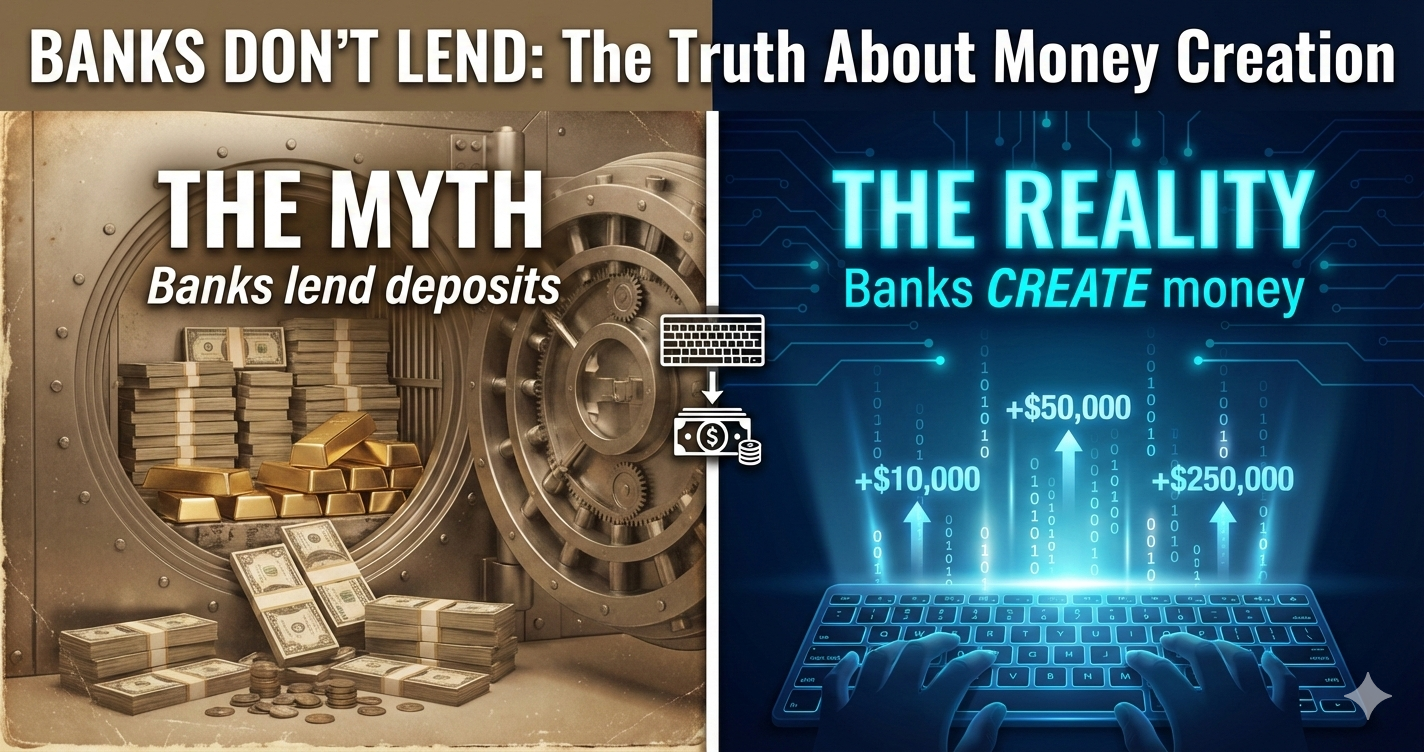
BANKS DON’T LEND: The Truth About Money Creation
Most of the “money” in your bank account was never saved by anyone. It was born the moment a bank approved a loan.
Banks DON’T Lend: The Truth About Money Creation (And What You Can Do About It)
You’ve been told a simple story.
You deposit money in the bank.
The bank keeps a bit in reserve.
Then it lends the rest to someone else.
Sounds tidy. Feels safe.
It’s also not how modern banking really works.
In legal and accounting reality, banks don’t take deposits the way most people think, and they don’t “lend out” pre‑existing money. Commercial banks create new money when they extend credit.
That’s not a conspiracy theory.
It’s in black and white in central bank publications, and it has been empirically demonstrated by researchers like Prof. Richard Werner.
And once this clicks, a LOT of things suddenly make sense:
- Why debt keeps exploding faster than wages
- Why housing bubbles keep inflating
- Why “tightening” or “loosening” credit reshapes entire economies
…all without a single printing press in sight.
Quick Reality Check: Why This Is Such a Big Deal
Here’s the wild part:
- Around 90–97% of all money in modern economies is bank deposits, not physical cash.
- Those deposits are mostly created when banks make loans not when you put your salary in the bank.
- The classic textbook story of “banks as intermediaries” that just lend out savings is explicitly rejected by the Bank of England in its own 2014 paper “Money creation in the modern economy”.
- Legally, your so‑called “deposit” is not held in custody for you. It’s actually a loan from you to the bank.
So when you “borrow” from a bank, the bank is not handing you someone else’s carefully stored savings.
It is buying your promissory note (your IOU) and in exchange creating a brand‑new deposit in your name money that didn’t exist yesterday.
No transfer.
No pile of cash moved from a vault.
Just accounting entries.
Let that sit for a moment.
How Banks REALLY Create Money (The Simple Version)
Strip away the jargon and here’s the core mechanism:
- You walk into a bank and ask for a loan.
- You sign a loan agreement / promissory note. Legally, that is a security your promise to repay in the future.
- The bank purchases that security from you. That’s its asset.
- In return, the bank creates a new “deposit” in your account its liability to you.
- That deposit is treated as money. You can now spend it, transfer it, invest it.
As the Bank of England puts it, “the act of lending creates deposits the reverse of the sequence typically described in textbooks.”
And as Prof. Richard Werner summarizes it, “banks don’t take deposits and banks don’t lend money… they’re in the business of purchasing securities.”
From the bank’s side:
- Asset: your loan / promissory note
- Liability: the new deposit in your name
From your side:
- Asset: the deposit (your bank balance)
- Liability: the loan you owe back over time
That’s it.
A few keystrokes. A signed promise. New money.
“But What About My Deposit Isn’t the Bank Holding My Money?”
Here’s the uncomfortable legal twist.
When you “deposit” money:
- The bank does not keep it in a little box with your name on it.
- In law, a deposit is not a bailment and not a custody arrangement.
- Courts have repeatedly clarified that your deposit is a LOAN to the bank, and the bank now owes you an equivalent amount, on demand.
So:
- You are an unsecured creditor of the bank.
- The balance you see in your app is the bank’s IOU to you, not “your” segregated cash.
From a systemic perspective, that IOU is treated as money.
But it’s still just a claim on the bank, not cash in a vault with your name on it.
This is why:
- Bank runs are dangerous (if too many people demand cash at once, the bank can fail).
- Deposit insurance and lender‑of‑last‑resort support from central banks exist at all.
The entire game rests on trust in bank IOUs.
Why the Old Story (Fractional-Reserve Multipliers) Is Misleading
Textbooks and even some finance courses still push a story like this:
- Someone deposits 100.
- Bank keeps 10, lends 90.
- That 90 gets deposited elsewhere, 81 is lent, and so on.
- A “money multiplier” emerges.
Central banks themselves now say: that’s not how the modern system actually operates.
In reality:
- Banks do not wait for deposits to lend.
- Banks first decide to lend (based on profit expectations, regulation, and perceived risk).
- That lending creates a new deposit somewhere in the system.
- Afterwards, the bank sources reserves and liquidity to settle payments and meet regulatory requirements, with help from the central bank if needed.
In other words:
From loans to deposits not deposits to loans.
Citations & Sources
Banks DON’T Lend: The Truth About Money Creation
Primary Sources
Bank of England – “Money Creation in the Modern Economy” (2014)
“Commercial banks create money…the reverse of the sequence typically described in textbooks.”
Full Paper
Prof. Richard Werner – “Banks Don’t Loan Money, They Purchase Securities”
Empirical pioneer proving banks create money via securities purchase, not deposit lending.
Interview | Transcript
MacroScan – “‘Loans First’ – Explaining Money Creation by Banks”
Technical breakdown of loan→deposit sequence.
PDF
Supporting Research
Crux Investor – “The Truth About Banking and Creating Money out of Thin Air” (2024)
Productive vs. speculative credit analysis.
Article
Bank for International Settlements (BIS) – Central Bank Papers
Credit and liquidity creation mechanics.
BIS Overview
Key Statistics Referenced
97% of money supply = bank deposits (Bank of England, 2014)
Loans create deposits sequence confirmed by central banks worldwide.
This “loans first” view has been rigorously laid out by heterodox economists and is now echoed, in more careful language, by institutions like the Bank of England.
Why This Matters for You (And the Whole Economy)
If banks create most of the money supply as they lend, then where that lending goes shapes everything:
- Productive credit (to businesses that create new goods and services)
→ jobs, innovation, real economic growth. - Unproductive or speculative credit (for existing real estate, stock buybacks, pure asset speculation)
→ bubbles, inequality, fragile financial systems.
Prof. Werner and others emphasize this distinction:
- Economies where bank credit is steered mainly into productive uses tend to have stable growth with fewer crises.
- Economies where bank credit floods into asset markets tend to experience boom–bust cycles, property bubbles, and financial crashes.
Germany’s long history of relatively stable, productive banking is closely linked to its network of local savings banks and cooperative banks, which prioritize lending to local businesses.
So the question is not just:
“Do banks create money?”
The more urgent question is:
“What are banks creating money for?”
The Hidden Pain Points of Credit-Created Money
Once the mechanism is clear, some familiar pain points look very different:
- Ever‑rising debt:
If new money mostly appears when loans are made, then debt tends to grow faster than incomes, unless there are deliberate policies to channel credit productively and allow safe debt reduction. - Property that never seems affordable:
When banks aggressively create money for mortgage lending and real estate speculation, house prices can detach from local incomes, driven by bank credit rather than real scarcity. - Boom–bust cycles:
Rapid expansion of credit for asset purchases can inflate bubbles; when credit creation slows or reverses, asset prices crash, hurting households and businesses. - Feeling powerless:
Most people are never told that private bank lending decisions effectively shape the money supply, while public debate focuses mostly on government budgets and central bank headlines.
Understanding the plumbing doesn’t fix everything.
But it turns vague anxiety into targeted awareness and action.
So What’s the Solution? A Practical, Step‑by‑Step Guide
Changing an entire monetary system sounds huge.
But there are concrete steps individuals, businesses, and communities can take right now to push things in a healthier direction.
Think in three layers:
- Personal finance moves
- Business and community strategy
- Policy and structural change
1. Personal Level: Protect Yourself and Use Money More Intentionally
Step 1: Stop thinking of your bank balance as “cash in a box”
- Mentally reframe your account balance as “a claim on my bank”, not cash held in custody.
- This mindset shift makes it easier to:
- Assess bank risk
- Appreciate why diversification matters
- Understand why systemic stability is a real issue
Step 2: Diversify where you hold value
Without giving investment advice, here are general principles:
- Consider not keeping all wealth as unsecured bank deposits.
- Spread risk across:
- Multiple banks or institutions
- Different asset types (e.g., high‑quality government bonds, short‑term funds, real assets), based on your risk profile and professional advice.
- For larger balances, understand deposit insurance limits in your country and stay intentionally below or around those thresholds per institution.
Step 3: Be strategic with your own debt
Every time you borrow:
- You are inviting new money into existence tied to your future income.
- Ask:
- “Is this borrowing financing something productive for my life?”
- “Will this loan increase my capacity to earn, create, or live more freely?”
Prioritize:
- Debt that funds education, skills, business, or essential housing over pure consumption.
- Clear, realistic repayment plans, especially in variable‑rate environments where central banks can raise rates quickly.
2. Business & Community Level: Direct Credit Towards the Real Economy
Step 4: If you are an entrepreneur, treat banks as money‑creation partners
When a bank approves a loan to your productive business, new money is created and flows into real activity. That’s powerful.
So:
- Build a strong, transparent case for how your project produces real value.
- Document:
- Cash flows
- Local job creation
- Export or innovation potential
- Seek banks (often smaller, regional, or cooperative ones) that have a history of productive SME lending rather than pure real‑estate speculation.
Step 5: Support local / mission‑driven banking
In many countries, community banks, credit unions, and cooperative banks are structurally closer to the productive, relationship‑based model highlighted by Werner.
Action steps:
- Research local institutions that:
- Focus on SME lending
- Have clear social or regional development mandates
- Maintain conservative, transparent risk policies
- Move at least part of your banking relationship (accounts, loans, merchant services) to those institutions when feasible.
- As a community, reward banks that actually support the real economy, not only asset bubbles.
Step 6: Build or join community finance initiatives
Depending on your jurisdiction:
- Explore or support:
- Credit unions
- Producer or consumer cooperatives
- Local investment clubs that funnel capital into real businesses
- These structures can:
- Improve bargaining power with banks
- Provide peer‑screened, productive uses of credit
- Reduce dependence on large, distant institutions
3. Policy & System Level: Push for Smarter Banking Rules
The structure of money creation can be redesigned. That requires public pressure and informed debate.
Step 7: Advocate for credit guidance, not just “more or less regulation”
Instead of only arguing for “tight” or “loose” rules, shift the question to:
“What types of bank lending should be encouraged and what should be constrained?”
Evidence suggests:
- Productive lending to businesses that increase real output supports stable growth.
- Credit for existing asset purchases (especially property speculation) tends to amplify bubbles and crises.
Policy ideas often discussed in the literature:
- Lower capital requirements or incentives for productive SME lending
- Higher capital weights or stricter terms for purely speculative real estate or financial speculation
- Public development banks that co‑lend with private banks into high‑impact productive sectors
Step 8: Demand transparency around bank credit allocation
Push for:
- Public data on what share of bank lending goes to:
- Non‑financial businesses
- Residential mortgages
- Commercial real estate
- Financial speculation and securities
- Clear, accessible dashboards published by regulators or central banks
Once the data is in the open, it becomes harder for policymakers to ignore distortions.
Step 9: Support monetary and banking education
Most voters, journalists, and even many professionals still carry the “banks as intermediaries” myth in their heads.
Practical moves:
- Share accessible explanations from central banks themselves, such as the Bank of England’s “Money creation in the modern economy”.
- Recommend talks and interviews that break down the legal and accounting reality, including Prof. Werner’s explanations of bank credit creation.
- Encourage schools, universities, and professional programs to update outdated textbook narratives.
Better understanding → better questions → better policy.
Key Takeaways (If You Remember Just Three Things)
To keep it ultra simple:
- Banks don’t “lend out” your deposits.
Your deposit is a loan to the bank. The bank owes you, not the other way around. - Bank lending creates new money.
When a bank approves a loan, it buys your IOU and credits your account with a fresh, digital deposit expanding the money supply. - What banks create money for shapes everything.
Credit to productive activity supports real growth. Credit to existing assets fuels bubbles, inequality, and crises.
Once this becomes common knowledge, the next questions change from:
“Can the government afford this?”
to:
“What are banks creating money for right now and is that actually serving society?”
Source Inspiration & Further Reading
This article was inspired in large part by Prof. Richard Werner’s explanation of how banks really operate, especially his interviews and talks where he states that “banks don’t take deposits and banks don’t lend money… they’re in the business of purchasing securities.”
Key starting points:
- Richard Werner – “Banks Don’t Loan Money, They Purchase Securities” (Video)
https://www.youtube.com/watch?v=KhYQ-qQutSw - Richard Werner – “Banks don’t lend money. They buy your promissory note.” (Clip + transcript)
https://www.youtube.com/watch?v=7vQt73UuGCI
Transcript summary: https://www.educatedinlaw.org/2017/03/banks-dont-take-deposits-banks-dont-lend-money/ - Bank of England – “Money creation in the modern economy” (2014)
Explains, in official central bank language, that commercial banks create money when they make loans and do not act as simple intermediaries between savers and borrowers.
Article: https://www.bankofengland.co.uk/quarterly-bulletin/2014/q1/money-creation-in-the-modern-economy
PDF: https://www.bankofengland.co.uk/-/media/boe/files/quarterly-bulletin/2014/money-creation-in-the-modern-economy - ‘Loans First’ – Explaining Money Creation by Banks (MacroScan)
A clear technical explanation of how bank lending creates deposits and why the traditional “deposit multiplier” story is flawed. - Crux Investor – “The Truth About Banking and Creating Money out of Thin Air”
A summary of Werner’s view on productive vs speculative credit and the role of community banks.
These sources together paint a consistent picture: modern money is largely bank credit, and understanding that unlocks more intelligent debate about debt, development, and democracy.
Final Thought And a Call to Action
If banks can create most of the money supply just by typing numbers into accounts, then money is far less “scarce” than people are told.
The real scarcity is:
- Productive, grounded uses of credit
- Wise regulation that channels credit into the real economy
- Public awareness of how the system actually works
So here’s the question:
Now that you know banks don’t really “lend” existing money, how does it change the way you see debt, savings, and power in the economy?
Drop your thoughts in the comments especially:
- What part of this blew your mind the most?
- Would you move your banking to a more productive, community‑oriented institution?
- What other myths about money do you want unpacked next?
👉 Comment below and share your biggest insight and if you want a curated list of resources on money creation and banking reform, mention “MONEY LINK” and a community link can be shared.
👉 Tag a friend who still thinks banks are just “lending out deposits”.
👉 Follow for more deep‑dive breakdowns on money, banking, and the real rules of the economic game.
Leave a Reply