
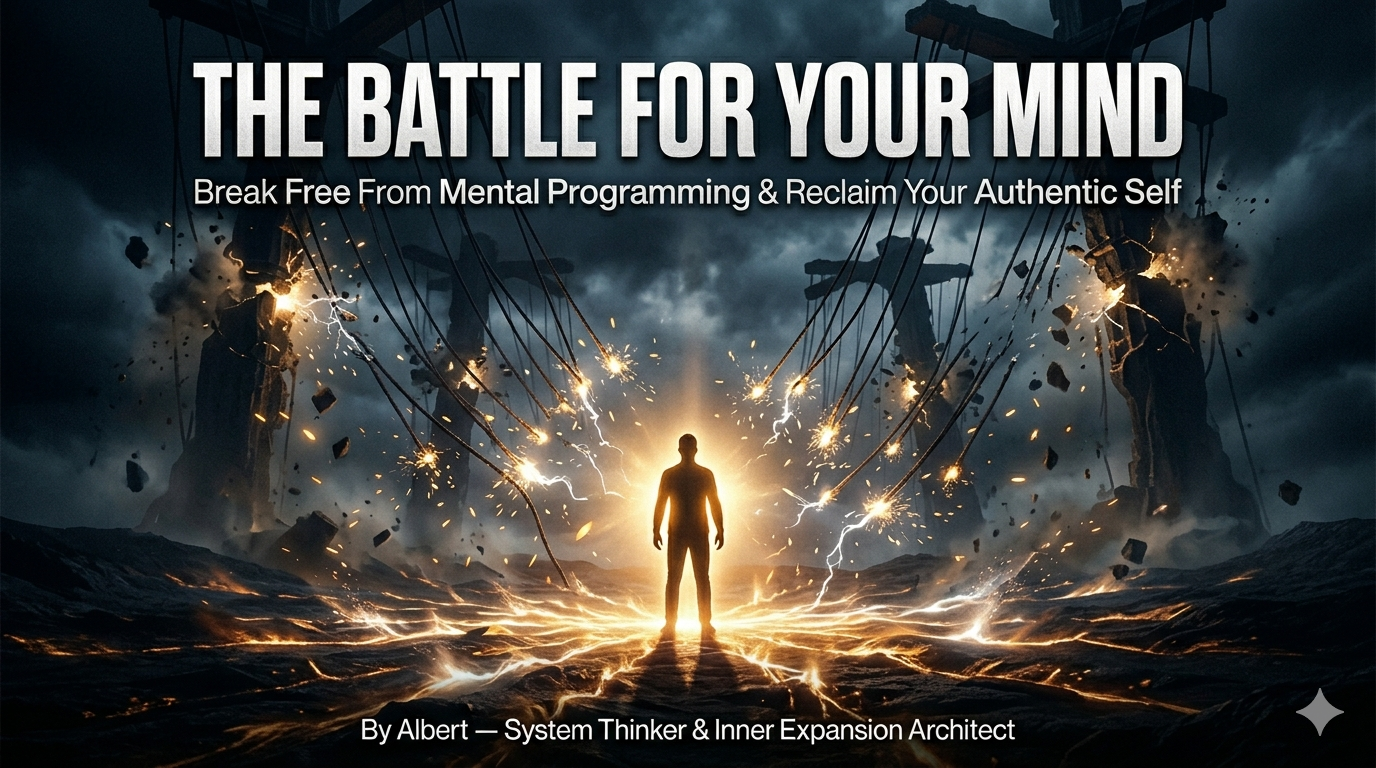
stealing your authentic self. Here’s what’s really happening
inside your mind and how to stop it.
Break Free From Mental Programming & Reclaim Your Authentic Self
By Albert | System Thinker & Inner Expansion Architect
Subscribe on LinkedInYou are not thinking your own thoughts. You never were. And THAT is the most dangerous thing no one told you.
Let that sink in for a second.
The beliefs you hold about yourself — your worth, your capabilities, your identity — were they actually YOURS to begin with? Or were they carefully installed by childhood experiences, cultural conditioning, and systems that needed you to stay small, obedient, and easy to manage?
This is not a conspiracy theory. This is neuroscience, psychology, and ancient wisdom all pointing at the same uncomfortable truth:
Most people are living inside a mind that was programmed for them — not by them.
In this post, we’re going deep. We’re going to unpack 5 profound insights that most people never realize about how their minds were shaped — and more importantly, give you a clear, actionable path to reclaim the mind you were born with.
Inspired by the pioneering work of philosopher Roy Masters, grounded in 21st-century behavioral science, and filtered through a systems-thinking lens — this is the article that could change everything.
Why This Matters More Than Ever in 2025
We live in the most information-saturated era in human history. Social media algorithms, 24/7 news cycles, political messaging, advertising, influencer culture — every single system is competing for one thing:
Your attention. Your agreement. Your compliance.
And here’s the scary part: most people don’t even notice it’s happening.
Consider these realities:
- Over 4.9 billion people use social media globally — each platform algorithmically designed to provoke emotional reactions that keep you scrolling
- Studies show the average person makes 35,000 decisions per day — and the vast majority are unconscious, habit-driven, and shaped by external influences
- Mental health disorders affect 1 in 8 people worldwide, with anxiety and identity crises at an all-time high — in countries that, on paper, offer the most freedom
- In democratic, open-market societies — places built on ideals of equality, social justice, and individual freedom — people paradoxically feel MORE trapped, less authentic, and more confused about who they actually are
The freedom we have on the outside has not translated to freedom on the inside. And that gap? That’s where the real battle is fought.
Source Inspiration
This article is inspired by the philosophical teachings of Roy Masters, founder of the Foundation of Human Understanding, and his profound exploration of mental conditioning, self-observation, and inner freedom. His work, particularly his talks on ‘The Battle for the Mind,’ laid the groundwork for much of what you’re about to read.
Watch the original talk here:
Roy Masters — The Battle for the Mind (YouTube)
Additional context and expansion by Albert, System Thinker & Inner Expansion Architect:
albertyzacharia.in/home/f/how-to-break-free-from-mental-programming-and-find-yourself
5 Profound Insights Most People Never Realize
INSIGHT #1: Your Knowledge May Actually Be Your Blindfold
“Knowledge is a form of ignorance.” — Roy Masters
This sounds paradoxical. But stay with me.
We live in a society that worships information. Degrees, certifications, data, expertise — we treat accumulated knowledge as the highest good. But Roy Masters makes a distinction that most academics never address: the difference between KNOWING and UNDERSTANDING.
Knowledge is mechanical. It’s the act of filing information into existing mental frameworks — frameworks that were, themselves, built by others. When you ‘know’ something, you’re often just retrieving a pre-installed belief and calling it thought.
Understanding is different. Understanding is alive. It emerges in real time, from direct observation, from presence — not from memory.
Masters argues that every human being is born with the capacity for profound, Einstein-level insight. The kind of clarity that doesn’t come from reading books — it comes from being fully present and seeing reality as it is, without the filter of prior conditioning.
But here’s what happens: from the earliest years of childhood, we are rewarded for memorizing and repeating what authorities tell us. Original thought is often punished or discouraged. And slowly, we learn to reach for the filing cabinet in our head instead of the living intelligence in our being.
The result? A society full of highly educated people who cannot think for themselves.
In the 21st century, this is amplified to an almost absurd degree. We have unprecedented access to information — and yet, critical thinking, self-awareness, and genuine wisdom seem to be in decline. We know more than ever. We understand less than ever.
The first step to mental freedom is recognizing that what you ‘know’ about yourself may be the very thing imprisoning you.
INSIGHT #2: You Were Shamed Into Submission — And You Didn’t Even Notice
Here’s where it gets deeply personal — and deeply uncomfortable.
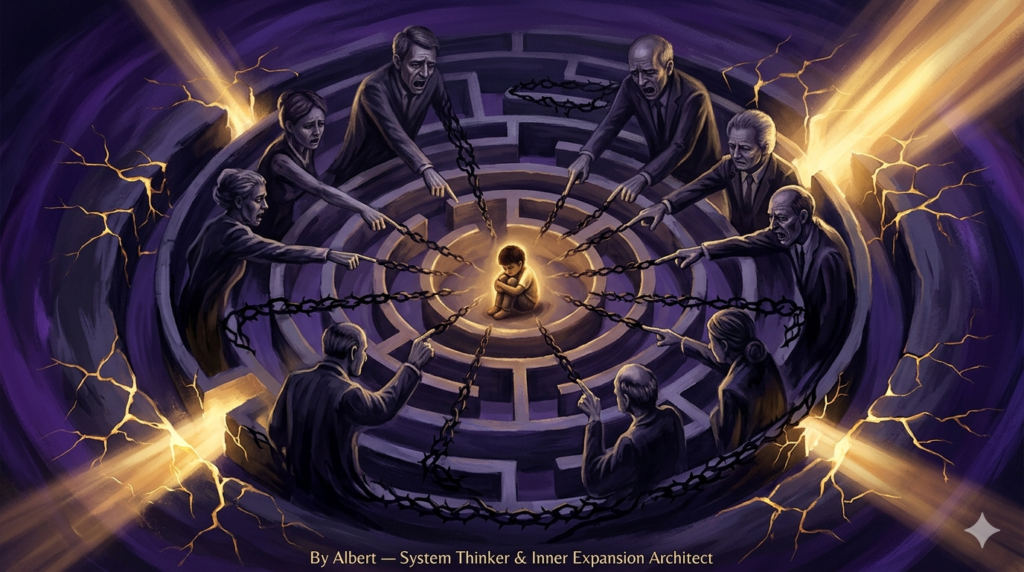
Children are born as pure perceiving machines. They SEE clearly. They feel authentically. They have an uncanny ability to notice when an adult is being inconsistent, hypocritical, or emotionally unstable.
But what happens when a child notices that their parent is flawed — and says so?
In most households? They get punished for it. Shamed. Told they’re ‘wrong’ to feel what they feel. Told they’re being ‘disrespectful’ for seeing what they see.
Masters identifies this as the birth of the false self. Because the child can’t survive without the parent’s love and approval, they do what any intelligent organism does: they adapt. They learn to doubt their own perception. They internalize the message: ‘My reality is wrong. Their reality is right.’
A child shamed for seeing the truth becomes an adult who can’t trust themselves — and therefore needs others to tell them who they are.
This is not just a personal trauma dynamic. It’s a SYSTEMIC one. It plays out in classrooms, in religious institutions, in corporate environments, in political systems. Anywhere that authority requires compliance, the same mechanism is at work:
- Reward obedience. Punish independent perception.
- Create dependency on external validation.
- Manufacture a population that is easy to lead — because they have been taught they cannot trust themselves.
And here’s the chilling modern application: social media is the most sophisticated shame-and-validation machine ever built. Every like, every comment, every follower metric is a digital upgrade of the same childhood conditioning. You post. You wait. You check. You feel good if approved — empty if ignored.
You are still that child, waiting to be told your reality is acceptable.
In democratic, open societies that champion equality and social justice, this is a profound contradiction. We have external structures of freedom — but millions of people walking around with internally colonized minds.
INSIGHT #3: The Corrupt Authorities You Escape — You Recreate
This one is going to sting. But it’s the insight that changes EVERYTHING if you’re willing to sit with it.
Masters explains that once a person has been conditioned to doubt their own perception and seek external validation, they don’t just do this occasionally — it becomes the organizing principle of their entire psychological life.
You leave your controlling parents — and find a controlling partner.
You escape a toxic boss — and end up under another one just like them.
You leave a religious institution that felt oppressive — and join a social movement, a political ideology, or a personal development cult that fills the same emotional role.
Why? Because your nervous system was wired for that dynamic. The familiar IS safety — even when the familiar is unhealthy. And so without deep self-awareness, you unconsciously recreate the same relational structure over and over, just with different people in the roles.
You don’t attract what you want. You attract what you are — and you ARE the product of your earliest conditioning.
This is why trauma-informed therapists talk about ‘repetition compulsion.’ It’s why people in domestic abuse situations often cycle through similar relationships. It’s why political revolutions so frequently produce the same structures of oppression they claimed to be overthrowing.
In 21st century terms: look at how people engage online. The most ‘liberated’ individuals — those who loudly champion free thinking and personal freedom — are often the most rigidly imprisoned by the echo chambers they’ve built, the influencers they’ve elevated to guru status, and the tribal identities they’ve adopted.
You cannot find freedom by changing the cage. You have to stop needing cages.
INSIGHT #4: Religion, Ideology, and Spirituality Can Be the Deepest Traps
This is perhaps the most sensitive insight — but also one of the most important.
Roy Masters does not dismiss spirituality. Quite the opposite. He argues that genuine spiritual development is the KEY to mental freedom. But he draws a sharp distinction between authentic spiritual growth and what most people call ‘religion’ or ‘belief.’
His observation: many people use religious or ideological participation as a sophisticated form of ego management.
- Church attendance becomes a way to ‘pay off’ guilt — a weekly reset button that lets you continue unhealthy patterns without genuine change
- Spiritual practices become performance — ways to project a virtuous image while harboring resentment, pride, or manipulation underneath
- Ideological commitment — whether religious, political, or philosophical — becomes a new external authority that relieves you of the terrifying responsibility of thinking for yourself
Masters is blunt about this: if your spiritual practice makes you feel better about your false self rather than challenging it, it’s not liberation. It’s just a more sophisticated form of the same conditioning.
This applies equally to secular belief systems. In 2025, we see entire political movements and social justice frameworks that, despite their genuine desire for good, function as tribal identity systems. Membership requires conformity of belief. Questioning is heresy. The emotional dynamics mirror fundamentalist religion — just with different language.
The most dangerous prison is the one you believe is a palace.
True spiritual intelligence — in any tradition — has always pointed toward the same thing: the dissolution of the false, conditioned self, and the emergence of something authentic beneath it. That process is uncomfortable. It involves sitting with uncertainty. It involves having your comfortable beliefs shaken.
If your spiritual or ideological path never makes you uncomfortable — it’s probably not setting you free.
INSIGHT #5: Observation — Not Effort — Is the Path to Freedom
Here’s the insight that sounds too simple to be profound — and turns out to be the most revolutionary thing you could ever practice.
Masters says: you can’t fight your way to freedom. You can’t willpower your way out of conditioning. You can’t think your way out of a mind that was shaped by faulty thinking.
The answer is OBSERVATION. Effortless, non-judgmental, present-moment self-observation.
Learn to observe yourself without effort. Watch what’s happening in you without adding commentary, judgment, or resistance. Just — see.
This is what the great contemplative traditions have always taught. Mindfulness. Witness consciousness. The ‘observer self.’ But Masters frames it with striking directness: the moment you can observe a thought or emotion without being consumed by it, you have reclaimed a piece of your original, pre-conditioned self.
Why does this work? Because conditioning operates in the dark. It runs on automatic. It requires your unconscious participation. The moment you SHINE LIGHT on a pattern — not to judge it, not to fight it, just to SEE it clearly — it begins to lose its power.
In neuroscience terms, this is consistent with what we know about metacognition and neural plasticity. When you observe your own thought processes (metacognition), you activate prefrontal cortex areas associated with executive function and rational choice — essentially stepping outside the automatic pattern.
In 21st-century practical terms: this is why journaling, meditation, therapy, and contemplative practices have real, measurable effects. They all involve creating space between stimulus and response — the space where freedom lives.
You don’t need to become something new. You need to STOP being what you were conditioned to be. And observation is how.
The Practical Path: Step-by-Step Guide to Reclaiming Your Mind
Insight without action is just entertainment. So here’s your road map — grounded in the 5 insights above, designed for real life in the 21st century.
PHASE 1 — Awareness (Weeks 1–2): See the Cage
Step 1: The 24-Hour Reaction Audit
For one full day, keep a small notebook or phone note. Every time you feel a strong emotional reaction — irritation, anxiety, the need to impress, defensiveness — write it down. Don’t analyze. Just log it.
At the end of the day, look at the list. Ask: ‘Where did I first learn to feel this way about this type of situation?’ You’re mapping your conditioning.
Step 2: Identify Your External Validators
Make a brutally honest list of the people, systems, or metrics whose approval you seek. Your boss. A parent. Social media likes. Your political tribe. Your religious community. Your partner’s opinion of you.
This is not about judging these relationships. It’s about seeing WHERE you have outsourced your sense of self-worth. You can’t reclaim what you don’t know you’ve given away.
Step 3: Notice the Voice of Shame
Begin catching the inner critic. When you make a mistake, what does the inner voice say? Whose voice does it actually sound like? When did you first hear those words directed at you?
This practice alone is transformative. Most people run from the inner critic. The first act of freedom is turning around and looking at it.
PHASE 2 — Detachment (Weeks 3–5): Create Space
Step 4: The Daily 20-Minute Observation Sit
This is the cornerstone practice. Set a timer for 20 minutes. Sit comfortably. Close your eyes. And simply WATCH your mind.
Don’t try to quiet it. Don’t meditate ‘correctly.’ Just observe. Thoughts arise — notice them. Emotions surface — notice them. The key phrase: ‘I am aware that I am thinking/feeling X.’ That ‘I am aware that’ creates the observer position. You are no longer the thought. You are the one watching the thought.
Do this daily. Non-negotiably. This is where real change happens.
Step 5: The Information Detox
Choose one platform or news source you consume daily and eliminate it completely for 21 days. Not to be uninformed — but to observe what happens in your psychology when that input is removed. Do you feel anxious? Disconnected? Bored? That discomfort is data. It tells you how much your sense of self was dependent on that external feed.
Step 6: Question Every Strong Belief
Pick one belief you hold with great certainty — political, religious, personal. Then deliberately seek out the strongest, most intelligent argument for the opposite position. Not to abandon your belief. But to test whether it was arrived at through genuine inquiry — or inherited without examination.
Real beliefs can withstand questioning. Conditioned beliefs fall apart under honest scrutiny. This is valuable information.
PHASE 3 — Integration (Weeks 6–12): Build the Real You
Step 7: The Authentic Preference Practice
Start small. In everyday choices — what to eat, what to wear, how to spend a free hour — practice asking yourself: ‘What do I actually want?’ (not ‘What should I want?’ or ‘What would make X approve?’).
This sounds trivial. It is not. Most people are profoundly out of touch with their genuine preferences because they have spent so long calibrating to others’ expectations. Re-learning your own desires is literally re-building the self.
Step 8: Find One Trustworthy Witness
The deconditioning journey is deeply personal — but it doesn’t have to be done alone. Find one person (a therapist, a trusted mentor, a deeply honest friend) who can reflect back what they see in you — including the patterns you’re too close to see yourself.
This is NOT about finding a new authority to validate you. This is about having a mirror. Choose someone who will tell you uncomfortable truths with kindness — not someone who will simply confirm your existing self-concept.
Step 9: Practice Sitting With Uncertainty
The conditioned mind HATES not knowing. It will grab for any certainty — any authority, any ideology, any identity — just to escape the discomfort of open questions. Begin deliberately practicing tolerance for not-knowing.
When a hard question arises — spiritual, political, personal — resist the urge to immediately resolve it. Sit with it. Let it be open. The capacity to hold open questions without anxiety is one of the clearest markers of genuine psychological maturity.
Step 10: Return, Repeatedly, to Observation
You will get pulled back into old patterns. This is guaranteed. Conditioning runs deep and the nervous system resists change. The practice is not to never be triggered — it is to notice more quickly when you have been.
‘I just reacted automatically. I can see that now.’ That observation IS the practice. Every time you catch yourself in the pattern, you shorten the time you spend unconscious inside it. Over months, what once hijacked you for days begins to last only hours. Then minutes. Then moments.
THIS is what Masters calls ‘stopping the world’ — breaking the automatic, conditioned response cycle — and reclaiming your original clarity.
The World That Becomes Possible
Imagine a society where the majority of people — in the democracies, the open markets, the advocates for equality and social justice that most of our world aspires to — are operating from genuine self-awareness rather than conditioned reaction.
Where political discourse is driven by actual values and reasoned thought rather than tribal fear and identity defense.
Where relationships are chosen from wholeness rather than recreated out of early-childhood wounding.
Where spiritual and religious communities are genuinely transformative rather than emotionally tranquilizing.
Where freedom is not just a legal status — but a psychological reality.
That world is built one mind at a time. And it starts — it can ONLY start — with the individual reclaiming sovereignty over their own inner landscape.
The most radical political act you can perform in 2025 is to free your own mind.
Not because external structures don’t matter — they do. But because every oppressive external structure is maintained by the unconscious compliance of internally conditioned people. Change the inside, and the outside eventually has nothing to hold onto.
Quick Recap — 5 Insights + 10 Steps
THE 5 INSIGHTS:
- Your accumulated knowledge may be your biggest blindfold — not your key to understanding
- You were shamed into doubting your own perception — and that wound is still running the show
- The corrupt authorities you flee, you unconsciously recreate — until you heal the pattern beneath
- Religion, ideology, and spirituality can deepen the conditioning instead of dissolving it
- Effortless self-observation — not willpower or knowledge — is the doorway to genuine freedom
THE 10 STEPS:
- 24-Hour Reaction Audit
- Map Your External Validators
- Name the Voice of Shame
- Daily 20-Minute Observation Sit
- 21-Day Information Detox
- Question Your Strongest Belief
- Authentic Preference Practice
- Find One Trustworthy Witness
- Practice Sitting With Uncertainty
- Return — Repeatedly — to Observation
Now, Your Turn
Here’s a question I want to leave with you:
Which of these 5 insights hit closest to home — and which one are you most tempted to argue against? Because the one you resist most? That’s probably the one that’s most true for you.
Drop your answer in the comments. I read every single one. And if this resonated — share it with one person you think is ready to hear it. Not to convince them. Just to plant a seed.
The battle for your mind is real. But here’s the good news:
Awareness is the beginning of the end of unconscious conditioning. And you’re already more aware than you were 10 minutes ago.
That matters. Don’t underestimate it.
About the Author
Albert is a System Thinker and Inner Expansion Architect who explores the intersection of consciousness, human behavior, and authentic self-development. His work bridges ancient wisdom and modern psychology to help people dismantle unconscious conditioning and build lives rooted in genuine inner freedom.
Read more articles: albertyzacharia.in/articles
Full blog: albertyzacharia.in/home?blog=y
Original article inspiration: How to Break Free from Mental Programming
Watch Roy Masters — The Battle for the Mind (YouTube)
SEO Keywords Embedded in This Post
Primary: how to break free from mental programming, battle for your mind, reclaim authentic self, Roy Masters philosophy, mental conditioning, brainwashing cycle
Secondary: self-discovery steps, inner freedom, unconscious conditioning, false self psychology, observation practice, deconditioning, systemic brainwashing, authentic identity, 21st century mental health
- The Conditioned Self vs. The Authentic Self: Reclaiming … – Over time, this conditioning can separate us from our authentic self, leading to shame, self-doubt, …
- The Conditioned Self vs the Authentic Self – The conditioned self is the self you have as an adult, and the authentic self is the self that got l…
- What is Conditioned and Authentic Self? | Anne-Marie Zanzal – We’re diving into the nitty-gritty of identity and behavior. Meet the two head honchos of our person…
- Authentic Self or Conditioned Self: Who’s Showing Up in … – One is our unvarnished, energized, Authentic Self, and the other (our Conditioned Self) helps us nav…
- Gaslighting by Authority Figures: 7 Red Flags to Watch For – Think your boss, doctor, or teacher is manipulating you? Learn 7 red flags of gaslighting by authori…
- Long‐term effects of childhood trauma subtypes on adult brain function – Childhood trauma is prevalent in our society, whereas little is known about why and how different fo…
- Long‐term effects of childhood trauma subtypes on adult brain function – Childhood trauma is prevalent in our society, whereas little is known about why and how different fo…
- Examining the Role of Impulsivity Facets in the Relationship Between Childhood Emotional Maltreatment and Aggressive Behavior in Adulthood – ABSTRACT Childhood emotional maltreatment and impulsivity in adulthood have been linked with aggress…
- 5 Ways to Awaken Your Authentic Self – Your authentic Self is your truest, most genuine, and natural inner Essence. Some people call this i…
- The Psychology of Religion and Motivated Behavior – In Module 9 we will discuss motivated behavior related to religiosity. Our discussion will tackle wh…
- Manipulation Strategies in Interpersonal Relationships and Their Psychological Impact – Manipulation is a purposeful, conscious, organized psychological influence with the aim of using the…
- Mind control: The secret weapon utilised by religious cults to control their followers – The aim of this article is to create awareness of the dangers of religious cults. The process utilis…
- Religious Behaviors as Strategies for Organizing Groups of People: A Social Contingency Analysis – …fits with observations that religions typically act to increase anxiety rather than to reduce it….
- Breaking Free of Mental Programming – Ask Yourself · What limiting thoughts run through my head? · What beliefs no longer serve me? · If t…
- Unprogramming Yourself: Breaking Free from Limiting Beliefs – Unprogramming limiting beliefs involves recognizing and reworking the mental code that no longer ser…
- RELIGIOSITY RELATED TO LIFE SATISFACTION, LOCUS OF CONTROL AND DEFENSE MECHANISMS – The proportion of non-religious individuals has been increasing rapidly over the last decade. Conseq…
- The Impact of Childhood Trauma on Children’s Welbeing and Adult Behavior – Abstract Background This article looks at the impact of childhood trauma on children’s wellbeing and…
- Effects of Parental Childhood Abuse on Daily Stress Processes in Adulthood – …daily stressors. The current study provides evidence that a history of parental childhood abuse m…
- The Lasting Effects of Childhood Trauma on Adult Mental …
- Ten Ways to Tell Your True Self vs Conditioned Self – Reflect: The conditioned self does not like imperfection or failure. The true self is rooted in the …
- How to Find Your Authentic Self: 8 Actionable Steps – Life Note – how to find your authentic self: uncover 6 practical paths such as journaling, mindfulness, and valu…
- Maladaptive personality traits may link childhood trauma history to current internalizing symptoms – Research supports a strong relationship between childhood maltreatment and internalizing psychopatho…
- The Impact of Maternal Childhood Trauma on Children’s Problem Behaviors: The Mediating Role of Maternal Depression and the Moderating Role of Mindful Parenting – Objective This study investigates the impact of maternal childhood trauma on children’s problem beha…
- Rediscover Your Authentic Self: Self Awareness and Recovery … – Ever felt like you’re wearing a mask during recovery? That’s the challenge of self awareness and rec…
- This is how you break through your own programming – This is how you break through your own programming
- Authority Bias: Unmask This Manipulation Psychology Secret! – Ever wondered why we often agree with someone just because of their title? Dive into the fascinating…
- Is Religion Special? – Religion makes unique claims (e.g., the existence of supernatural agents) not found in other belief …
- Association of Childhood Trauma Exposure With Adult Psychiatric Disorders and Functional Outcomes – Key Points Question Are adult psychiatric and functional outcomes associated with cumulative childho…
- Association of Childhood Trauma Exposure With Adult Psychiatric Disorders and Functional Outcomes – Key Points Question Are adult psychiatric and functional outcomes associated with cumulative childho…
- The Cult Mentality Behind Organized Religion – , we explore how major religions often mirror the psychological control systems used by cults: obedi…
- The link between childhood trauma and adult behaviour – Childhood trauma is recognised for its profound impact on mental health in adulthood. Discover more …
- Uncovering The Power Of Authority Manipulation: Strategies To Influence And Persuade Effectively | Growthex – In the digital age, mastering the art of authority manipulation is a game-changer for those looking …
- Religion and Emotion Regulation: A Systematic Review of Quantitative Studies – The association between religion/spirituality and emotion regulation has been the subject of growing…
- How to Discover Your Authentic Self: 5 Powerful Steps to Reclaim Your True Identity – 🌟 Do you know who you truly are? Many of us spend our lives answering society’s questions about succ…
- How Authority Figures Subtly Manipulate Followers – Discover how authority figures subtly manipulate followers using psychological tactics to gain contr…
Leave a Reply