
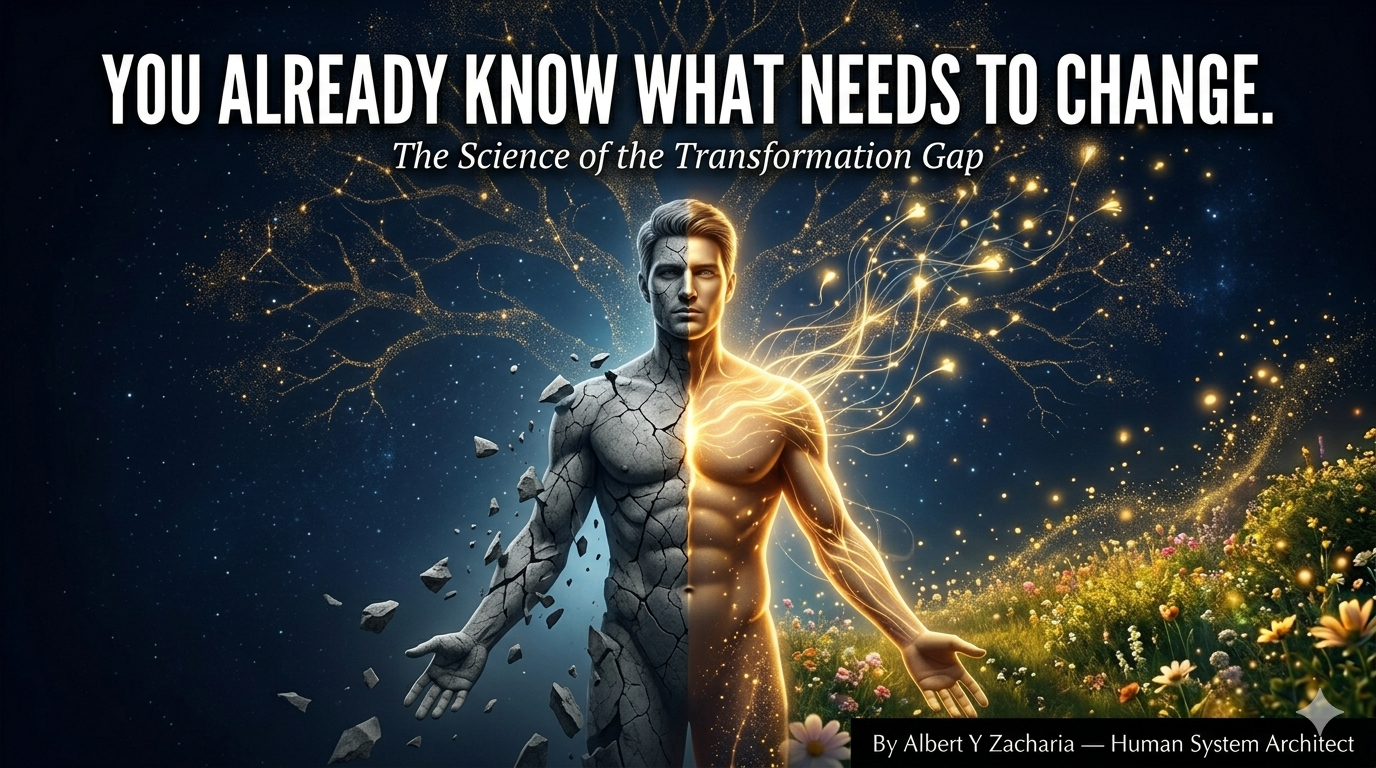
You’re Aware. So Why Aren’t You Changing?
Most people confuse awareness with transformation. Here are 5 brutal truths about what change actually requires — and why the gap between knowing and becoming is where most people quietly give up.
Here’s something nobody tells you: awareness is just the beginning of the hardest part. You already know what you should change. You probably have for a while. You’ve read the books, watched the talks, maybe even journaled about it. And yet — here you are. Knowing but not becoming. Seeing the problem but not solving it. That gap? That’s not a knowledge problem. It’s a transformation problem.
Let’s talk about what’s really happening — because the journey from awareness to actual transformation is one of the least understood, most mis-sold topics in the entire personal development world.
I’ve spent years as a system thinker and inner expansion architect, studying how individuals and societies evolve — and I keep seeing the same pattern. People get stuck at the awareness stage and mistake it for progress. They think insight equals change. It doesn’t.
“Transformation isn’t a single event. It is an ongoing process of becoming — and most people quit exactly at the moment the real work begins.”
Here are 5 PROFOUND INSIGHTS that most people overlook on this journey. These aren’t motivational clichés. They’re hard truths — backed by behavioral science, systems thinking, and the quiet wisdom of everyone who has ever actually changed.
The Overlooked Gap
Awareness Is Not the Starting Line. It’s the Pre-Game Warmup.
We celebrate the moment of awareness — the “aha!” — as if it were already change. But awareness is just the moment you notice the door. WALKING THROUGH IT IS A COMPLETELY DIFFERENT SKILL.
Neuroscientist Lisa Feldman Barrett’s research on how emotions are constructed tells us that simply knowing something intellectually doesn’t automatically rewire how your nervous system responds to it. The brain is a prediction machine. It will default to existing patterns unless those patterns are systematically disrupted and replaced.
The ancient Stoics understood this too. Marcus Aurelius didn’t just know about discipline — he wrote to himself, rehearsed his values, and practiced them ritually. He used awareness as fuel, not as the destination.
- Awareness reveals the problem — it doesn’t solve it
- Emotional insight and behavioral change operate on different timescales
- The brain needs repetition, not revelation, to change its defaults
- Most “I need to change” moments fade within 72 hours without a structural follow-through
- The gap between insight and action is where old identity reclaims its power
The System Problem
You’re Not Fighting Your Habits. You’re Fighting Your Environment — and You Don’t Even Know It.
Here’s what blew my mind when I went deep into systems thinking: YOUR BEHAVIOR IS A PRODUCT OF YOUR SYSTEM, NOT JUST YOUR WILLPOWER.
Stanford psychologist BJ Fogg’s Tiny Habits research confirms what architect Winston Churchill once famously observed: “We shape our buildings, and thereafter our buildings shape us.” The same is true of every environment you inhabit — digital, physical, social, or psychological.
This is why someone can have a transformative retreat experience — deep insight, real breakthroughs — and return home to the exact same behaviors within three weeks. The insight was real. But the environment swallowed it whole.
Systems thinker Donella Meadows identified this as system resistance — where the structure of a system actively works to maintain its current state. Personal transformation that doesn’t redesign the system around the person is fighting upstream. Always.
- Your habits are solutions your environment trained you to use — change the environment first
- Social environment is the most powerful behavioral regulator we systematically underestimate
- Digital environments are now the #1 architect of modern attention and behavior patterns
- Friction design matters — adding small obstacles to bad behaviors works better than willpower
The Identity Paradox
Real Transformation Isn’t About Changing What You Do. It’s About Changing Who You Think You Are.
Most people try to change their behavior. But behavior flows from identity. And most transformation efforts never touch identity at all.
James Clear articulated this brilliantly in Atomic Habits — the difference between “I’m trying to quit smoking” and “I’m not a smoker.” One is a battle against a habit. The other is an expression of identity. Same action, completely different staying power.
But here’s what Clear doesn’t fully explore: IDENTITY ITSELF IS A SYSTEM. It was built — by experiences, by the people around you, by the stories you were told about who you are. That means it can be rebuilt, but it takes more than a new morning routine.
Psychologist Dan McAdams calls this the “narrative self” — we are, at our core, the stories we tell about ourselves. And most people’s self-narrative was authored by someone else, in a chapter of life they’ve long since outgrown. Transformation, at the deepest level, is authoring a new story — deliberately, persistently, with enough courage to hold the pen even when the old story feels safer.
“You can change your habits and still feel like the old version of yourself. Identity is the operating system. Habits are just apps running on top of it.”
- Every habit vote is a vote for a new identity — consistency casts the ballot
- Grief is a legitimate part of identity change — you’re mourning an old self
- Community and language are the two most powerful identity-reshaping tools available to us
- The question isn’t “what do I want to do?” but “who do I want to be?”
The Non-Linear Secret
Transformation Doesn’t Go in a Straight Line — and the Setbacks ARE the Progress.
We’ve been sold a linear model of transformation: identify problem → take action → get results. Clean. Logical. Completely wrong.
Real transformation follows what researchers James Prochaska and Carlo DiClemente identified as the Transtheoretical Model of change — a spiral, not a line. Most people relapse. Most people cycle through pre-contemplation, contemplation, and preparation before they ever reach sustained action. And MOST OF THAT CYCLING IS INVISIBLE PROGRESS.
Complexity theorists call this “phase transition” — the system is reorganizing itself beneath the surface before a visible shift occurs. Like water molecules aligning before freezing. It looks like nothing is happening. Then suddenly, everything shifts.
This is why the people who achieve lasting transformation are rarely the ones who “felt motivated” — they’re the ones who stayed curious instead of judgmental when they fell short. They used failure as data, not as verdict.
- Relapse is statistically normal — 3 to 5 attempts before lasting change is average
- Self-compassion during setbacks has been shown to increase resilience more than self-criticism
- The question after a setback isn’t “why did I fail?” — it’s “what does the system need adjusting?”
- Micro-progress is invisible on the surface and enormous in the nervous system
The Collective Dimension
Personal Transformation Without Societal Awareness Is a Privilege You Can’t Afford to Keep.
Here’s the one most personal development content completely avoids: you are not transforming in a vacuum.
The systems around you — economic, cultural, institutional — are actively shaping what feels possible, what feels normal, what feels like “just the way things are.” And for many people, the inability to sustain personal transformation isn’t a character flaw. IT’S A STRUCTURAL PROBLEM WEARING A PERSONAL MASK.
Sociologist C. Wright Mills called this the “sociological imagination” — the ability to understand your personal experience within its social and historical context. Systems thinker Donella Meadows argued that the highest leverage point in any system is not its rules or parameters, but the mindsets and paradigms that hold the system in place.
This doesn’t mean personal effort is meaningless — it means it’s most powerful when it’s paired with an understanding of the larger system. Personal transformation and collective evolution are not separate journeys. They are the same journey at different scales.
- Your habits are partly cultural products — knowing that removes shame and adds strategy
- Community change is exponential — one transformed person influences five to ten others on average
- Systemic barriers require systemic solutions, not just personal willpower upgrades
- The most resilient changemakers operate at both personal and structural levels simultaneously
The Practical Path
The 7-Step Awareness-to-Transformation Framework
Insight is only the first step. Here’s your actionable, system-based roadmap from “I know” to “I’ve become.”
Name It Precisely — Not Vaguely
Don’t say “I need to be healthier.” Say “I consistently skip meals and eat reactively when under stress.” The more specific the awareness, the more targeted the intervention. Write it down. Give the pattern a name. This is the first act of authorship.
Map the System Around the Behavior
Ask: What triggers this pattern? What rewards maintain it? Who around me normalizes it? What physical environment makes it easy? Use a simple sheet of paper and map the inputs, outputs, and feedback loops that keep the behavior in place. You’re not diagnosing yourself — you’re diagnosing the system.
Choose One Lever, Not Ten
Systems thinking teaches that change one high-leverage variable and the whole system shifts. What is the single environmental, social, or behavioral lever that, if changed, would make the old pattern structurally difficult? Focus 80% of your energy there. Resist the impulse to overhaul everything at once — it’s the most common reason people collapse.
Build a Tiny Daily Practice — Then Stack It
Start with something so small it’s almost embarrassing. Two minutes. One rep. One sentence. The goal in the first 30 days is not results — it’s identity votes. Every time you do the small thing, your nervous system logs it as “this is who I am now.” After 30 days of consistency, layer the next behavior on top. Stack slowly, compound powerfully.
Design for Failure, Not Just Success
Write your “if-then” plan before you need it. “If I miss my morning routine because of travel, then I will do a 5-minute version in the hotel room.” Research on implementation intentions (Peter Gollwitzer, NYU) shows this single act doubles the likelihood of follow-through. Failures are not the end of your plan — they are part of it.
Update Your Narrative Actively
Once a week, write one sentence that describes who you are becoming — present tense. “I am someone who treats my body as a foundation.” “I am someone who chooses stillness before reaction.” Read it each morning. It sounds simple. It’s not. This is identity architecture. You’re literally editing your operating system.
Connect to the Larger Why — Personal AND Collective
The most sustainable transformations are fueled by purpose that goes beyond the self. Ask: How does my personal transformation make me a better force in my family, community, or field? When the “why” is large enough, the “how” finds its own momentum. Transformation that serves others is transformation that sustains.
The Takeaway: You Are Not Behind. You Are Exactly Where Change Begins.
If you’ve been sitting in awareness for a while — aware of the gap between who you are and who you could be — that’s not failure. That’s the pre-game. The spiral working its way forward. The water molecules aligning before the freeze.
What transforms you isn’t a bigger breakthrough. It’s a better system, a more honest identity story, and the courage to stay curious rather than judgmental when the road bends.
Transformation is not a destination. It’s a direction. And every small, honest, intentional step in that direction — no matter how quiet — counts.
“The future of both personal wellbeing and collective evolution depends on our ability to sustain this journey: to remain aware, to stay curious, and to translate understanding into action.”
SO HERE’S MY QUESTION FOR YOU: Which of these 5 insights hit closest to home? Where on the spiral are you right now — and what’s the ONE system lever you could pull this week?
Drop your answer in the comments. I read every single one. And if you know someone who’s been “aware but stuck” — tag them. This might be exactly what they need to read today.
This blog is inspired by original reflections from Albert Zacharia’s Signature Framework and the From Awareness to Transformation article at albertyzacharia.in. Research references include: Prochaska & DiClemente’s Transtheoretical Model; BJ Fogg’s Tiny Habits; James Clear’s Atomic Habits; Donella Meadows’ Thinking in Systems; Lisa Feldman Barrett’s How Emotions Are Made; Peter Gollwitzer’s Implementation Intentions research (NYU); C. Wright Mills’ The Sociological Imagination; and University College London’s habit formation study (Lally et al., 2010).
Ready to Move From Awareness to Actual Transformation?
Join a community of people doing the real inner work — not just reading about it. I share frameworks, tools, and honest reflections every week.
Explore the Signature Framework → Read More on the Blog💬 Comment below and I’ll send you the community link · Tag a friend who needs this · Follow for weekly insights
Leave a Reply