
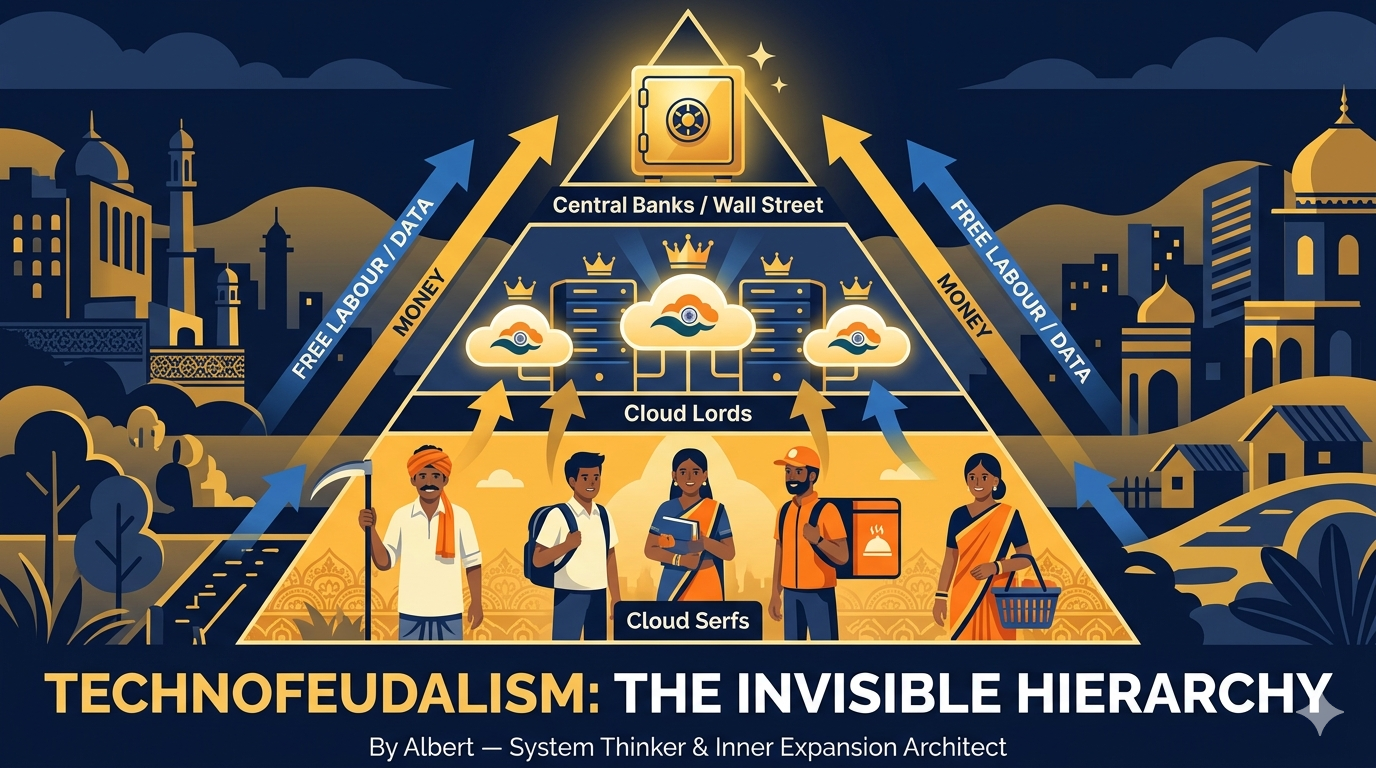
Your Data Is the Product.
How Big Tech Stole Trillions — and Why India Must Fight Back
Google pays just 1% of its revenue in worker salaries. Big Tech was built on public bailout money. And YOU are the unpaid labourer powering it all. Here’s what it means for India’s 950 million internet users.
What If the Biggest Heist in History Had No Guns, No Masks — Just an App?
Think about your morning. You wake up. You scroll Instagram. You search something on Google. You DM a friend on WhatsApp. You order breakfast on Swiggy.
Every single one of those actions — every scroll, every tap, every search — is being harvested, packaged, and sold. And here is the part nobody tells you: you are not the customer. You are the product.
Economist and former Greek Finance Minister Yanis Varoufakis calls this Technofeudalism — a new economic system where Big Tech companies have built digital “cloud fiefdoms” on the back of public money, and we — billions of users worldwide — are the serfs who power them. For FREE.
“The worst kind of slavery is one you choose.” — Yanis Varoufakis, Technofeudalism: What Killed Capitalism (2023)
This isn’t a conspiracy theory. The numbers are right in front of us. And for India — a nation of 950 million internet users, the world’s THIRD largest digitalised economy — the stakes have never been higher. So let’s break this down, and let’s make it personal.
The $35 Trillion Setup — Follow the Money
To understand how Big Tech became this powerful, you have to go back to 2008. The global financial crisis. Wall Street banks had gambled with the world’s savings and lost. So what did governments do?
They printed money. Thirty-five THOUSAND billion dollars. ₹2,900 lakh crore — a number so large it’s almost meaningless. This was handed to bankers at negative interest rates. The central banks were literally paying them to take it.
What did the CEOs of major corporations do? They looked at their workers — crushed by austerity, wages stagnant, spending power gone — and said: “There’s no demand out there. Why would we invest in factories or jobs?”
So instead, they bought back their own company shares. Share price goes up. Bonus goes up. CEO gets richer. No new jobs. No real economic growth. Just a magic trick with numbers.
⚡ The Critical Difference — Cloud Capital
Here’s where it gets ingenious. The ONE group of capitalists who did invest were the Big Tech founders — Zuckerberg, Bezos, Pichai. They took the cheap public money and built something entirely new: Cloud Capital. The algorithms, platforms, servers, and apps that now run our lives. And then they invited us all in — for free — and locked the door behind us.
Traditional companies like Ford or Tata pay around 85% of their revenue in salaries — to everyone from the CEO down to the floor worker. That money circulates. It creates demand. It powers the economy.
Google? 1% of revenue goes to workers. Facebook? Also 1%. The other 99%? It doesn’t go back into the economy. It flows to the Cayman Islands, to stock buybacks, to offshore accounts — OUT of the circular flow of income that keeps ordinary people employed and businesses running.
“Nine out of every ten dollars Big Tech invested in cloud capital came from our central banks — from public money.” — Yanis Varoufakis, paraphrased from Technofeudalism (2023)
The result? A slow economic suffocation. Traditional businesses can’t invest because demand is low. Governments print more money to keep economies alive. That creates inflation. Your rent goes up. Your groceries cost more. Your salary buys less. And you’re still scrolling Instagram for free, generating data worth billions — none of which you see.
750 Million Digital Citizens. Whose Economy Are We Building?
India is a spectacular story. We have the world’s cheapest mobile data. Over 950 million internet subscribers. The world’s highest volume of digital payment transactions. More GitHub AI contributors than any other country. We are, without question, a digital powerhouse.
But here’s the uncomfortable question: whose empire are we building?
India’s digital economy contributed 11.74% of GDP in 2022-23 and is projected to hit 20% of national income by 2029-30 — surpassing agriculture and manufacturing. That’s extraordinary. But the fastest-growing slice of that growth? Digital intermediaries and platforms. Many of them foreign-owned. Big Tech.
The Data Drain Is Real
Every time a farmer in Bihar searches for crop prices on Google, that data leaves India. Every time a student in Chennai uses YouTube to learn, her attention and behavioural data is monetised by an American corporation. Every UPI payment processed through Google Pay generates behavioural data captured by a Californian algorithm.
India is, in the words of digital rights activists, a data colony — producing the raw material (our data, our attention, our behaviour) that enriches foreign cloud empires, while the wealth created flows out. Cybersecurity incidents in India nearly doubled in just two years, rising from 10.29 lakh in 2022 to 22.68 lakh in 2024. We are deeply integrated into a system designed elsewhere, by others, for their benefit.
India is a welfare state. Our Constitution promises citizens dignity, livelihood, and protection from exploitation. Article 21 guarantees the Right to Life and Liberty — and the Supreme Court has confirmed in 2017 that this includes the Right to Privacy. The digital realm is not a lawless frontier. It is where life is lived now. And our welfare state obligations extend there.
“Even if you have the simplest phone and never use social media — if prices rise, if jobs disappear, if your government prints money to fund inflation — you are still subject to Technofeudalism.” — Adapted from Yanis Varoufakis
What Most People Never Realise About This System
These are the things they don’t teach in school, don’t cover on the evening news, and Big Tech’s PR teams work overtime to obscure. Let’s name them clearly.
You Are the Unpaid Employee of Every App You Use
When you like a post, search for a restaurant, or even pause on a video — you are performing labour. Your attention, your preferences, your emotional reactions are data that trains AI, targets advertising, and shapes platform algorithms. This is real economic value. You produce it. You receive nothing for it. Varoufakis calls this “cloud serfdom” — we voluntarily work inside digital estates for zero wages.
The 2008 Bailout Was Big Tech’s Venture Capital
Most people remember 2008 as a banking crisis. They don’t realise that the $35 trillion created by central banks didn’t just save banks — it became the seed capital for the cloud empires. Big Tech picked up cheap money, invested in cloud infrastructure while others bought back shares, and used that infrastructure to enclose our digital lives. We, the public, funded the cage that now holds us.
Inflation Is Partly a Big Tech Problem
When 35% of global GDP is siphoned to offshore accounts and never re-enters the circular flow of income — demand falls. Governments print more money to compensate. That money chases fewer goods. Prices rise. Your real wages fall. So even if you’ve never downloaded a tech app in your life, Big Tech’s offshore money-hoarding directly affects the price of your vegetables, your rent, your children’s school fees.
“Free” Is the Most Expensive Word in Digital History
Gmail is free. Instagram is free. Google Maps is free. But free means the price is being paid in a currency you can’t see: your behavioural data, your attention hours, your psychological vulnerabilities mapped by algorithms engineered for maximum addiction. The “free” internet is the most sophisticated surveillance and manipulation infrastructure ever built. And we built it ourselves — willingly.
India’s Scale Makes It Uniquely Powerful — and Uniquely Vulnerable
With 950 million internet users, India has the leverage to reshape global Big Tech if it chooses. Our UPI infrastructure — genuinely public, genuinely open — is proof that India can build world-class digital infrastructure without surrendering sovereignty to Silicon Valley. But our DPDP Act (fully enforceable only from May 2027) is still catching up with the scale of data extraction already happening. Every day of delay costs us more.
Digital Swaraj: What YOU Can Do Starting Today
Gandhi’s Swaraj was about refusing to be a subject of exploitation — political and economic. Digital Swaraj is the same idea for the 21st century. You may not be able to dismantle Big Tech overnight. But you can withdraw your unpaid labour, protect your data, and demand more as a citizen. Here’s how.
🔒 Level 1 — Protect Yourself Immediately (30 Minutes)
- Audit your app permissions right now. Go to Settings → Apps → Permissions. Does your flashlight app need access to your contacts? Your calculator need location data? Revoke everything that isn’t essential.
- Switch your default browser and search engine. Replace Chrome with Firefox or Brave. Replace Google Search with DuckDuckGo or Startpage. These alternatives don’t build a behavioural profile of you.
- Enable end-to-end encryption everywhere. Use Signal instead of SMS for sensitive conversations. Use ProtonMail for personal emails. Use a VPN (Mullvad or ProtonVPN) when on public Wi-Fi.
- Review your Google and Facebook data. Go to myaccount.google.com → Data & Privacy → Delete your activity history. Go to Facebook Settings → Your Facebook Information → Download or delete your data. You’ll be shocked what they have.
- Stop using “Sign in with Google/Facebook.” Every time you do this, you give those platforms knowledge of every service you use. Create separate email-based accounts instead.
🌱 Level 2 — Build Privacy Habits (This Week)
- Use a password manager. Bitwarden is free, open-source, and India-accessible. One strong master password secures everything. This also stops cross-platform tracking via credential sharing.
- Enable two-factor authentication (2FA) on every account — especially email, banking, and social media. Use an authenticator app (like Aegis or Authy) rather than SMS, which can be intercepted.
- Read privacy notices once — actually read one. Pick any app you use daily. Spend 15 minutes reading its actual data policy. When you see what they collect, you’ll understand why this matters.
- Reduce your algorithmic footprint. Pause YouTube watch history. Turn off personalised ads on Google (adssettings.google.com). Every interaction you DENY them is free labour they don’t receive.
- Know your DPDP rights. Under the Digital Personal Data Protection Act 2023, you have the right to access your data, correct inaccuracies, and request deletion. The Data Protection Board of India becomes your enforcement ally from May 2027.
🔧 Privacy Tools — Your Digital Toolkit
| Category | Big Tech Default | Privacy Alternative | Cost |
|---|---|---|---|
| Browser | Chrome | Brave / Firefox | Free |
| Search | DuckDuckGo / Startpage | Free | |
| Gmail | ProtonMail / Tutanota | Free tier | |
| Messaging | Signal | Free | |
| Passwords | Google Passwords | Bitwarden | Free |
| Cloud Storage | Google Drive | Nextcloud / Tresorit | Paid |
| Maps | Google Maps | OsmAnd / Organic Maps | Free |
| VPN | None | ProtonVPN / Mullvad | Paid |
What India Must Do as a Country — A 6-Point Sovereignty Plan
Individual privacy hygiene matters. But systemic change requires state action. Here’s what India’s welfare state obligations demand in the digital age — and the good news is, we’re already part of the way there.
- Implement and enforce the DPDP Act without dilution. The Digital Personal Data Protection Act 2023 and the Rules notified in November 2025 are significant steps forward. Full enforcement comes in May 2027. The government must resist lobbying pressure to water down protections, especially the broad exemptions for state data access which critics rightly flag as inconsistent with the fundamental right to privacy.
- Build on Digital Public Infrastructure (DPI) — and protect it. UPI is a global model for what sovereign digital infrastructure looks like — open, interoperable, not owned by a private gatekeeper. India must extend this philosophy. We need public alternatives in search, maps, cloud storage, and identity infrastructure. IndiaStack is the foundation. Build on it fearlessly.
- Adopt a Digital Markets Act on the lines of the EU. The European Union’s Digital Markets Act designates Big Tech “gatekeepers” and imposes obligations — no self-preferencing, mandatory interoperability, no pre-installation monopolies. India, with 950 million users, has enormous leverage to demand similar concessions. Our market is too large to ignore. Use that power.
- Tax Big Tech revenues generated in India — and tax them properly. India’s Equalisation Levy is a start. But data extraction at scale — where a company harvests the behavioural data of 500 million Indians to generate global advertising revenue — must be taxed more aggressively. Data is a resource. Resource extraction without fair compensation is colonialism, digital or otherwise.
- Mandate Digital Literacy as a national curriculum subject. Privacy, data rights, algorithmic literacy, and digital critical thinking must be taught in every school — from Class 6 onwards. CBSE and state boards must integrate this. A citizen who understands how platforms work is harder to manipulate and more capable of demanding their rights.
- Create a robust, independent Data Protection Board — fast. The Data Protection Board of India must be genuinely independent, adequately funded, and staffed with technical experts — not just bureaucrats. It must have the teeth to impose real penalties (the Act allows up to ₹250 crore per violation) and the mandate to go after Big Tech fiduciaries proactively, not just reactively.
This Isn’t Anti-Technology. It’s Pro-Human.
Let’s be absolutely clear: this is not a call to throw away your phone or boycott the internet. Technology is not the enemy. The ownership structure of technology is.
The internet was born as a public good — a network of networks, designed for openness and sharing. What Big Tech did was enclose it. Build walls. Make us dependent. Extract value. Ship profits offshore. That’s not the internet’s destiny. It’s a choice that was made — and choices can be unmade.
India has a unique opportunity. We have the scale to matter. We have the cultural tradition of Swaraj — self-determination — as a guiding philosophy. We have genuinely world-class public digital infrastructure in UPI and Aadhaar. And we have 1.4 billion people who deserve to participate in the digital economy as citizens with rights, not as unpaid data labourers in someone else’s empire.
🇮🇳 India’s Strengths
UPI — world’s most open payment rail. Aadhaar — 1.3 billion biometric IDs. 55% of world’s Global Capability Centres. 3rd largest digitalised economy. Constitutional right to privacy (2017 SC ruling). DPDP Act 2023 — framework exists.
⚠️ India’s Vulnerabilities
DPDP Rules not fully in force until May 2027. Broad government data exemptions risk surveillance overreach. Foreign Big Tech dominates search, social, and cloud. Cybersecurity incidents doubling every two years. Digital literacy still patchy in rural areas.
The answer is Digital Swaraj — not isolation, but sovereignty. Not paranoia, but awareness. Not rejection of technology, but insistence that technology serve us, not the other way around.
Ready to Reclaim Your Digital Life?
This conversation is just beginning. Join thousands of Indians who are waking up to digital sovereignty — and doing something about it.
Explore Digital Swaraj → Read the Manifesto💬 What do you think? Which insight surprised you most? Drop a comment below — and tag a friend who needs to read this. Let’s build a digitally sovereign India together.
Credit & Further Reading
- Primary Inspiration: Yanis Varoufakis — Technofeudalism: What Killed Capitalism (2023) & public talks on Big Tech and cloud capital
- India Data: MeitY — Estimation and Measurement of India’s Digital Economy Report (Jan 2025)
- India Policy: ICRIER — State of India’s Digital Economy (SIDE) Reports 2024 & 2025
- Privacy Law: Digital Personal Data Protection Act, 2023 — Ministry of Electronics and Information Technology
- Privacy Rules: DPDP Rules 2025, notified November 13, 2025 — MeitY
- Privacy Jurisprudence: Justice K.S. Puttaswamy v. Union of India (2017) — Supreme Court of India
- Digital Swaraj Framework: Albert Zacharia — albertyzacharia.in
- Cybersecurity Data: Drishti IAS — India’s Digital Ecosystem: Between Scale and Stability (Dec 2025)
Leave a Reply