
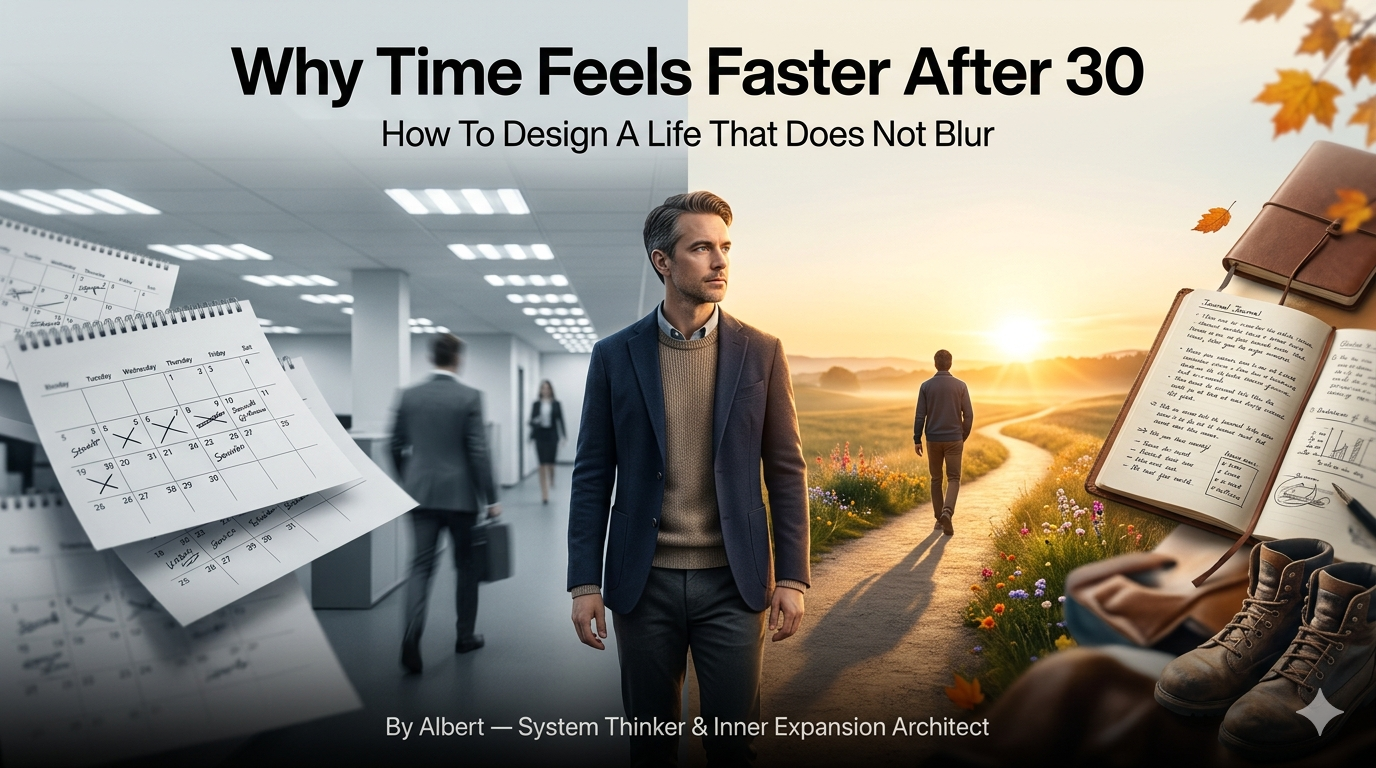
Why Time Feels Faster After 30 And How To Design A Life That Does Not Blur
- Time feels faster after 30 because your brain encodes fewer distinct events, not because you are broken. Learn the science of time perception and a systems level framework to slow your life down again.
Time is not speeding up, your life is flattening.
Here is what neuroscience, psychology, and systems thinking reveal about why your thirties feel like a blur, and how to design a week that your brain actually remembers.[1][5][11][8]
There is a quiet horror in realising you just lived through three whole years and can only remember five days that felt genuinely alive.[11][1]
Most people think this is just what adulthood feels like, a trade between aliveness and responsibility, but that is not what the science says and it is not a trade you have to accept.[2][5][1]
If you are reading this, you are the hero of this story, not the problem.
You are a human system running inside environments that were optimised for throughput, notifications, and quarterly targets, not for nervous system health or felt time richness.[5][2]
My own work lives at the intersection of human system design, constitutional governance, and inner expansion, and the same logic that can rewire a village health system or a civic process can be used to redesign the way your life manufactures the feeling of time.[8]
Once you see your life as a time ecology instead of a to do list, the conversation shifts from self blame to structural redesign.
Across countries and cultures, adults repeatedly report that time seems to speed up as they get older, with holidays like Christmas or festivals like Ramadan somehow arriving faster each year.[3][4]
Psychologists and neuroscientists have spent decades quantifying this experience and tying it to changes in attention, memory, mood, and the way the brain segments events, not just to being busier or having more responsibilities.[1][2][5]
In one line of work, people watch movies or perform tasks while researchers track how their brains carve continuous activity into discrete events, and these studies find age related shifts in how finely we slice the stream of life.[16][17][10][8]
The problem is not just that our calendars are full, it is that our experience of those days is increasingly thin, repetitive, and poorly encoded, which makes entire years collapse into a forgettable blur when we look back.
First Principles Breakdown – What Time Perception Really Is
If you strip time perception down to first principles, you realise something uncomfortable.
You never directly feel time itself, what you experience is change plus memory, your nervous system tracks differences in what you are sensing and doing, then stores some of those differences as episodes you can later recall.[5][1]
In classical timing models, the brain is treated as an internal clock counting pulses, but newer perspectives emphasise context and events, they show that how long an interval feels depends on how much mental content and how many shifts of context occur during that interval.[1][5]
This means that from your brain’s point of view, sixty minutes of richly varied, emotionally meaningful experience and sixty minutes of homogenous autopilot are not the same object, even though the wall clock insists they are.
Seen this way, a life that is high in repetition and low in distinct change will always feel shorter than a life that is dense with meaningful variation, even if both lives have the same number of years.
Systems Thinking – The Adult Time Compression Loop
Now step back and treat your thirties as a system, not as isolated days.
For many people there is a simple reinforcing loop at play, more routine and digital overwhelm lead to fewer distinct, meaningful events, fewer events produce sparse memory and a sense that time is flying, that sense of blur feels demotivating, so people retreat further into numbing habits and rigid routine, which then reduces distinct events even more.[7][6][5]
This is a self strengthening circuit.
You come home from another identical workday, too tired to deliberately design your evening, so you scroll, binge, crash, repeat, and when you glance back at the last six months it looks like a single undifferentiated block labelled work and tired.[6][5]
On top of that, modern work cultures and digital platforms reward exactly the kind of fragmented attention that makes time feel wrong, you jump between tabs and tasks, but the underlying pattern of days still does not change, so you feel both rushed in the moment and strangely empty in retrospect.[2][5]
In system language, your life has strong reinforcing loops around routine and distraction, and very weak balancing loops that would otherwise inject novelty, reflection, and integration.
Design Thinking – Standing Inside A 32 Year Old’s Week
To make this tangible, stand inside the life of a composite thirty-two-year-old.
They wake up already behind, phone in hand, low grade anxiety in the chest, half remembering dreams they do not have time to write down, and they move straight into messages, news, and a commute that looks exactly like yesterday.[2][5]
The day is a sequence of meetings, Slack pings, problem solving, quick meals, and micro bursts of social media, with no conscious beginnings or endings, just one long undifferentiated activation of the nervous system that never fully completes a cycle.[5][2]
Evenings are supposed to be rest, but rest has been redesigned into consumption, shows play in the background while more scrolling happens in the foreground, and sleep comes late, shallow, and interrupted.
If you ask this person two questions, what did last Tuesday feel like, and what in your last quarter genuinely changed how you see life, there is often a long pause, then an honest answer, I do not really know.
Design thinking starts there, with empathy for that lived experience, and asks, how might we redesign this week so that the same human nervous system starts producing days that are actually worth remembering.
Profound Insight 1 – Your Brain Writes Life As Episodes, Not Timelines
One of the more striking pieces of research uses an old television episode from Alfred Hitchcock Presents, titled “Bang, You are Dead”.
In a large Cambridge study, more than five hundred adults aged eighteen to eighty eight watched an eight minute clip while their brains were scanned, and researchers used an algorithm called Greedy State Boundary Search to detect transitions between relatively stable patterns of brain activity, also called neural states.[9][10][8]
They found that older adults tended to have fewer and longer neural states during the clip, which suggests that their brains were chunking the unfolding story into fewer segments, even though the objective video was identical for everyone.[10][9][8]
Other work using eye tracking and behavioural markers of event segmentation shows that how people mark the boundaries between events predicts how well they later remember what they saw, and that there are age related differences in how tightly people align with normative event structure.[17][16][10][8]
Translated out of lab language, your brain does not store life as a smooth timeline, it writes episodes, and as you age, your default episode boundaries may become coarser, especially if your environment is aggressively repetitive.
Profound Insight 2 – Sameness Deletes Memory, Which Deletes Years
The hippocampus, the region of your brain most famous for building episodic memory, is particularly sensitive to novelty and distinctiveness.
Experiments in both animals and humans show that novel contexts and surprising events trigger stronger encoding and often involve neuromodulators like dopamine that help tag experiences as important.[11][1]
In real life that means travel, new skills, new relationships, and emotionally meaningful firsts become dense memory anchors, while copy pasted days barely register, which is why childhood and periods of intense change often feel long when you look back.[11][1][2]
Studies on time perception in naturalistic environments find that when stimuli are context rich and varied, age differences in timing can shrink, but when people are embedded in bland, repetitive contexts, older adults in particular show more distortions.[6][5]
So if your thirties collapse into a few faint impressions of work projects and a handful of vacations, the issue is not that you were not productive enough, it is that you built a life in which your memory system had almost nothing new to work with.
Profound Insight 3 – Proportional Time And Nervous System Load
There is another layer to the story that often gets framed fatalistically.
Mathematical models of subjective time argue that we track life in proportions, not in raw years, one year for a five year old is twenty percent of all remembered life so far, one year for a fifty year old is two percent, so each new year naturally feels smaller.[4][12]
If you combine that with the neural and memory effects we just discussed, you can see why the default adult trajectory is accelerated, each year is a smaller fraction, and within that year your brain is writing fewer distinct episodes.
On top of this, aging is associated with changes in attention control and increased vulnerability to depressive symptoms, both of which are linked to distortions in temporal processing and to difficulties in accurately judging durations.[13][1][5]
In some conditions of stress or low mood, people report that moments drag but chunks of life vanish, which is one of the cruel paradoxes of nervous system overload, you feel like you are enduring endless days, yet when you look back, entire months feel like they did not exist.[13][1]
The point here is not that you are doomed to feel time racing, it is that proportional time and nervous system load are real constraints, and any honest solution has to work with them rather than pretending they do not exist.
Profound Insight 4 – Novelty And Mindfulness Work Only As Part Of A System
The viral video that triggered this piece claims that science has found two fixes for fast time, novelty and meditation.
There is real evidence behind both levers, but they are not magic buttons.
On the novelty side, studies and reviews show that distinct, surprising experiences are more strongly encoded and lead to richer, more expansive subjective time in retrospect, especially when they cluster in periods like travel or life transitions.[1][11]
On the mindfulness side, experimental work finds that short mindfulness practices can change how long intervals feel, in some studies meditators overestimate durations, which means time feels more stretched, and experienced meditators often report an expanded present and altered sense of time across broader spans.[18][14][15]
But most of these effects are measured over seconds, minutes, or weeks in controlled settings, and not all meditation styles or novelty experiences pull in the same direction, some protocols even shorten perceived time while reducing anxiety, and intense novelty without recovery can distort time in unpleasant ways.[19][18][8]
In other words, novelty and mindfulness are powerful levers, but without a supportive system of sleep, psychological safety, boundaries, and integration, they become isolated hacks that cannot compete with the structural force of the adult time compression loop.
The Personal Time Ecology Framework
So what does a systems level solution look like for a single human life.
Think of your life as an ecology of time, where different species of experience, routine tasks, focused work, social connection, rest, and exploration, coexist and interact.
A personal time ecology has four primary levers:
- Episodic design – you deliberately create clear beginnings, middles, and endings for experiences, so your brain has clean boundaries to tag, instead of one continuous smear of activity.[17][1]
- Curated novelty – you do not chase constant stimulation, you strategically insert distinct experiences, new routes, new skills, new social contexts, so that each week contains a few genuine landmarks.[11][1]
- Mindful presence – you train attention through practices like breath based meditation or sensory awareness, so that ordinary moments become thicker and more fully registered instead of sliding past in half awareness.[18][14][15]
- Nervous system infrastructure – you treat sleep, movement, light exposure, emotional processing, and boundaries as non negotiable scaffolding, because without a regulated nervous system, no amount of novelty or mindfulness will encode well.[13][5][1]
When these four levers are designed together, your weeks start producing more distinct, well encoded episodes with less physiological cost, and that is the raw material from which a slower felt life is constructed.
Step by Step Guide – Seven Stages To Reclaim Time After 30
Here is how you turn this from an idea into a lived experiment.
For one week, without changing anything, you simply log your days as a narrative, not as a time sheet, what did today actually feel like, where did you feel alive, where did you go numb.
This is where most people are shocked to see how few moments they can describe in concrete sensory terms.
With that week in front of you, you ask systems questions, where are my reinforcing loops, where does routine silently erase distinction, where does my phone hijack my nervous system, where do I try to rest using the same screens that exhaust me.
You are not judging yourself, you are mapping the system you currently live in.
Next you rewrite two stories, the story that says “this is just adulthood” and the story that says “time is supposed to feel like this now,” replacing them with a more accurate script, “my brain encodes change and memory, and I can design both.”[8][5][1]
You also stop treating this as time management and start treating it as nervous system design.
Only now do you add interventions, one small change in each of the four levers, for example, turning one daily activity into a mini ritual with a clear beginning and end, scheduling one new experience per week, practicing five minutes of mindful breathing before opening your phone in the morning, and protecting a realistic sleep window.
The key is to start embarrassingly small so that your system does not reject the upgrade.
At the end of each week you ask three questions, which changes actually happened, which ones changed how I remember the week, and what did my nervous system pay for them in energy.
You are listening for interventions that create more remembered episodes with minimal additional stress.
Based on that feedback, you adjust, you drop the glamorous but draining experiments, double down on the surprisingly powerful micro shifts, and gently increase the dose of novelty and mindfulness that your current infrastructure can support.
This is where it starts feeling less like discipline and more like tuning a system.
Once a pattern proves itself across several weeks, you institutionalise it, you anchor it in your calendar, your social agreements, your environment, so it does not depend on motivation, aligning with the principle that good systems should survive bad days.[2][5][8]
Over months, this seven stage loop becomes your new meta habit, you are no longer hoping that time will slow down on its own, you are continuously shaping the ecology that produces your felt experience of years.
Real World Example – From Blur Calendar To Episodic Life
Consider a composite example built from clients and citizens I have worked with.
Riya is thirty four, works in a mid level management role, and lives in an Indian metro, she feels like the last four years have been a cycle of sprints, recoveries, and scrolling, with only vacations and crises standing out.
In her Awareness week she realises that she cannot describe a single ordinary Tuesday in the last month beyond “meetings and calls,” and that most evenings end in what she herself calls “couch amnesia.”
For Diagnosis she maps her loops, back to back video calls, no real transitions, late night phone use, social plans that look like the same restaurant and the same conversations, sleep debt, and zero spaces where she is not reachable.
She reframes by accepting that her brain is not failing, it is responding exactly as designed to a high sameness, high stimulation environment, and she decides her goal is not to do less, but to create more episodes that are worth remembering.
Her first month of Intervention looks like this, she bookends her workday with a three minute arrival and exit ritual, physically stepping outside before opening her laptop and after closing it, she commits to one weekly micro adventure within her city, a new neighbourhood walk, a different cafe, a public lecture, she inserts a ten minute phone free tea at her window every evening, and she sets an alarm that kicks in a wind down routine forty five minutes before bed.
The first week feels awkward, but by the Feedback stage at week four she notices two things, she remembers specific details from each weekly micro adventure, including small human encounters, and her evening tea has become a surprisingly thick slice of time where she regularly feels present.
Over three months, through Iteration, she experiments with different kinds of novelty, dropping the ones that feel like performative content creation, and leans into ones that genuinely feed her curiosity, like a short course at a local institute and volunteering one Saturday a month.
By the time she reaches Scaling, several habits no longer feel like habits, they are simply how her life is structured, colleagues know she is not reachable in a certain evening window, friends expect micro adventures instead of the same bar, and her calendar now has episodic anchors that make each month feel distinct.
When she looks back at the year, she does not remember every meeting, but she can recall a surprising number of specific evenings, conversations, and places, and her subjective sense is that this year felt longer than the last one, even though the objective workload did not shrink.[15][11]
This is what reclaiming time looks like in practice, not quitting your life to move to a beach, but changing the architecture of your weeks so that your brain has reasons to slow down.
Future Implications, Conclusion, Call To Action
A culture where most adults feel that time is racing and life is a blur is not just a wellness problem, it is a governance problem.
When nervous systems are chronically overloaded and years feel compressed, people have less cognitive and emotional bandwidth to engage with complex issues, to participate deeply in civic life, or to hold institutions to account, which quietly shifts power toward systems that benefit from your numbness.[5][1][2]
Designing lives that generate richer, slower time is therefore not only an act of self care, it is a form of micro level governance reform, you are rebuilding the basic human infrastructure on which any healthy society rests.
You will not stop the calendar.
What you can do is decide that your next twelve months will not be filed as “miscellaneous adulthood,” but as a series of episodes that your future self can feel in the body when they remember them.
Start with one week.
Design a single micro adventure, a single daily pocket of mindful presence, and one small boundary that protects your nervous system, then observe how much more of that week you can actually recall.
If you find that your subjective time begins to thicken, know that you have just proved something, your life is not condemned to blur, it was simply waiting for a different architect.
Comment below if you recognise your own time compression loops.
Tag someone who always says “this year just flew by.”
Follow for more conversations at the intersection of human systems, inner expansion, and the future of how we live time.
By Albert, A System Thinker and Inner Expansion Architect
1. Is there really scientific proof that time feels faster with age, or is it just a feeling.
Several surveys and experimental studies report that people commonly experience time as accelerating with age, and researchers have connected this to changes in memory, attention, and how events are segmented, rather than dismissing it as a mere illusion.[3][4][7][1]
2. Did the Cambridge Hitchcock study actually prove that older brains take fewer “mental screenshots”.
The Cambridge work found that older adults had fewer and longer neural states while watching an eight minute Hitchcock clip, which suggests coarser event segmentation, but the “mental screenshots” language is a metaphor, and the study did not directly measure multi year life perception.[9][10][8]
3. Can small novelties like new routes or new dishes really slow time, or do I need big life changes.
The evidence suggests that distinct novelty, clearly different from your usual patterns, is what most strongly enriches memory, while smaller novelties have modest but still useful effects when used consistently across weeks.[1][11]
4. Does mindfulness meditation always make time feel slower.
No, different meditation styles and timescales produce different effects, some experiments find that mindfulness stretches the felt duration of short intervals, while others show shortened time accompanied by greater calm, so context and individual differences matter.[19][18][14][15]
5. How long does it take to feel a difference if I apply the personal time ecology approach.
In practice, people often notice shifts in recall and richness within a few weeks of deliberate episodic design and daily presence practices, but making a whole year feel slower is a longer experiment that depends on your starting routines, stress levels, and willingness to iterate.[15][6][11]
You can link to these as further reading for scientifically inclined readers:
- Review on cognitive aging and time perception in the hundredths of milliseconds to minutes range.[1]
- Nature collection on the malleability and fluidity of time perception.[5]
- Cambridge neural state study using Hitchcock clips and event boundaries.[10][9]
- Articles explaining proportional time and why years feel faster as we get older.[12][4][3]
- Research on mindfulness meditation and altered time experience.[18][14][15]
⁂
- 1. https://pmc.ncbi.nlm.nih.gov/articles/PMC4870863/
- 2. https://pmc.ncbi.nlm.nih.gov/articles/PMC11137112/
- 3. https://lsa.umich.edu/psych/news-events/all-news/faculty-news/the-scientific-reason-years-get-faster-as-we-get-older—and-how.html
- 4. https://www.psychologytoday.com/us/blog/out-of-the-darkness/202409/why-does-time-seem-to-speed-up-as-we-get-older
- 5. https://www.nature.com/articles/s41598-024-62189-7
- 6. https://pmc.ncbi.nlm.nih.gov/articles/PMC8450996/
- 7. https://spacedaily.com/t-research-suggests-that-people-who-feel-time-slipping-away-faster-every-year-arent-losing-their-minds-theyve-just-stopped-creating-what-neuroscientists-call-temporal-landmarks-the-small-disruptions/
- 8. Why-time-feels-faster-after-30_May-30-2026-12_34.docx
- 9. https://www.nature.com/articles/s42003-025-08792-4
- 10. https://pmc.ncbi.nlm.nih.gov/articles/PMC12086427/
- 11. https://superage.com/why-time-speeds-up-as-we-age-and-how-to-slow-it-down/
- 12. https://arxiv.org/pdf/2310.05945.pdf
- 13. https://pmc.ncbi.nlm.nih.gov/articles/PMC10349066/
- 14. https://neurosciencenews.com/psychology-time-perception-meditation-250/
- 15. https://pmc.ncbi.nlm.nih.gov/articles/PMC6799951/
- 16. https://pubmed.ncbi.nlm.nih.gov/23984846/
- 17. https://pmc.ncbi.nlm.nih.gov/articles/PMC11774534/
- 18. https://journals.plos.org/plosone/article?id=10.1371%2Fjournal.pone.0223567
- 19. https://pmc.ncbi.nlm.nih.gov/articles/PMC9330740/
Leave a Reply