
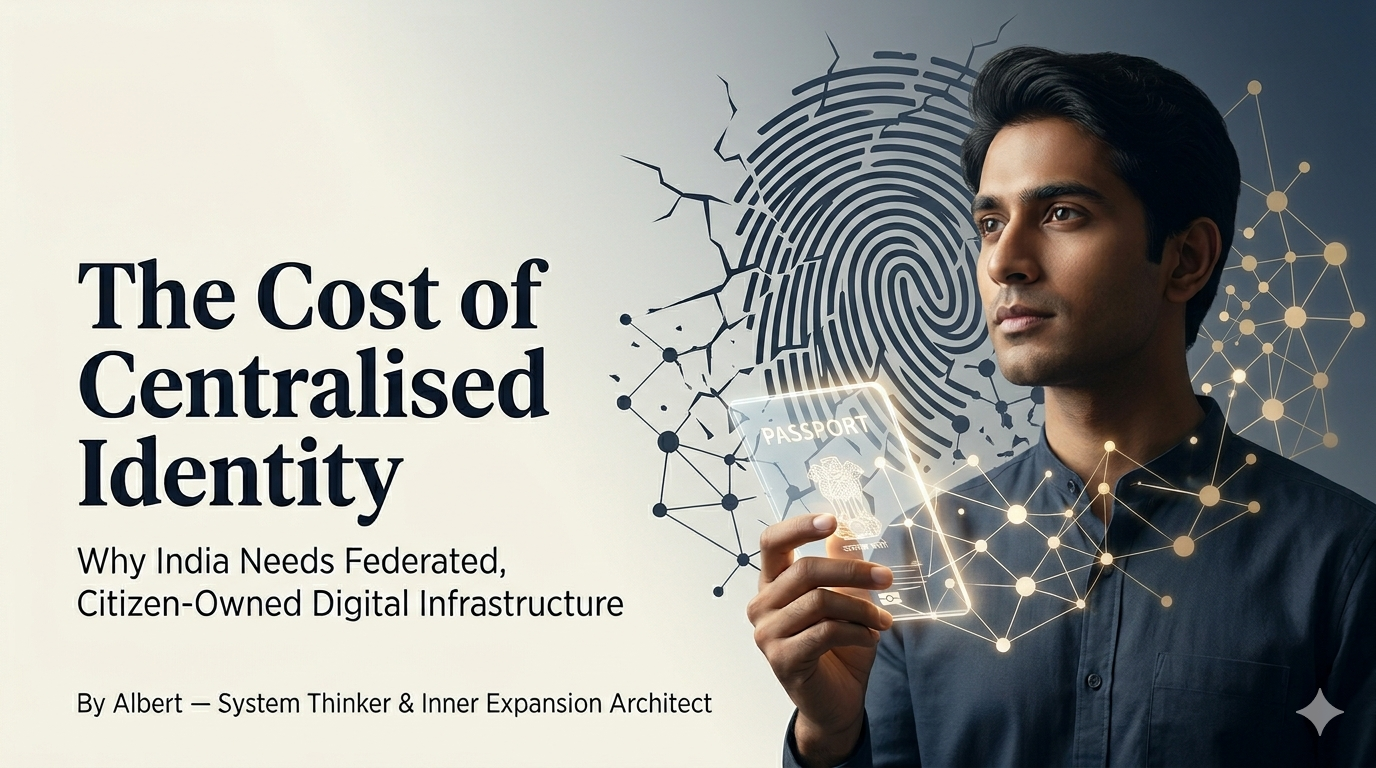
Aadhaar, Surveillance, and Sovereignty: Why India Needs Federated Digital Identity
Aadhaar promised efficiency. Instead, it built a central surveillance spine. This deep dive unpacks how centralized biometrics threaten privacy and dignity in India, and outlines a federated, citizen owned alternative for Digital Public Infrastructure.
Aadhaar began as an inclusion project, then quietly became the operating system of Indian citizenship. Somewhere in that journey, efficiency outran dignity. This article pulls the system apart using first principles, systems thinking, and design thinking. It exposes the surveillance bargain hidden inside the Central Identities Data Repository, then sketches a different path, one where identity is citizen owned, consent based, and technologically humble enough to protect the individual while serving a billion lives at scale.
We built Aadhaar to plug leakages and speed up welfare.
We ended up wiring a surveillance grid into everyday life.
This is not an anti tech rant, it is a blueprint for rebuilding Digital Public Infrastructure around dignity, consent, and sovereignty.
Core Thesis (one sentence)
India’s Aadhaar architecture chose centralized biometric control for state efficiency, and the only way to restore constitutional dignity and real sovereignty is to shift toward federated, citizen owned identity systems that treat privacy as a design primitive, not an afterthought.[1][2]
You can lose your ration for the month in less than one second, all it takes is a fingerprint scanner that refuses to recognise you. Biometric failure feels like a technical glitch from the outside, but from the inside it feels like the state quietly deciding you do not exist that day.[6][5]
India did not set out to humiliate people, it set out to plug leakages and modernise welfare. Somewhere along the way, a welfare identity system became a central nervous system for governing a billion lives.
“We built a system for scale, but forgot to build it for dignity.”
Aadhaar began as a project to give every resident a unique number so that subsidies could be delivered more cleanly and corruption could be reduced in schemes like the Public Distribution System. Over time, it has become the default identity rail for banking, telecom, taxation, pensions, mobile SIMs, and a range of public and private services, well beyond its original welfare framing.[8][3]
At the heart of this expansion sits the Central Identities Data Repository, a centralised database that stores each Aadhaar number along with core biometric and demographic data. When you authenticate using Aadhaar, your number and your biometrics are sent to this central repository for verification, which returns a yes or no based on what is stored there.[4][1]
This architecture matters because every point of life where Aadhaar is demanded becomes a potential log entry inside a central system controlled by a single authority. It turns one identifier into a master key that can, in practice, connect your welfare use, your banking, your telecom activity, your tax profile, and more, even when you never explicitly consented to those linkages one by one.[4][3]
The official story says this is about efficiency, fraud prevention, and inclusion. The deeper story is that India has accidentally wired a surveillance spine into the ordinary act of being a citizen.
If we strip all the branding away, we are left with three basic questions. What is identity for, what is the state for, and what is privacy for. Identity exists so that specific claims can be verified in specific contexts, not so that one number can trail you forever.
The state has a legitimate interest in knowing that the person receiving a subsidy or casting a vote is who they say they are. It does not have a legitimate interest in being able to reconstruct every interaction that person has with banks, telcos, or hospitals into a continuously updated behavioural profile. That crosses the line from governance to management of human beings.
Privacy, recognised as a fundamental right by the Supreme Court in K S Puttaswamy, is not a luxury for people with something to hide, it is the condition that makes autonomy, dissent, and inner life possible in a democracy. The Court clearly affirmed informational privacy as part of this right, including protection of personal data and control over how it is used.[14][15][2]
If we accept these first principles, the design brief for any Digital Public Infrastructure becomes simple and demanding. Help the state verify what it truly needs for a defined purpose, while keeping the person’s life as opaque as possible to everyone else.
Once you create a universal identifier and a central biometric repository, you create a set of feedback loops that are very hard to reverse. Every new department that links to Aadhaar gets cheaper verification, so bureaucratic incentives favour more linkage, not less. Politicians can claim visible efficiency gains without having to account for invisible privacy losses, because those do not show up in electoral dashboards.[3][4]
There is also classic function creep. Aadhaar was justified in the name of better welfare delivery, then extended into tax compliance, SIM registration, bank account seeding, school admissions, and more. Each expansion is framed as a minor technical adjustment. The cumulative effect is a system where opting out is no longer realistic for anyone who wants to live a normal economic life.[8][3]
On the ground, biometric authentication failures are treated as acceptable noise rather than signals of structural harm. Government data submitted in Parliament showed substantial failure rates for Aadhaar biometric authentication attempts, and recent analysis estimates that roughly 312 million Aadhaar based biometric authentications are attempted every month with about 20.3 million failures, a rate of around 6.5 percent that has stayed stubbornly flat. That is not a rounding error, that is exclusion baked into the core loop.[5][6]
From a systems perspective, Aadhaar has become a high gain amplifier. Any bias, error, or design flaw is scaled to hundreds of millions of interactions a month. The central database becomes a single point where attacks, leaks, or misuse can have cascading effects on welfare, finance, and basic rights.[16][17][4]
Design thinking begins with empathy, not with backend architecture diagrams. So imagine a woman in a tribal village whose fingerprints have worn out due to manual labour. For her, a failed scan at a ration shop is not a technical outage, it is hunger and shame in public. The system currently treats that as a temporary glitch to be retried, not as a design failure that violates her right to food.[5]
Biometrics have another brutal property. They are not secrets. You leave your fingerprints on every glass you touch and your face is visible to every camera you walk past. Once biometric data is leaked or misused, you cannot reset your fingerprints or iris in the way you reset a password. That makes centralised biometric databases uniquely dangerous, because breaches are irreversible at the level of the person.[7][8]
On the private sector side, banks, telecom operators, and other entities have often stored Aadhaar numbers and related data in their own systems, sometimes in violation of best practice, creating a patchwork of local databases that sit outside coherent regulatory control. This is not just state surveillance, it is an ungoverned ecosystem where data can be profiled, sold, or breached.[7][8]
If you apply design thinking honestly, a few truths become unavoidable. Any identity system for a billion people must assume messy fingerprints, intermittent connectivity, low literacy, fear of authority, and deep power asymmetries. A design that does not fail gently at the margins will produce the most harm where people have the least capacity to resist.
The 5 Profound Insights Most People Overlook
1. Efficiency without dignity is just more elegant control
The promise of Aadhaar has been faster queues, fewer middlemen, and cleaner databases. That is real and visible. But efficiency without dignity simply allows control to be exercised more smoothly, with less friction and fewer witnesses. When every welfare transaction is mediated by a central identity check, a denial feels machine neutral but is still a human decision embedded in code.[5][3]
The deeper question is not how fast the system works when it works, but how it behaves when it fails. A rights respecting design starts from the hardest case and works backward. A control first design optimises for averages and treats the casualties as collateral.
2. A universal ID quietly erases meaningful consent
Consent is not just a checkbox on a form, it is the ability to say no without losing your basic entitlements. Once Aadhaar is seeded into banking, telecom, tax, welfare, and often de facto into school and exam systems, refusing linkage is not a real option for most people.[8][3]
This collapses consent into compliance. You can “choose” not to share, but then you may not get your ration, your pension, or your phone connection. That is not consent, it is a coerced trade, and it sits uneasily with the Supreme Court’s insistence that informational privacy is part of the fundamental right to privacy.[2][14]
3. Central biometrics change who is accountable when harm occurs
When identity is verified through a local document, like a ration card, failures or misuse can often be traced to a specific official or shop. When everything passes through a central biometric repository, harm becomes abstract. The scanner failed. The server timed out. The system rejected you.[6][5]
This diffusion of responsibility is a classic systems risk. People experience real harm, but no actor feels personally accountable, and grievance redress becomes an obstacle course through UIDAI and local departments that are often not designed for the poor to navigate. A system that concentrates technical power while diluting accountability is precisely the kind of architecture a constitutional democracy should be suspicious of.[3]
4. The surveillance risk is not only what the state does, but what it could do tomorrow
Defenders of Aadhaar often say, “But we are not misusing it,” as if current restraint neutralises structural risk. That misses the point. Once a comprehensive identity and authentication infrastructure exists, future governments, or even private actors with state like power, can repurpose it with far fewer checks.[4][3]
It becomes technically simple to imagine credit scoring, protest tracking, or welfare behaviour penalties wired into the same rails, even if those are not explicitly on the table today. Privacy jurisprudence is clear that constitutional rights are not evaluated only on present good faith, but on potential for abuse. A design that makes abuse cheap and quiet is a bad design, regardless of current intentions.[15][2]
5. Alternatives exist, and they already work at national scale
There is a quiet myth that “there is no alternative” to centralised biometrics if you want scale. This is simply not true. South Africa’s Smart ID card securely stores biometric information on the physical card itself, not in a single central biometric vault that has to be queried for every verification.[12][9]
In Europe, the General Data Protection Regulation hard wires principles like data minimisation, storage limitation, and purpose limitation. Controllers are expected to collect only what is necessary for a specific purpose and not reuse that data for unrelated activities without fresh legal basis and consent. These are not utopian small countries, they are large, complex states that still chose architectures that respect federated information control.[18][10]
The insight here is simple and powerful. Centralising verification does not require centralising all sensitive data.
New Solution Model: From Centralised Aadhaar to Federated, Citizen Owned Identity
So what would a different model look like if we took Indian constitutional values, technical possibilities, and practical constraints seriously. One anchor is federated identity. Under a federated model, your core attributes are issued and held by different trusted entities, such as banks, universities, and government departments, rather than pumped into a single data lake.[11][10]
Verification happens through cryptographic proofs instead of raw data disclosure. With tools like zero knowledge proofs, a verifier can ask, “Is this person over 18,” and receive a yes or no that has been mathematically attested by the issuer, without ever seeing your date of birth. Similarly, a welfare department can know that you are eligible without learning your full financial history. The Aadhaar number as a universal link becomes unnecessary.[11]
Another anchor is self sovereign identity. In this paradigm, your credentials live in a digital wallet that you control, often on your phone or a hardware token, and you selectively present them as needed. Each presentation can be consented, time bound, and revocable, and verifiers only see what they truly need.[10][11]
On the biometric side, instead of central storage, India could move toward on card or on device biometrics, where the match happens locally, on a secure chip, and only a simple yes or no plus a non identifying transaction token ever leaves the device. That preserves strong authentication without constructing a national biometric vault that can become a honeypot for attackers or a temptation for overreach.[9][12]
In my own language, this is conditions based design: you do not fight the state or abandon digital rails, you redesign the conditions under which identity interacts with power, so that life can flourish without constant exposure.[19]
Step by Step Guide: Seven Stages of Transition
If we treat this as a governance design problem, not a tech hobby project, the path forward can be staged. Think of it as seven movements.
- Awareness
Start by naming the problem clearly in public narrative. Shift the discourse from “Aadhaar versus no Aadhaar” to “centralised biometrics versus federated, rights centric identity”. Use stories of exclusion, legal analysis of Puttaswamy, and comparative examples to build a shared mental model.[2][9][5] - Diagnosis
Map concrete harms and risks. Where are authentication failures highest, which populations are most excluded, how many departments have made Aadhaar de facto mandatory, what data retention practices exist across private and public actors. This is systems diagnosis, not just policy critique.[6][7][5] - Reframing
Reframe Aadhaar from “the identity” to “one identity rail among many”. Legally and politically, begin to assert that no single identifier should be a mandatory gateway for essential services, and that identity must be modular, task specific, and replaceable. The goal is to loosen the psychological and legal lock in. - Intervention
Pilot alternative architectures in limited domains. For example, test an on card biometric plus cryptographic proof model for one welfare scheme in one state, or roll out a self sovereign identity wallet for university credentials. These are low risk spaces to learn and adapt.[12][9][11] - Feedback
Treat these pilots as evidence infrastructure. Measure exclusion rates, citizen experience, administrative burden, security incidents, and rights impacts compared to the Aadhaar plus CIDR baseline. Iterate based on actual data and lived experience, not just technical preference.[19] - Iteration
Based on feedback, refine legal frameworks, technical standards, and institutional arrangements. Strengthen data protection law around purpose limitation, minimisation, and user rights, and embed explicit bans on certain uses of biometric data.[18][10][2] - Scaling
Gradually rearchitect national Digital Public Infrastructure so that Aadhaar’s central repository is no longer the default authentication hub. Instead, multiple federated identity providers, citizen wallets, and on card biometrics share the load under strict, rights respecting protocols. Use legislative amendments, regulatory standards, and public procurement to push this design into practice.
This is not a switch, it is a transition curve. It is the kind of slow, intelligent evolution that my governance work already argues for, connecting existing capacities into a more humane architecture rather than tearing everything down.[19]
Real World Example: Learning from South Africa and Europe
South Africa’s smart identity card offers a useful reference point. The card securely stores biometric information on an embedded chip, which can be used for verification without constantly querying a central biometric database. The government has been phasing in this card to replace older ID books, and the design explicitly contemplates using the card for voting and other functions without needing a giant biometric panopticon.[9][12]
In Europe, GDPR does not just regulate consent banners. It sets baseline principles for all personal data processing, including lawfulness, fairness, transparency, purpose limitation, data minimisation, accuracy, storage limitation, and integrity. In practice, this has pushed both governments and companies toward architectures that avoid hoarding more data than necessary, and that separate functions so that a central actor cannot easily repurpose data without facing legal and reputational consequences.[18][10]
India does not have to copy these models blindly. But they prove something important. It is entirely possible to build national scale identity, reduce fraud, and support digital services without storing everyone’s biometrics in one central repository and wiring every major life interaction through it.
Future Implications: Cost of Inaction vs Possibility of Evolution
If India continues on the current trajectory, Aadhaar will tighten its grip as the default gateway to welfare, finance, and everyday transactions. Biometric failure rates may be slowly improved at the margin, but millions will still face periodic exclusion, with little recourse. As more data sources are linked and analytics deepen, the system will quietly tilt from eligibility verification toward behaviour monitoring, even if this is never stated openly.[13][5]
The chilling effect will not show up on a dashboard. It will show up in the choice not to attend a protest, not to sign a petition, not to question a local official, because people intuit that everything is traceable and that refusal to be compliant might carry invisible future costs. Once citizens internalise that the safest strategy is to be less visible, democracy decays on the inside long before institutions collapse on the outside.[7][8]
By contrast, a shift to federated, citizen owned identity opens up a different future. It allows India to use AI, data, and digital rails to target welfare, improve services, and reduce leakages, while structurally limiting any actor’s ability to see everything and remember everything. It aligns with the Supreme Court’s privacy jurisprudence, global best practices, and my own philosophy that systems exist to create conditions for human flourishing, not to extract maximum legibility from every person.[10][11][19]
Conclusion: Beyond Efficiency Metrics
The story we have been sold is simple. Without Aadhaar we cannot plug leakages, we cannot modernise welfare, we cannot build a digital India. That story is incomplete. The real question is not whether we use digital identity, it is what kind of identity we build and who it ultimately serves.
A system that keeps the poor out of their ration because their fingerprints have worn out, that centralises biometric power in one repository, and that normalises consent as a formality is not neutral. It encodes a theory of governance where people are data points to be administered, not citizens whose dignity and autonomy place hard constraints on what the state may do, even in the name of efficiency.[2][7][5]
Progress in a constitutional democracy is not measured only by how quickly a transaction clears. It is measured by whether the weakest person in the queue can say, “This system sees me enough to serve me, but not so much that it owns me.” That is the shift from surveillance to sovereignty.
If you are a citizen, start by refusing the lazy narrative that “there is no alternative”. Share stories of exclusion, ask your representatives how they plan to align Aadhaar with the privacy judgment, and push local institutions to adopt less invasive identity practices where possible.[2][5]
If you work in policy, law, technology, or civil society, treat Aadhaar reform as a design challenge, not a culture war. Build coalitions that can draft model amendments, design pilots for federated identity, and push for a data protection regime that has teeth, not just principles on paper.[18][10][3]
If you build or lead systems, remember: life flourishes through conditions. Your responsibility is not to extract as much data as possible, but to design infrastructures that are powerful enough to serve billions and humble enough to protect the individual.[19]
“By Albert, A System Thinker and Inner Expansion Architect”
1. Is Aadhaar itself unconstitutional after the K S Puttaswamy privacy verdict.
The Supreme Court recognised privacy as a fundamental right in K S Puttaswamy and later upheld the Aadhaar Act with significant limitations, including restricting mandatory use to specific contexts and emphasising proportionality. The constitutional question today is less about Aadhaar’s existence and more about whether its current uses, linkages, and data practices still respect those limits.[14][15][2]
2. How serious are Aadhaar biometric authentication failures in practice.
Government data and later analysis show that hundreds of millions of Aadhaar based authentications are attempted monthly, with failure rates around 6.5 percent, which translates to over 20 million failed attempts each month. For people at the edge of welfare systems, even a small percentage translates into large numbers of real human exclusions.[6][5]
3. Are central biometric databases the only way to fight fraud at scale.
No. Countries like South Africa use smart ID cards that store biometrics on the card itself and can verify identity without constant checks against a central biometric repository. The European data protection regime also encourages architectures that minimise centralised data collection while still allowing strong verification through careful legal and technical design.[12][9][10][18]
4. What is the difference between federated identity and self sovereign identity.
Federated identity means different trusted institutions issue and hold different parts of your identity, so no single actor owns the full picture, while self sovereign identity adds a layer where you control a digital wallet that contains these credentials and decide when and how to present them. Both models reduce the need for a universal central identifier to be present in every transaction.[11][10]
5. What concrete legal changes would make Aadhaar less prone to surveillance misuse.
Key changes include embedding strict purpose limitation and data minimisation into law, placing hard bans on certain uses of biometric data, restricting mandatory Aadhaar linkage to narrow contexts, and creating independent oversight with real enforcement powers. A robust data protection framework combined with architectural changes away from central biometric storage would together reduce surveillance risk.[10][3][2]
- UIDAI Operation Model, including definition and role of the Central Identities Data Repository (CIDR).[1]
- Analyses of Aadhaar’s legal and governance framework, including criticism of accountability gaps and function creep.[4][3]
- K S Puttaswamy privacy judgment commentary and Aadhaar constitutionality summaries.[15][14][2]
- Government and independent reporting on Aadhaar biometric authentication failure rates and their impact on welfare access.[13][5][6]
- Ethical critiques of Aadhaar in digital health and welfare contexts, focusing on privacy, data ownership, and exploitation risks.[7][8]
- Documentation on South Africa’s Smart ID card and its on card biometric design.[9][12]
- GDPR data protection principles and practice notes on data minimisation and purpose limitation.[11][18][10]
- Technical and research work proposing decentralised or blockchain based alternatives to Aadhaar’s centralised authentication model.[17][16]
⁂
- 1. https://uidai.gov.in/en/ecosystem/authentication-ecosystem/operation-model.html
- 2. https://www.freelaw.in/legalarticles/The-Evolution-of-Right-to-Privacy-From-K-S-Puttaswamy-to-Aadhaar
- 3. https://www.theregreview.org/2020/06/16/emamian-india-aadhaar-needs-checks-balances/
- 4. https://www.sciencedirect.com/science/article/pii/S2590291125001354
- 5. https://www.policycircle.org/opinion/aadhaar-authentication-failures/
- 6. https://uidai.gov.in/images/rajyasabha/RSPQ400(Unstarred).pdf
- 7. https://www.ncbi.nlm.nih.gov/pmc/articles/PMC7133485/pdf/BLT.19.237123.pdf
- 8. https://pmc.ncbi.nlm.nih.gov/articles/PMC7133485/
- 9. https://en.wikipedia.org/wiki/South_African_identity_card
- 10. https://www.dataprotection.ie/en/individuals/data-protection-basics/principles-data-protection
- 11. https://ceur-ws.org/Vol-3221/IAIL_paper2.pdf
- 12. https://www.mymzansi.gov.za/roadmap/initiative-1
- 13. https://www.biometricupdate.com/202507/high-rates-of-aadhaar-biometric-verification-failure-leads-to-uidai-scrutiny
- 14. https://www.scobserver.in/reports/constitutionality-of-aadhaar-justice-k-s-puttaswamy-union-of-india-judgment-in-plain-english/
- 15. https://globalfreedomofexpression.columbia.edu/cases/puttaswamy-v-union-of-india-ii/
- 16. http://arxiv.org/pdf/2012.04215.pdf
- 17. http://telkomnika.uad.ac.id/index.php/TELKOMNIKA/article/download/24231/11499
- 18. https://dpo-india.com/Blogs/navigating-data/
- 19. Master_Project_Instructions_v6_Publication_Grade.docx
- 20. https://www.ijfmr.com/papers/2023/3/2905.pdf
- 21. http://www.northern-cape.gov.za/index.php/about-us/nc-dg/185-media-room/social-development/press-releases/958-introduction-of-smart-card-identity-document
Leave a Reply