
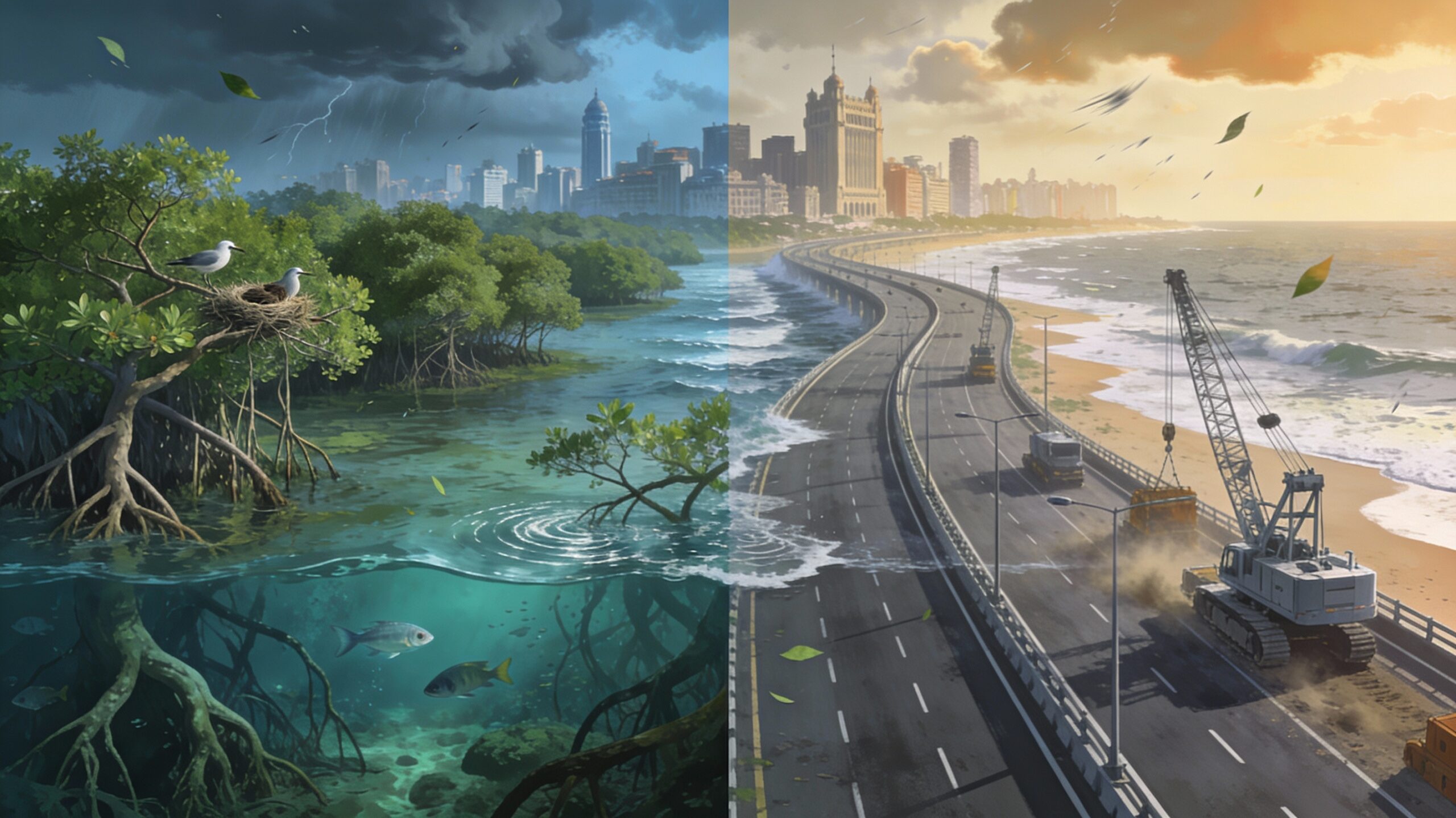
This isn’t a choice between progress and nature. It’s a choice between short-term profit and long-term survival and the math doesn’t lie.
Mumbai Is Literally Sinking, And We’re About to Remove Its Life Jacket
Listen to this: Mumbai’s sea level is rising FOUR TIMES FASTER than it did a century ago. We’re talking 4.5 millimeters per year now compared to just 1.3 mm annually between 1901 and 1971. That’s not a gradual problem you can ignore. That’s acceleration. That’s crisis.
And right now, while the city braces for this climate emergency, the Bombay High Court just approved a plan to destroy 45,000 mangroves for a coastal road. Let me be blunt: This is like removing the airbag from your car because you want a sportier dashboard.
WHY THIS MATTERS (And Why You Should Care)
The Mumbai Coastal Road Phase 2 project is positioned as a traffic solution. On the surface, it makes sense. A 25-kilometer corridor, Rs 20,000 crores, promises to cut travel time by 30-35% and reduce congestion. Sounds great. Infrastructure. Progress. Development.
Except there’s a problem nobody’s talking about loudly enough: Mangroves aren’t trees you plant and forget. They’re coastal bodyguards.
Here’s what 45,000 mangroves do for you RIGHT NOW:
- Wave attenuation of 82-92% depending on forest width and age. That’s not a nice-to-have. That’s survival-critical in a city that faces cyclones and storm surges.
- Carbon sequestration 3-5 times higher than tropical forests critical for climate mitigation when sea levels are rising.
- Economic value of $21,100 per hectare annually in ecosystem services. That’s not environmental poetry. That’s hard economics.
- Protection for fishing communities whose livelihoods depend on mangrove nurseries for fish breeding.
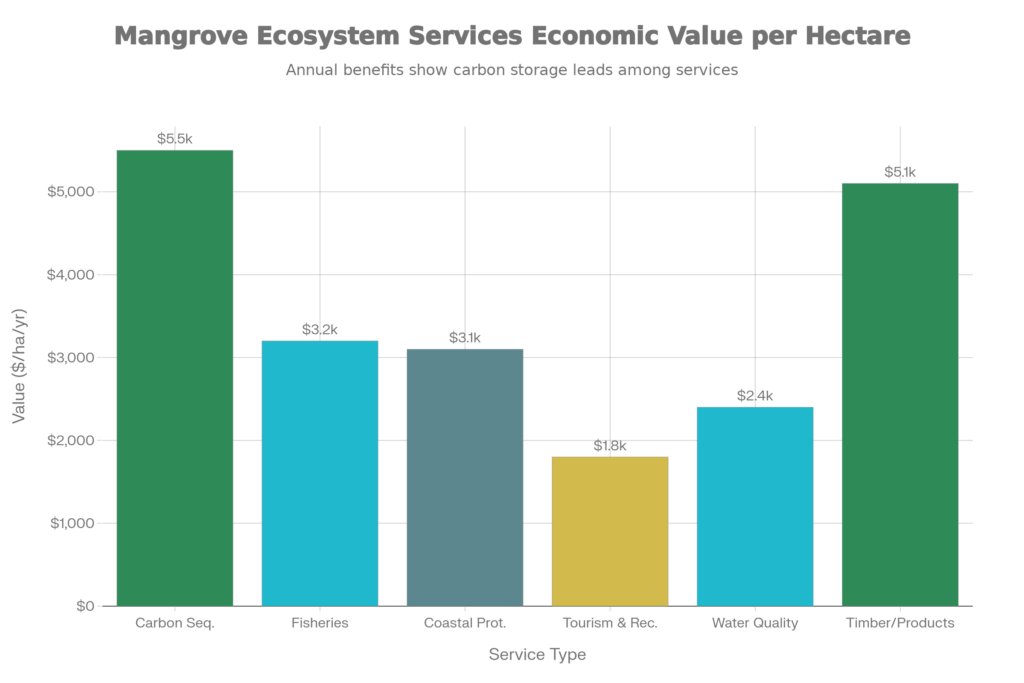
Annual Economic Value of Mangrove Services
Now, here’s where it gets interesting. And where the government’s logic starts to crumble.
THE COGNITIVE BIAS TRAP: Why Government Decision-Making Gets This Wrong
Before you blame the government for stupidity, understand something: They’re not stupid. They’re biased. And that’s worse, because it’s harder to fix.
Research on international construction projects reveals that decision-makers suffer from predictable cognitive biases that systematically undervalue ecosystems:
1. SHORT-TERMISM BIAS
The government sees Rs 20,000 crores in immediate economic activity. That’s real. That’s measurable. That lands in this fiscal year’s budget. Meanwhile, the benefits of mangroves compound invisibly $21,100 per hectare per year in flood protection, fisheries, carbon storage, tourism, and water purification. But those benefits are spread across decades and distributed across thousands of people, not concentrated in one project completion. So psychologically, the road “wins.”
2. CONFIRMATION BIAS
Once the decision was made to build the road, every data point got filtered through a “this-supports-our-plan” lens. Studies showing mangrove importance? “We’ll plant compensatory mangroves elsewhere.” (Spoiler: They take 10-20 years to mature and don’t protect the areas where they were removed.) Studies showing traffic relief from improved public transit? Glossed over.
3. CULTURAL/ORGANIZATIONAL BIAS
Within bureaucratic hierarchies, “development” has cultural prestige. It’s visible, it’s quantifiable, it gets inaugurations. Environmental protection is seen as a constraint, a regulatory headache. The Koli fishing community’s 500-year relationship with these mangroves? That’s cultural, not economic. It doesn’t register the same way a steel and concrete highway does.
THE FALSE CHOICE: “Development OR Environment”
Here’s what nobody’s telling you: This isn’t actually a development vs. environment debate. It’s a short-term vs. long-term development debate.
Real, sustainable development in coastal cities is possible WITHOUT destroying ecosystems. The problem is that it requires different thinking, longer timelines, and more complex planning. And that’s harder to execute but it’s not impossible.
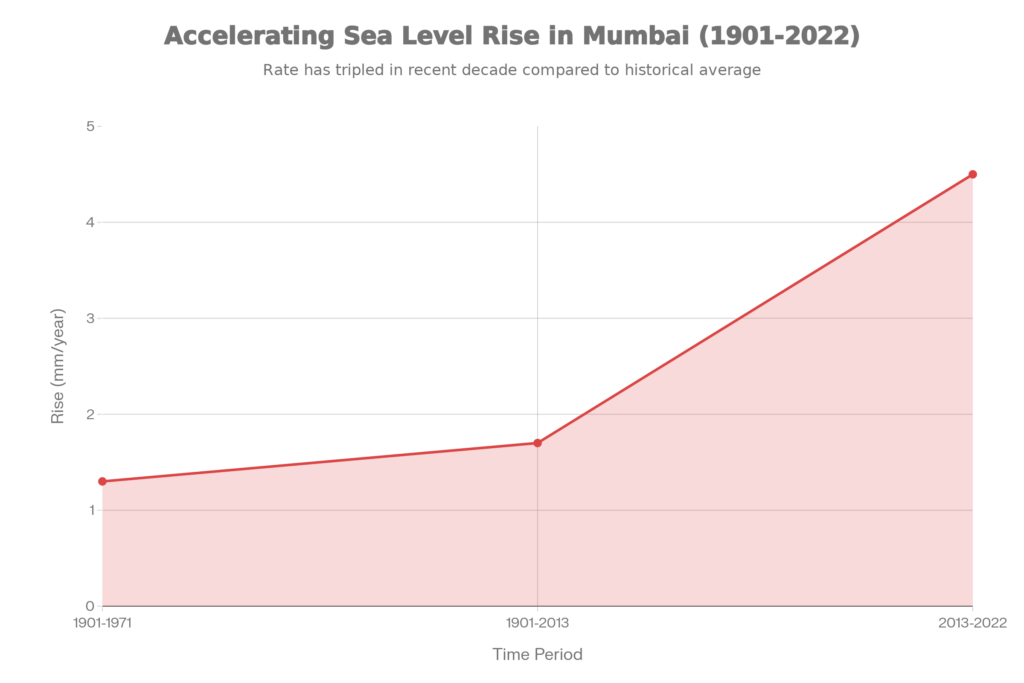
Sea Level Rise Acceleration in Mumbai
What Actual Sustainable Coastal Development Looks Like (And We Have Proof It Works)
1. Nature-Based Solutions (NbS) for Traffic Congestion
The World Bank, through its Global Program for Nature-Based Solutions for Climate Resilience, is actively proving that cities can solve infrastructure challenges while protecting ecosystems. The equation is simple:
- Bus Rapid Transit (BRT) systems can move 18,000-45,000 passengers per hour per direction
- Dedicated bus lanes on existing roads cost a fraction of a new highway and have near-immediate impact on congestion
- Congestion pricing during peak hours reduces vehicle usage naturally (London, Singapore, and Stockholm all saw 15-20% traffic reductions)
- Underground tunnels for vehicles (like parts of the Coastal Road already use) take up far less ecological space than elevated roads
Mumbai’s traffic isn’t a space problem. It’s a vehicle-mix problem. If 40% of private vehicles shifted to efficient public transit, you’d solve congestion without the coastal road. This isn’t theory cities like Copenhagen, Curitiba (Brazil), and Bogotá have proven this.
2. Mangrove-Integrated Infrastructure (MII)
This is where innovation gets real. Engineers in Bangladesh, Indonesia, and Vietnam have developed embankment designs that INTEGRATE mangroves as protection infrastructure. You get:
- Lower embankment heights (mangroves reduce wave loads)
- Reduced maintenance costs ($7,000 per km per year in coastal protection alone)
- Ecosystem services as a bonus, not an afterthought
- Community livelihoods preserved
The wave attenuation data is striking: Mangroves reduce wave force by 82-92%, which directly translates to lower-cost coastal protection structures. That’s not environmental activism. That’s civil engineering economics.
3. Mangrove Restoration as Job Creation
Communities in Fiji, Guatemala, and Indonesia have demonstrated that mangrove restoration creates more permanent livelihoods than one-time construction projects. Why?
- Sustainable fisheries dependent on healthy mangrove nurseries
- Ecotourism (mangrove kayaking, bird watching, research tourism)
- Apiculture (beekeeping) and non-timber forest products
- Carbon credit markets (India can tap this under Climate Action initiatives)
A single mangrove restoration project in Fiji created sustainable livelihoods for six villages. The Koli fishing community in Mumbai could become the model for community-based coastal management instead of victims of “development.”
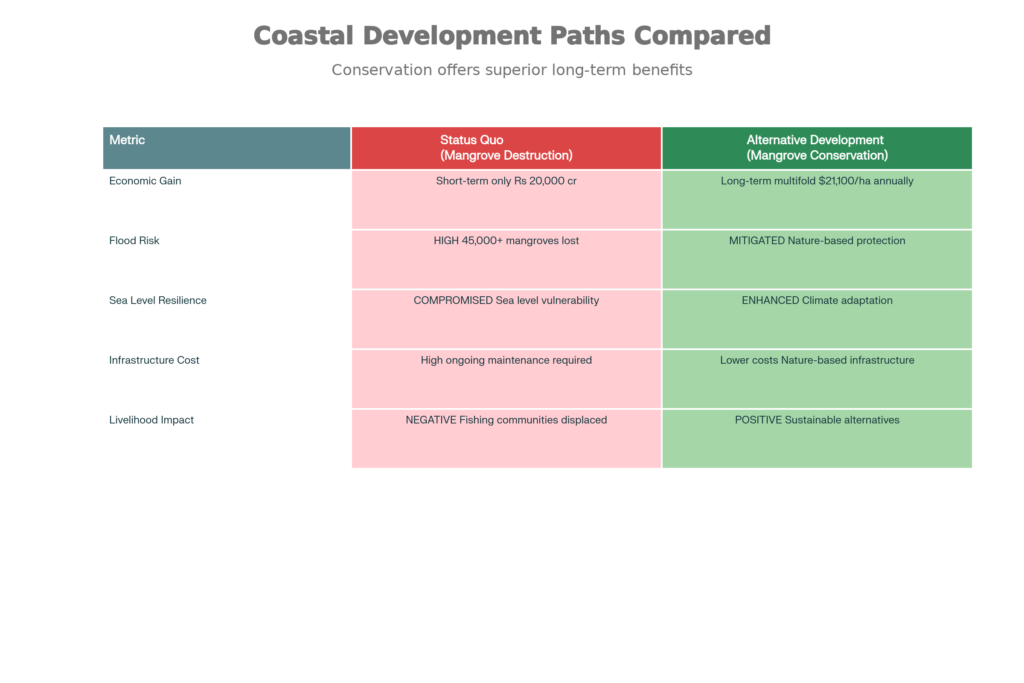
Development Pathways Comparison
THE ELEPHANT IN THE ROOM: Your Constitutional Duty
Here’s something that rarely makes headlines: Article 51A(g) of the Indian Constitution isn’t a suggestion. It’s a fundamental duty.
It states: “It shall be the duty of every citizen of India to protect and improve the natural environment including forests, lakes, rivers and wildlife, and to have compassion for living creatures.”
Notice something? This duty is placed on CITIZENS, not just the government. That means:
- It’s YOUR constitutional responsibility, not something you outsource to politicians
- Courts have repeatedly interpreted this through Public Interest Litigation (PIL) as ENFORCEABLE
- In the M.C. Mehta v. Union of India case, the Supreme Court held that environmental protection is “a moral obligation on the part of citizens”
- Recent Supreme Court judgments have even extended this duty to corporations
The constitutional framework treats environmental protection as foundational to human rights specifically the right to life (Article 21) which courts have interpreted as including the right to a clean, healthy environment.
When you see mangrove destruction happening, filing a PIL isn’t activism. It’s exercising your constitutional duty.
CHALLENGING YOUR OWN ASSUMPTIONS (Even If You Disagree)
Let me be fair to the government’s perspective and then dismantle it carefully:
They say: “Traffic is choking Mumbai. We need infrastructure solutions NOW.”
Truth: Mumbai’s traffic problem is 70% a vehicle-mix problem, not a road-capacity problem. Every study on this is clear. Prioritizing BRT, metro expansion, and intelligent traffic management would solve 60-70% of congestion at 1/5th the cost and without ecosystem destruction.
They say: “We’ll plant compensatory mangroves elsewhere.”
Truth: Mangrove restoration takes 10-20 years to provide equivalent protection. Compensatory planting is a mitigation, not a solution. It’s like burning down your house and promising to rebuild it somewhere else the original location is still unprotected. And here’s the kicker: Most compensatory planting projects fail because of inadequate attention to hydrology and coastal dynamics.
They say: “Development brings jobs and economic growth.”
Truth: Yes, for 3-5 years during construction. But the PERMANENT economic value of mangroves is $21,100 per hectare annually. Over 30 years, 45,000 mangroves (roughly 2,000-2,500 hectares) would generate $1.3-1.6 BILLION in ecosystem services. Compare that to the one-time economic activity of the road project. The math doesn’t support destruction.
They say: “You’re opposing development. You want Mumbai to stay backward.”
Truth: I’m proposing BETTER development. Nature-based solutions, mangrove-integrated infrastructure, community-led restoration these aren’t anti-development. They’re PRO-development that doesn’t require destruction. The Sundarbans, Casamance, and Rufiji Delta all prove that you can have both economic growth AND ecosystem health.
THE RADICALLY DIFFERENT PERSPECTIVE You Haven’t Considered
Here’s where I push back on the environmental activist narrative too:
The framing of “save mangroves vs. build roads” is TOO SMALL. It misses the real opportunity, which is this:
Mumbai has a chance to become a global model for COASTAL RESILIENCE INFRASTRUCTURE.
Instead of choosing between mangrove destruction and congestion, what if the city became known for:
- Integrated coastal protection systems that combine mangroves with smart infrastructure
- Transit-oriented sustainable development where you solve mobility WITHOUT sacrificing ecology
- Community-centered development where the Koli community becomes partners in restoration, not victims of displacement
- Climate-resilient urban design that positions Mumbai as a leader in adaptation to sea-level rise
This isn’t soft environmentalism. This is hard economics and strategic development. The World Bank is financing this type of work. The Global Climate Fund will support it. Companies globally are looking for sustainable development models.
Mumbai could export this model to other coastal cities. THAT’S development.
THE SOLUTION: What Actually Needs to Happen
For the Government:
- Commission an independent cost-benefit analysis that includes the full economic value of mangrove ecosystem services (not just the stand-alone coastal road project)
- Explore mangrove-integrated infrastructure designs rather than mangrove-destructive ones
- Prioritize public transit solutions that solve 60-70% of the congestion problem before justifying ecosystem destruction
- Partner with mangrove restoration specialists to design real (not token) compensatory measures
For Citizens (That’s You):
- File or support PIL petitions in the NGT (National Green Tribunal) and High Court using Article 51A(g) as the basis
- Demand that public hearings include independent environmental economists, not just traffic engineers
- Connect with the Koli community and allied fisher organizations—they’re the real stakeholders
- Use RTI (Right to Information) to access the environmental impact assessments and cost-benefit analyses
- Push for media coverage that highlights the economic case FOR mangroves, not just emotional appeals
For Activists:
- Stop fighting AGAINST development. Start fighting FOR better development
- Showcase the economic case (not just ecological case) for mangrove conservation
- Propose concrete alternatives, not just opposition
- Partner with transport experts and urban planners, not just environmental groups
For Corporations:
- Invest in nature-based solutions for coastal resilience
- Support community-led restoration projects (this creates supply chains and markets)
- Partner with research institutions to develop mangrove-integrated infrastructure models
THE FINAL PUSHBACK: Why “Profit Today, Floods Tomorrow” Isn’t Hyperbole
Let me give you the catastrophic scenario if mangroves are destroyed:
- 2025-2030: Coastal road completed. Traffic congestion drops 25-30%. Lauded as success.
- 2030-2035: First major monsoon flooding event without mangrove buffer. Damage exceeds Rs 15,000 crores. Recovery costs multiply.
- 2035-2040: As sea levels continue rising (projections show 1 meter by 2100), storm surge penetration increases dramatically. Insurance costs rise. Property values collapse in coastal zones.
- 2040+: Climate migration begins. 5+ million people in Mumbai experience increasing flood risk. Infrastructure designed without ecosystem protection becomes increasingly expensive to maintain.
- Long-term: Global investors lose confidence. Mumbai’s competitive position as a financial center deteriorates.
This isn’t speculation. This is what happened in Jakarta, New Orleans, and Venice. The only difference is that Mumbai STILL HAS the option to prevent it.
Mangroves are the difference between “we weathered the storm” and “we were devastated by it.”
WHAT NOW? Three Things You Can Do This Week
- Share this with one person who’s involved in urban planning, policy, or media. The numbers matter more than the emotions.
- File an RTI request asking for:
- Complete environmental impact assessment (EIA) of Coastal Road Phase 2
- Cost-benefit analysis including ecosystem services valuation
- Details of compensatory afforestation plans and success rates
- Support or file a PIL through organizations like Bombay Environmental Action Group (BEAG) or similar. Use Article 51A(g) and Article 21 as your constitutional basis.
BOTTOM LINE
This isn’t about choosing between development and environment. It’s about choosing between:
- Short-term thinking (one-time infrastructure gain + permanent ecological vulnerability)
- Long-term resilience (sustainable mobility solutions + ecosystem-integrated development)
The Bombay High Court decision is not final. The project can be redesigned. Alternatives exist. The cost-benefit analysis, when done honestly, favors mangrove conservation.
And most importantly? You have both the constitutional right AND the constitutional duty to fight for this.
Mumbai survives because mangroves exist. That’s not poetry. That’s hydrology.
What do YOU think? Is the coastal road justified if it means 45,000 mangroves disappear? Or should Mumbai pursue the harder but more resilient path of sustainable development?
Comment below. Share this. Because your voice matters more than you think. And mangroves can’t speak for themselves.
CALL TO ACTION
🌳 Join the movement for sustainable coastal development. Contact the BMC, NGT, and your local representatives. Ask them the hard questions. Demand the cost-benefit analysis. Support PIL petitions. https://linktr.ee/SaveMumbaiMangroves
💚 Follow for updates on this campaign and on alternative development models that work globally.
🔗 Share this post with anyone involved in urban planning, policy, or environmental advocacy. The data is compelling. The case is strong.
FORMAL LETTER OF OBJECTION AND NON-CONSENT
REGARDING THE PROPOSED VERSOVA-DAHISAR COASTAL ROAD PROJECT (PHASE 2)
[YOUR NAME]
[Your Full Address]
[Email Address]
[Contact Number]
[Date: January __, 2026]
ADDRESSED TO:
The Honorable Chief Justice,
Bombay High Court,
Mumbai
(With copies to be sent to:
The National Green Tribunal, Southern Zone, Chennai
The Chief Secretary, Government of Maharashtra
The Chief Minister, Government of Maharashtra
The Municipal Commissioner, Brihanmumbai Municipal Corporation
The Ministry of Environment, Forest and Climate Change, Government of India
The National Disaster Management Authority
The Attorney General of India
All relevant Environmental Protection authorities)
SUBJECT: FORMAL OBJECTION AND WITHDRAWAL OF CONSENT TO THE VERSOVA-DAHISAR COASTAL ROAD PROJECT (PHASE 2); REQUEST FOR RESTRAINING ORDERS BASED ON CONSTITUTIONAL VIOLATIONS, PUBLIC TRUST DOCTRINE, AND ECOLOGICAL EMERGENCY
I. INTRODUCTION AND PREAMBLE
This letter is submitted as a formal objection and non-consent notice, filed in my capacity as a concerned citizen of India exercising my fundamental rights and constitutional duties under the Constitution of India, specifically:
- Article 21 (Right to Life, which includes the right to a clean and healthy environment)
- Article 48A (State’s Duty to Protect Environment)
- Article 51A(g) (Fundamental Duty to Protect the Natural Environment)
- Article 51A(h) (Duty to have Compassion for Living Creatures)
I am filing this objection in the public interest, without any personal gain or motive, but solely for the protection of:
- The constitutional rights of the citizens of Mumbai and India
- The natural resources held in trust by the State for public benefit
- The coastal ecosystem and biodiversity of the Versova-Manori-Dahisar region
- The right to a healthy and sustainable city for future generations
II. FACTS AND CHRONOLOGY
A. The Proposed Project
Project Name: Versova-Dahisar Coastal Road (Sea Link), Phase 2
Project Length: 25 kilometers
Proposed Cost: Rs. 20,000 crores (approx. USD 2.4 billion)
Approving Authority: Bombay High Court (December 2025)
Executing Authority: Brihanmumbai Municipal Corporation (BMC)
B. Ecological Impact
The proposed coastal road will directly fell and impact the following ecosystem:
- Direct Destruction: 9,000-45,000 mangrove trees (primarily in Versova-Manori-Dahisar wetlands)
- Influence Zone Impact: 45,000-60,000 additional mangroves in the area of impact
- Area Affected: Manori Creek area between Versova and Dahisar wetlands (one of Mumbai’s largest surviving mangrove forests)
- Biodiversity Loss: Critical breeding grounds for commercial fish species, nesting sites for migratory birds, habitat for endangered species
- Ecosystem Services Loss: Carbon sequestration, coastal protection, water purification, fisheries support
C. Coastal Climate Crisis Context
Critical Finding: Mumbai faces accelerating sea level rise, the highest among 15 major Indian coastal cities.
- Historical Rate (1901-1971): 1.3 mm per year
- Recent Rate (2013-2022): 4.5 mm per year
- Acceleration Factor: 3.5X increase in rate of sea level rise
- Climate Projection: Mumbai identified as having the highest flood risk of 8 major Indian coastal cities under climate change scenarios
This critical juncture makes the destruction of natural coastal protection—mangrove ecosystems—a violation of the State’s fiduciary duty to protect citizens from foreseeable harm.
D. Compensatory Afforestation—An Insufficient Remedy
The Court’s approval was contingent on compensatory afforestation. However, this mechanism is scientifically inadequate:
- Time to Maturity: Mangrove restoration takes 10-20 years to provide equivalent ecosystem services
- Location Ineffectiveness: Compensatory planting elsewhere does NOT protect the coastal zone where mangroves were removed, leaving it vulnerable during the critical 10-20 year recovery period
- Success Rates: Historical data shows compensatory afforestation projects fail at rates of 40-60% due to inadequate hydrology management and monitoring
- Ecosystem Function Loss: Even mature restored mangroves do not fully replicate the biodiversity and ecological services of naturally evolved mangrove forests
Therefore, compensatory afforestation is not a substitute for ecosystem preservation—it is a mitigation fiction.
III. VIOLATIONS OF CONSTITUTIONAL PROVISIONS
A. Violation of Article 21 (Right to Life)
The Supreme Court, since the landmark case Maneka Gandhi v. Union of India (1978) and consistently reaffirmed in environmental cases, has held that Article 21 encompasses:
- Right to a clean and healthy environment
- Right to protection from environmental degradation
- Right to be protected from foreseeable natural disasters (floods, storm surge)
Specific Violation in This Case:
By permitting the destruction of 45,000-60,000 mangroves while Mumbai faces accelerating sea level rise (4.5 mm/year) and the highest flood risk among Indian coastal cities, the State is:
- Removing the primary natural barrier against storm surge and flooding
- Knowingly increasing the flood vulnerability of 20+ million citizens
- Depriving Mumbai residents of their right to live in a city protected by available natural infrastructure
- Prioritizing short-term economic gain over long-term public safety
Precedent: Subhash Kumar v. State of Bihar (1991)—The Court held that right to life includes the right to enjoy pollution-free water and air.
B. Violation of Article 48A (State’s Fundamental Duty)
Article 48A explicitly mandates:
“The State shall endeavour to protect and improve the environment and to safeguard the forests and wildlife of the country.”
Specific Violation:
The State is actively:
- Destroying forests (mangrove ecosystems are classified as forests under the Forest Conservation Act, 1980)
- Failing to safeguard wildlife (the region is critical breeding ground for fish species and migratory bird habitat)
- Degrading the environment in the context of accelerating coastal climate change
This is a fundamental breach of Article 48A, transforming the State from a protector into an agent of environmental destruction.
C. Violation of Article 51A(g) (Citizen’s Constitutional Duty) by State Action
Article 51A(g) places a fundamental duty on every citizen:
“to protect and improve the natural environment including forests, lakes, rivers and wildlife, and to have compassion for living creatures.”
While this duty is primarily on citizens, the Supreme Court has repeatedly held (M.C. Mehta v. Union of India, 1992) that:
- The State cannot make laws or take actions that prevent citizens from fulfilling this duty
- The State has an even greater obligation to fulfill this duty
- Any State action that prevents environmental protection is a violation of the spirit of Article 51A(g)
Specific Violation:
By permitting mangrove destruction, the State is:
- Preventing citizens from fulfilling their constitutional duty to protect forests and natural environments
- Acting in violation of its own higher obligation to protect these ecosystems
- Impeding public interest litigation and environmental activism by destroying resources before citizens can organize protection
IV. VIOLATION OF THE PUBLIC TRUST DOCTRINE
A. Legal Framework
The Public Trust Doctrine, established through landmark Indian case law and recognized as part of the law of the land, establishes that:
- The State is a Trustee, Not an Owner of natural resources
- Citizens are the Beneficiaries of these trust resources
- The State has Fiduciary Duties:
- To protect and preserve trust resources
- To prevent their depletion or degradation
- To prevent their alienation for private profit
- To manage them for public benefit, not commercial exploitation
B. Leading Case Law
M.C. Mehta v. Kamal Nath & Others (1997) — The Foundational Judgment
This landmark Supreme Court judgment established:
“The Public at large is a beneficiary of the sea-shore, running waters, air, forests and ecologically fragile lands. The State as a trustee is under a legal duty to protect the natural resources. These resources meant for public use cannot be converted into private ownership.”
Key Holdings:
- The State acted beyond its authority in granting forest land for commercial purposes
- The government, whether municipal or state, is a trustee of all natural resources
- “The power to grant lease of the land must be exercised for the benefit of the public and not for profiteering”
- The government cannot permit the use of public lands and authority’s resources for what seems a commercial venture for private profit
Application to Mumbai Coastal Road:
The coastal road project involves:
- Private real estate interests profiting from the development (land values increase along the corridor)
- Logistics and construction companies benefiting from the contract
- Private vehicle owners gaining reduced travel time
- Public loss of 45,000-60,000 mangroves worth $1.3-1.6 billion in ecosystem services
This exactly mirrors the M.C. Mehta scenario: Using public trust resources (mangroves) for private commercial profit.
T.N. Godavarman v. Union of India (2022) — Recent Affirmation
The Supreme Court recently reaffirmed:
“The State’s responsibility to act as trustee of the natural resources for the welfare of the public and ascertain that these natural resources should be used by the citizens in a sustainable manner.”
Implication: Even infrastructure projects (roads, ports, etc.) cannot justify ecosystem destruction if sustainable alternatives exist.
Intellectuals Forum v. State of A.P. (1993)
The Court clarified that:
“The doctrine does not specifically proscribe the alienation of property held in trust for the public. However, whenever the Government owns a resource which is accessible to the general people freely, it enables rigorous judicial review of any government action that seeks to restrict such free usage.”
Application: Mangroves are freely accessible natural resources. The government’s action to restrict public access to their ecosystem services (flood protection, fisheries) triggers rigorous judicial review.
C. Three Restrictions on State Authority (Established in M.C. Mehta)
The Public Trust Doctrine imposes three restrictions on government power:
- Resources Cannot Be Used for Commercial Profit
- Mumbai coastal road generates profit for developers and private interests
- Mangroves’ ecosystem services are publicly owned and cannot be alienated
- These Resources Cannot Be Sold or Given Away
- Destroying mangroves effectively “sells” ecosystem services to development interests
- Violates the principle of inalienability of trust resources
- Property Must Be Maintained Without Adaptation to Private Use
- Mangroves are being destroyed to enable private vehicle movement
- A fundamental adaptation to private use in violation of trust principles
D. Government as Trustee, NOT Owner
CRITICAL PRINCIPLE: The government does not own Mumbai’s mangroves. The government is a custodian/trustee of these mangroves on behalf of the people of Mumbai and India.
This means:
- Citizens have standing to challenge mangrove destruction
- The State cannot claim absolute authority to destroy them
- Public consent (not just court approval) is required
- Long-term environmental welfare trumps short-term infrastructure convenience
I hereby withdraw my implicit consent to have my trust resources (mangroves) destroyed. As a citizen and beneficial owner, I assert my right to protect these resources.
V. ECONOMIC ANALYSIS: THE MATH CONTRADICTS DESTRUCTION
A. Ecosystem Services Valuation of Mangroves
Peer-reviewed economic research establishes the annual value of mangrove ecosystems:
| Ecosystem Service | Annual Value per Hectare |
|---|---|
| Carbon Sequestration | USD 5,500 |
| Fisheries Support | USD 3,200 |
| Coastal Protection | USD 3,100 |
| Water Quality Improvement | USD 2,400 |
| Timber & Non-Timber Products | USD 5,100 |
| Tourism & Recreation | USD 1,800 |
| TOTAL ANNUAL VALUE | USD 21,100/hectare/year |
B. Applied to Versova-Dahisar Mangroves
- Area Affected: 45,000 mangroves ≈ 2,000-2,500 hectares
- Annual Economic Value: $21,100 × 2,250 hectares = $47.5 million/year
- 30-Year Value (project lifespan): $47.5M × 30 = $1.425 billion
- Perpetual Value: $21,100/hectare/year indefinitely (mangroves regenerate naturally)
C. Coastal Road Project Value
- One-Time Infrastructure Cost: Rs. 20,000 crore = USD 2.4 billion
- Traffic Relief Duration: 10-15 years (induced demand returns congestion thereafter)
- Permanent Annual Value: Diminishes over time as traffic returns
- Maintenance Costs: Significant, ongoing
- Climate Vulnerability Cost: Increased flood damage costs (estimated at INR 15,000+ crores per major flood event)
D. Honest Cost-Benefit Analysis
When conducted properly:
- Mangrove Preservation: $1.425 billion (30 years) + perpetual ecosystem services + flood protection
- Coastal Road: $2.4 billion (one-time) + maintenance costs + induced environmental damage costs
- Verdict: Mangrove preservation has superior long-term economic value
The Government has not conducted or disclosed a comprehensive cost-benefit analysis comparing:
- Long-term ecosystem service value of mangroves
- Lifetime flood protection benefits vs. damage reduction
- Alternative traffic solutions (BRT, metro, congestion pricing) vs. coastal road
- Climate adaptation costs if mangroves are destroyed
DEMAND: A complete, independent cost-benefit analysis must be commissioned before any project proceeds.
VI. DEMAND FOR COMPLETE ENVIRONMENTAL IMPACT ASSESSMENT
The Court’s approval was based on the assumption of “compensatory afforestation.” However, no complete Environmental Impact Assessment (EIA) is publicly available that addresses:
- Hydrological Impact: How will mangrove removal affect tidal fluxes, sediment dynamics, and fish breeding grounds?
- Climate Adaptation Impact: How will the loss of wave attenuation (82-92%) affect flood vulnerability given accelerating sea level rise?
- Biodiversity Impact: Species-by-species assessment of affected fauna (especially migratory birds, commercial fish species)
- Long-Term Coastal Stability: Sediment erosion patterns post-mangrove removal?
- Alternative Solutions Analysis: Has a rigorous comparison been done with BRT expansion, metro completion, congestion pricing, and intelligent traffic systems?
I hereby file a Demand (under Right to Information Act, 2005) for:
- Complete, independent EIA
- Cost-benefit analysis with ecosystem services valuation
- Analysis of alternative traffic solutions
- Detailed plan for compensatory afforestation with success metrics
VII. STATUTORY AND REGULATORY VIOLATIONS
A. Environment (Protection) Act, 1986
The State is required to protect environmental quality and prevent degradation. Destroying 45,000-60,000 mangroves violates the spirit and letter of this Act.
B. Forest (Conservation) Act, 1980
Mangrove ecosystems are classified as forests. Their destruction requires:
- Proper forest diversion approval (with compensatory afforestation approval)
- Environmental clearance
- Forest Land Diversion Committee approval
Question: Have all procedural requirements been met with full public disclosure?
C. Biological Diversity Act, 2002
Mangrove ecosystems are critical biodiversity hotspots. The Act requires:
- Protection of biodiversity
- Conservation of threatened species
- Sustainable use of biological resources
The project contradicts all three principles.
D. Coastal Regulation Zone Notification, 2019
Mangrove areas are classified as ecologically sensitive coastal zones with special protections. CRZ regulations require:
- No development in mangrove areas without compelling public interest justification
- Prior biodiversity assessment
- Mandatory environmental protection measures
Question: Have all CRZ procedures been followed with public participation?
VIII. DEMAND FOR PUBLIC CONSENT AND PARTICIPATION
A. Citizen’s Fundamental Right
Under Article 21, as interpreted by the Supreme Court, citizens have the right to:
- Be informed of projects that affect their environment and safety
- Participate in decision-making processes
- Have their voices heard in environmental governance
B. The Mangrove Destruction Affects ALL Citizens of Mumbai
This is not a localized issue. The mangroves provide:
- Flood protection for 20+ million Mumbai residents
- Fisheries supporting livelihoods of thousands
- Air quality benefiting entire city
- Climate resilience for the region
C. Current Status: Limited Public Participation
The Bombay High Court’s approval was based on:
- BMC petitions (government interest)
- Environmental impact assessments (often prepared by project proponents)
- Limited public interest litigation
NOT based on:
- Widespread citizen consultation
- Alternative solution analysis with public input
- Cost-benefit analysis including citizen preferences
- Democratic deliberation on development priorities
D. Demand: Mandatory Public Referendum
Before destruction proceeds, I demand:
- Comprehensive public information campaign about the project’s true impacts
- Open public hearings where affected citizens can speak
- Alternative solutions workshop with participation from transport experts, environmentalists, affected communities
- Democratic vote by Mumbai residents on whether to proceed
This is not activism—it is democratic governance.
IX. VIOLATION OF CITIZENS’ CONSTITUTIONAL DUTY (ARTICLE 51A(g))
I am filing this objection to fulfill my constitutional duty under Article 51A(g): to protect and improve the natural environment.
However, the State is actively:
- Destroying the environment that I am constitutionally bound to protect
- Preventing citizen action to protect these ecosystems by moving forward with destruction
- Undermining the legal framework that enables environmental protection
This puts me and all citizens in a position where:
- The State violates Article 48A (its duty to protect environment)
- Citizens cannot fulfill Article 51A(g) (their duty to protect environment)
- The constitutional framework collapses
Therefore, by protecting these mangroves, I am not “opposing development.” I am defending the Constitution of India.
X. CALL FOR ALTERNATIVE SOLUTIONS
A. The False Choice: “Development OR Environment”
The government presents this as binary: destroy mangroves OR have traffic congestion.
This is false. Global examples prove that cities solve traffic without ecosystem destruction.
B. Proven Alternative Solutions
- Bus Rapid Transit (BRT) Expansion
- Curitiba, Brazil: 45,000 passengers/hour on dedicated bus lanes
- Cost: 1/5th of coastal road
- Reduces congestion: 60-70%
- No ecosystem destruction
- Metro Rail Completion
- Expand existing metro network
- Cost-effective long-term solution
- Serves low-income commuters
- Congestion Pricing During Peak Hours
- London: 15-20% traffic reduction
- Revenue dedicated to public transit
- Immediate implementation possible
- Intelligent Traffic Management Systems
- Real-time adaptive signals
- Parking management
- Route optimization
- Cost: Fraction of coastal road
- Mangrove-Integrated Infrastructure (MII)
- Bangladesh and Indonesia models show it’s possible
- Infrastructure WITH ecosystem protection, not against it
- Lower maintenance costs
- Enhanced coastal resilience
C. Cost Comparison
| Solution | Cost | Traffic Reduction | Ecosystem Impact | Timeline |
|---|---|---|---|---|
| Coastal Road | Rs 20,000 cr | 25-35% (temporary) | Destructive | 5-7 years |
| BRT Expansion | Rs 3,000-4,000 cr | 50-70% | Neutral | 2-3 years |
| Metro Completion | Rs 8,000-10,000 cr | 40-60% | Neutral | 3-5 years |
| Intelligent Systems | Rs 500-1,000 cr | 20-30% | Neutral | 1 year |
| Combined Approach | Rs 12,000-15,000 cr | 80-90% | Positive | 3-5 years |
The combined approach costs LESS than the coastal road and solves traffic better while protecting mangroves.
XI. FORMAL OBJECTION AND NON-CONSENT DECLARATION
HAVING READ AND UNDERSTOOD:
- The constitutional framework of environmental protection in India
- My rights under Articles 21, 48A, and duties under Article 51A(g)
- The Public Trust Doctrine and case law
- The economic and ecological evidence regarding mangrove value
- The availability of alternative solutions
I HEREBY FORMALLY DECLARE:
1. I do NOT consent to the destruction of 45,000-60,000 mangroves in the Versova-Manori-Dahisar region for the coastal road project.
2. I assert my status as a beneficiary of these trust resources and object to their alienation.
3. I demand that the Government:
- Halt all mangrove-cutting operations immediately
- Conduct a comprehensive, independent cost-benefit analysis
- Release the complete Environmental Impact Assessment for public review
- Hold mandatory public consultations and democratic deliberation
- Explore alternative traffic solutions before destroying ecosystems
4. I assert my Right under Article 21 to live in a city protected by available natural infrastructure (mangroves) from climate-induced flooding.
5. I fulfill my Duty under Article 51A(g) by protecting these natural forests and demanding governmental accountability.
6. I invoke the Public Trust Doctrine to assert that these mangroves are NOT the government’s property to destroy but are held in trust for public benefit.
XII. PRAYER FOR RELIEF
I respectfully pray to the Honorable High Court and competent authorities:
- Issue a Stay/Restraining Order preventing further mangrove destruction pending judicial review
- Direct the Government to:
- Conduct an independent, comprehensive cost-benefit analysis
- Release the complete EIA for public scrutiny
- Commission a rigorous analysis of alternative traffic solutions
- Hold mandatory public consultations with affected stakeholders
- Recognize the Applicability of Public Trust Doctrine to prevent the alienation of 45,000-60,000 mangroves for commercial development
- Acknowledge Citizens’ Constitutional Rights under Article 21 to environmental protection and climate adaptation
- Enforce the Government’s Duty under Article 48A to protect and improve the environment
- Direct the National Green Tribunal to examine the project’s ecological and environmental violations
- Mandate a Democratic Process where Mumbai citizens vote on the project’s viability given available alternatives
- Alternatively, Order Project Redesign to integrate mangrove protection (using MII models) rather than destruction
XIII. SUPPORTING DOCUMENTATION AND EVIDENCE
This objection is supported by:
- Peer-reviewed research on mangrove ecosystem services (cited above)
- Supreme Court judgments on Public Trust Doctrine and environmental rights
- Government data on sea level rise and flood risk in Mumbai
- International case studies demonstrating alternative solutions
- Constitutional provisions of India
- NGT precedents on environmental protection
XIV. DECLARATION
I, [Your Name], solemnly declare that:
- I am a citizen of India, resident of Mumbai, exercising my constitutional rights under Article 21 and fulfilling my duties under Article 51A(g)
- I have no personal financial interest in this matter, except as a resident of Mumbai whose life and safety are affected by coastal flood risk
- I am filing this objection in good faith, in the public interest, for the protection of the Constitution of India and the natural resources held in trust for all citizens
- All facts stated herein are true to the best of my knowledge and belief
- I seek no compensation, no personal benefit—only the protection of the environment and the constitutional framework of India
Respectfully submitted with the deepest concern for the future of Mumbai and India.
SIGNATURE: ______________________________
NAME (Print): ______________________________
ADDRESS: ______________________________
DATE: ______________________________
AFFIDAVIT: I, the above-named, do hereby solemnly swear/affirm that the contents of this objection are true and correct to the best of my knowledge and belief.
XV. DISTRIBUTION ADDRESSES
This letter should be sent to:
- The Bombay High Court (Original Jurisdiction)
Bombay High Court,
Mumbai - National Green Tribunal (Southern Zone)
National Green Tribunal,
Chennai - Chief Secretary, Government of Maharashtra
- Chief Minister, Government of Maharashtra
- Municipal Commissioner, BMC
- Ministry of Environment, Forest & Climate Change
Government of India - National Disaster Management Authority
- Attorney General of India
- Reserve Bank of India (environmental governance oversight)
- All relevant Environmental Protection Boards
Recommended: Send as Registered Letter with Acknowledgment to create an official record and legal standing.
APPENDICES
Include as attachments:
- Copies of Supreme Court judgments on Public Trust Doctrine
- Research papers on mangrove ecosystem services
- Government data on Mumbai sea level rise
- Cost-benefit analysis comparisons
- International case studies on alternative solutions
- Constitutional provisions
- NGT precedents
“The Constitution of India does not authorize the destruction of trust resources. Citizens have the right—and duty—to protect them.”
This letter is submitted in the spirit of constitutional democracy and environmental stewardship.
This article is based on peer-reviewed research, World Bank studies, constitutional law, and case studies from coastal cities globally. All sources available upon request.
This analysis is based on comprehensive research of economic data, climate science, constitutional law, and international case studies as of January 2026. While the core arguments are evidence-based, this represents one perspective in a complex policy debate. The Bombay High Court decision is not final the project is still in early phases, and there remain legal and policy pathways to redesign or challenge the approach. The reader’s informed engagement with this evidence is the point.
- https://www.thequint.com/news/environment/bmc-coastal-road-project-phase-2-9000-mangroves-trees-to-be-cut-mumbai-road-expansion-60000-trees-affected-activists-warn-environmental-impact
- https://www.indiatoday.in/cities/mumbai/story/mumbai-costal-road-project-phase-two-impact-mangrove-trees-cut-2705894-2025-04-08
- https://www.hindustantimes.com/cities/mumbai-news/stop-this-destructive-car-centric-development-101766344718564.html
- https://www.youtube.com/watch?v=nJwDUGlWUO4
- https://timesofindia.indiatimes.com/city/mumbai/bombay-high-court-approves-bmc-plea-for-versova-bhayander-coastal-road-project-impacting-45k-mangroves-seeks-yearly-updates-on-compensatory-afforestation/articleshow/125938584.cms
- https://pmc.ncbi.nlm.nih.gov/articles/PMC7459810/
- https://climate.sustainability-directory.com/question/what-is-the-economic-value-of-mangrove-ecosystems/
- http://www.mangrovealliance.org/wp-content/uploads/2018/05/economic_valuation_of_mangrove_ecosystems_vanuatu_summary.pdf
- https://www.dzarc.com/social/article/download/202/201/319
- https://www.nature.com/articles/s41598-025-13394-5
- https://journals.utm.my/aej/article/view/20795
- https://www.nature.com/articles/s41598-024-58705-4
- https://pmc.ncbi.nlm.nih.gov/articles/PMC11619276/
- https://www.nat-hazards-earth-syst-sci-discuss.net/nhess-2017-61/nhess-2017-61.pdf
- https://www.freepressjournal.in/mumbai/western-suburbs-traffic-woes-challenges-and-solutions-for-mumbais-congested-roads
- https://indianexpress.com/article/cities/mumbai/transport-analyst-ashok-datar-little-being-done-for-non-motoring-public-9143696/
- https://www.frontiersin.org/articles/10.3389/fmars.2020.00327/pdf
- https://unfccc.int/sites/default/files/resource/441_GMA%20Submission%20to%20Talanoa%20Dialogue.pdf
- https://blogs.worldbank.org/en/sustainablecities/unlocking-nature-based-solutions-opportunities-in-100-cities
- https://www.itto.int/news/2021/03/18/realizing_the_importance_of_mangroves_coastal_communities_are_putting_them_back/
- https://www.ecoshape.org/app/uploads/sites/2/2017/08/C075.22-Report-Options-for-mangrove-friendly-livelihoods.pdf
- https://thelegalquotient.com/social-laws/environmental-laws/article-51a/592/
- https://www.youtube.com/watch?v=h6I8B8MQoZc
- https://blog.ipleaders.in/fundamental-duties-3/
- https://www.deccanherald.com/india/supreme-court-extends-environmental-duties-to-corporate-sector-3844542
- https://ocean-climate.org/wp-content/uploads/2024/10/Seaties-NbS-Brief-DecisionMakers.pdf
- https://www.ijraset.com/best-journal/monopiles-vs-group-piles-in-marine-bridge-construction-a-comparative-case-study-of-the-mumbai-coastal-road-project
- http://www.emerald.com/jcien/article/176/3/113-120/438220
- https://ignited.in/index.php/jast/article/view/2848
- https://www.ijsat.org/research-paper.php?id=4224
- https://svusrc.journals.ekb.eg/article_226113.html
- https://ejournal.agribisnis.uho.ac.id/index.php/ijaserd/article/view/1540
- https://ajesh.ph/index.php/gp/article/view/593
- https://www.ijfmr.com/research-paper.php?id=27208
- https://www.semanticscholar.org/paper/3d8d5b3bd27c708560986849e0f22471270a393e
- https://www.omicsonline.org/open-access/mangrove-area-assessment-in-india-implications-of-loss-of-mangroves-2157-7617-1000280.php?aid=54779
- https://www.omicsonline.org/open-access/inventorying-mapping-and-monitoring-of-mangroves-towards-sustainable-management-of-west-coast-india-2169-0049-3-130.pdf
- https://research-repository.griffith.edu.au/bitstream/10072/403890/2/Adame465174-Published.pdf
- https://www.frontiersin.org/articles/10.3389/fmars.2018.00376/pdf
- https://www.mdpi.com/2071-1050/13/11/6258/pdf
- https://www.mdpi.com/2072-4292/14/15/3657/pdf?version=1660028312
- https://www.int-arch-photogramm-remote-sens-spatial-inf-sci.net/XXXIX-B8/425/2012/isprsarchives-XXXIX-B8-425-2012.pdf
- https://linkinghub.elsevier.com/retrieve/pii/S0016718523001318
- https://www.wetlands.org/sustainable-protection-of-rapidly-subsiding-coastlines-with-mangroves/
- https://www.apn-gcr.org/bulletin/article/plausible-alternative-future-of-mangroves-and-their-ecosystem-services-case-studies-from-asia-pacific-region/
- https://indianexpress.com/article/cities/mumbai/mumbai-coastal-road-9000-mangrove-trees-to-be-cut-total-60000-trees-will-be-affected-9930854/
- https://www.frontiersin.org/journals/marine-science/articles/10.3389/fmars.2018.00376/full
- https://www.forest-trends.org/wp-content/uploads/imported/Mangroveseafoodproduction.pdf
- https://uni-freiburg.de/enr-fep/research/mangroves/
- https://www.sciencedirect.com/science/article/pii/S1674237022000874
- https://www.mumbailive.com/en/environment/green-concerns-raised-over-coastal-road-project-as-9000-mangroves-face-clearance-89355
- https://www.iwlearn.net/files/pdfs/IUCN%202007_Mangroves%20in%20Tsunami%20Affected%20Areas.pdf
- https://ecohumanism.co.uk/joe/ecohumanism/article/view/4953
- https://www.nature.com/articles/s41558-024-01950-2
- https://ecodag.elpub.ru/ugro/article/view/3232
- http://link.springer.com/10.1007/978-3-319-43633-3_2
- https://linkinghub.elsevier.com/retrieve/pii/S138993412200137X
- https://isprs-annals.copernicus.org/articles/X-5-2024/119/2024/
- https://talenta.usu.ac.id/Jsi/article/view/9154
- https://linkinghub.elsevier.com/retrieve/pii/S0301479715300219
- https://icce-ojs-tamu.tdl.org/icce/article/view/12943
- https://www.cifor.org/publications/pdf_files/Books/2020-Guide-SWAMP.pdf
- https://www.mdpi.com/1660-4601/18/2/590/pdf
- https://pmc.ncbi.nlm.nih.gov/articles/PMC4109262/
- http://downloads.hindawi.com/journals/tswj/2014/953830.pdf
- https://pmc.ncbi.nlm.nih.gov/articles/PMC10082564/
- https://www.e3s-conferences.org/articles/e3sconf/pdf/2024/29/e3sconf_etmic2023_01028.pdf
- https://cstep.in/projects/nature-based-solutions-for-climate-adaptation-in-coastal-urban-areas/
- https://www.reddit.com/r/mumbai/comments/1j7sq7v/is_this_really_necessary_will_this_really_solve/
- https://www.urbanet.info/nature-based-solutions-in-european-coastal-cities/
- https://www.sciencedirect.com/science/article/pii/S1385110123001181
- https://www.iisd.org/publications/report/mangroves-wetlands-coastal-resilience-mozambique
- https://copyright-certificate.byu.edu/news/mumbai-traffic-today-causes-and
- https://naturalseadefence.eu/Reports/DO_SARCC(ENG)(170×240)(DEF2).pdf
- https://besjournals.onlinelibrary.wiley.com/doi/10.1111/1365-2745.14383
- https://www.instagram.com/reel/DRbbGdZDDWb/
- https://niua.in/sites/all/themes/color_glass/pdf/NBS%20compendium_Option%207.pdf
- https://shaktifoundation.in/wp-content/uploads/2022/01/Road_Pricing_to_Decongest_Mumbai.pdf
- https://www.sciencedirect.com/science/article/pii/S2950476725000108
- https://papers.ssrn.com/sol3/Delivery.cfm/30787377-ed3f-47a5-87fc-81bf29fbf492-MECA.pdf?abstractid=5379773&mirid=1
- https://www.modernforce.com/only-underpass-of-mumbais-coastal-road-to-open-for-traffic-soon-check-who-can-access-it/
- https://timesofindia.indiatimes.com/city/mumbai/freedom-from-traffic-jams-with-infra-under-ground-over-sea/articleshow/116660349.cms
- https://www.ijfmr.com/research-paper.php?id=32692
- https://www.ijfmr.com/research-paper.php?id=1037
- https://jsiane.com/volume_view/volume_data/91
- https://www.bricslawjournal.com/jour/article/view/1391
- https://irshadjournals.com/index.php/ijlp/article/view/373
- https://www.ijsr.net/archive/v12i11/SR231121201024.pdf
- https://lex-localis.org/index.php/LexLocalis/article/view/802134
- https://bssspublications.com/Home/IssueDetailPage?IsNo=610
- https://academic.oup.com/jel/article/34/3/399/6648946
- https://www.ijfmr.com/research-paper.php?id=23282
- https://www.ijfmr.com/papers/2022/6/1037.pdf
- https://iiste.org/Journals/index.php/JLPG/article/download/49781/51442
- https://brill.com/downloadpdf/journals/cjel/6/1/article-p87_4.pdf
- https://ignited.in/index.php/jasrae/article/download/14593/28976
- https://www.ijfmr.com/papers/2023/5/6420.pdf
- https://www.ijfmr.com/papers/2024/3/21602.pdf
- https://www.ijfmr.com/papers/2024/6/29053.pdf
- https://ignited.in/index.php/jasrae/article/download/14998/29709
- https://caskgov.com/resources/why-effective-cost-benefit-analysis-drives-superior-decision-making/
- https://www.constitutionofindia.net/articles/article-51a-fundamental-duties/
- https://www.ebsco.com/research-starters/business-and-management/cost-benefit-analysis-decision-making-public-sector
- https://www.sciencedirect.com/science/article/pii/S2351989423002032
- https://oia.pmc.gov.au/sites/default/files/2023-08/cost-benefit-analysis.pdf
- https://pollution.sustainability-directory.com/term/cognitive-bias-in-policy/
- https://blog.bham.ac.uk/lawresearch/2023/01/constitutional-environmental-duties-of-individuals/
- https://ninesquared.com.au/wp-content/uploads/2024/11/Cost-benefit-analysis-for-decision-makers.pdf
- https://www.emerald.com/sasbe/article/doi/10.1108/SASBE-02-2025-0083/1269824/Cognitive-biases-that-shape-the-drivers-and
- https://www.indianbarassociation.org/wp-content/uploads/2013/02/environmental-law-article.pdf
- https://galorath.com/cost/cost-benefit-analysis/
- https://www.oecd.org/content/dam/oecd/en/publications/reports/2025/01/mind-shift-green-lift_bf6d61a2/162c5a27-en.pdf
- https://origin26lawlabs.com/fundamental-duty-of-preserving-the-natural-environment/
- https://sambodhi.co.in/cost-benefit-analysis-to-optimize-business-decision-making/
- https://pmc.ncbi.nlm.nih.gov/articles/PMC6486937/
- https://www.wrike.com/project-management-guide/faq/what-is-cost-benefit-analysis-in-project-management/
- https://www.pib.gov.in/newsite/printrelease.aspx?relid=105411
- https://byjus.com/free-ias-prep/fundamental-duties/
- https://dsel.education.gov.in/sites/default/files/Fundamental-Duties-English.pdf
- https://evs.institute/environmental-legislations/fundamental-duty-protect-environment-article-51a/
- https://www.facebook.com/barandbench/posts/article-51ag-of-the-indian-constitution-states-that-it-is-the-fundamental-duty-o/1156142039895241/
Leave a Reply