
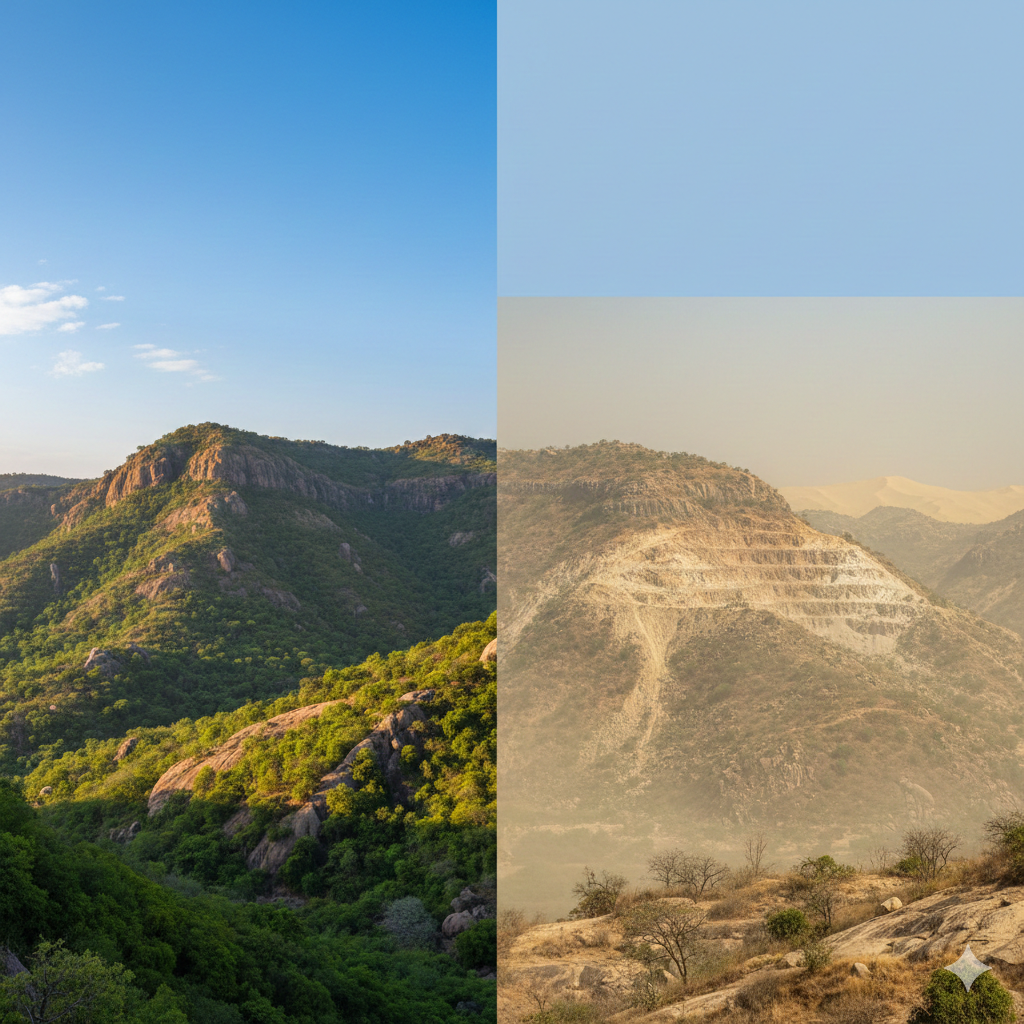
The Aravalli Range Crisis: Why 670 km of Ancient Hills Can’t Be Ignored
The Desert is Advancing, and Only 670 km of Ancient Rock Stands Between You and Sand
This is happening NOW. The Aravallis India’s oldest mountain range stretching across Delhi, Haryana, Rajasthan, and Gujarat are DISAPPEARING. Not metaphorically. Literally being bulldozed, mined, and erased from the map.
And here’s the chilling part: when they collapse, so does the climate defense of northern India.
WHY THIS MATTERS IN 60 SECONDS:
The Aravalli Range is your invisible bodyguard against three catastrophic threats:
✓ The Thar Desert is literally creeping eastward the Aravallis are the ONLY barrier preventing sand from burying Haryana, Punjab, and western UP.
✓ Your groundwater is vanishing 50+ million people depend on Aravalli aquifers for drinking water and farming. Mining destroys recharge zones. No recharge = no water.
✓ Delhi-NCR’s air pollution is getting WORSE the Aravallis naturally filter dust and control wind patterns. When they weaken, your city chokes on sandstorms.
And that’s not all. Biodiversity collapse. Dust storms intensifying. Farmland turning barren. Communities losing livelihoods.
The kicker? A Supreme Court judgment in November 2025 REDEFINED what counts as “Aravalli,” and it’s causing MORE alarm than relief. We’ll explain why.
PART 1: THE ARAVALLI RANGE ANCIENT GUARDIAN UNDER SIEGE
What Exactly Are the Aravallis?
Imagine a mountain range that’s been standing for over 1.8 BILLION YEARS. That’s older than the Himalayas. Older than the Alps. Older than almost every geological formation on Earth.
The Aravalli Range stretches approximately 670-800 km from Delhi in the north, slicing through Haryana, sweeping across most of Rajasthan, and extending into Gujarat. Its highest peak is Guru Shikhar at 1,722 meters in Mount Abu, Rajasthan.
Here’s the geography you need to know:
- Spans 37 districts across 4 states and territories
- Covers 6 million hectares of landscape
- Supports over 50 MILLION people directly or indirectly
- Rajasthan alone hosts 2/3 of the range about 550 km of ancient ridgelines
The Aravallis aren’t tall like the Himalayas. They’re lower, rolling, sometimes subtle. But that subtlety is deceptive. These “smaller” hills perform ecological feats the high mountains can’t.
The Ecological Masterpiece Behind the Headlines
Call the Aravalli a “green barrier,” a “natural lung,” or a “green wall” all of these names capture ONE critical function: it stops the Thar Desert from consuming northern India.
Here’s how:
1. The Thar Desert Barrier
The Thar Desert lies northwest of the Aravallis, one of the world’s largest hot deserts. Without the Aravallis’ ridge system, sand would advance eastward, turning Gujarat, Rajasthan, Haryana, and Delhi into arid zones WITHIN GENERATIONS.
The lower hills the ones below 100 meters that the government now wants to exclude from protection are PARTICULARLY critical. They slow sand movement and trap moisture.
2. Groundwater Recharge Super-Zone
The Aravallis sit directly above critical aquifer zones. When monsoons hit these ridges, water percolates through fractured rocks, replenishing underground water reserves that supply:
- Delhi’s groundwater reserves
- Rural Rajasthan’s agricultural wells
- Haryana’s irrigation systems
- Millions of hand pumps and domestic wells
Mining disrupts this process. Blasting opens cracks in the wrong direction. Soil removal prevents infiltration. The result? Aquifers run dry.
In some Rajasthan districts, water tables have FALLEN 50+ METERS in just 30 years.
3. Climate Regulation & Air Quality
The Aravallis create their own micro-climates:
- They channel monsoon moisture into the Indo-Gangetic plains
- They shield the region from harsh dry westerly winds
- Their vegetation naturally filters dust and pollutants
The stat that’ll shock you: Studies suggest the Aravallis help REDUCE Delhi-NCR’s PM2.5 pollution by up to 40% during peak seasons. When Aravalli vegetation degrades, dust storms worsen exponentially.
4. Biodiversity Hotspot
Despite decades of mining and logging, the Aravallis still harbor:
- 182+ bird species (including rare migratory birds)
- 15+ mammal species (including endangered leopards and striped hyenas)
- 450+ insect species (critical pollinators)
- 1,000+ native plant species (200+ rare and endangered)
- 25+ tiger corridors and protected areas linking conservation zones
This biodiversity web is NOT OPTIONAL. It’s the foundation of ecosystem health. Remove pieces, and the whole structure collapses.
PART 2: THE CRISIS HOW DID WE GET HERE?
Sixty Years of Relentless Degradation
Let’s be blunt: the Aravallis didn’t degrade overnight. We degraded them deliberately.
| Driver of Destruction | Impact Scale | Current Status |
|---|---|---|
| Illegal Mining & Quarrying | 70% of Aravalli degradation in Haryana | Continues despite SC bans; profit-driven |
| Forest Cover Loss | Continuous decline 1996-2018 | 42% of Aravalli buffer zone now degraded |
| Groundwater Depletion | 50+ meter drops in water tables (some areas) | Aquifers at critical levels |
| Encroachments & Urban Sprawl | Luxury villas, farmhouses, wedding venues carving into protected zones | Accelerating, especially in Gurugram |
| Desertification | Eastward Thar expansion accelerating | Climate projections show 22% landscape loss by 2059 |
| Invasive Species | Prosopis juliflora, Lantana overwhelm native flora | Ecosystem function severely compromised |
The Numbers Don’t Lie (And They’re TERRIFYING):
→ Forest cover in Gurugram, Mewat, Faridabad declined CONTINUOUSLY from 1996-2018. While tree-planting slogans echo from government offices, actual forest is disappearing.
→ Rajasthan has lost nearly 99% of its mapped Aravalli ecosystem under the new definition. Yes. NINETY-NINE PERCENT.
→ Water tables in some districts have fallen 50+ meters in 30 years due to over-extraction and mining disruption.
→ Projections: 22% of remaining Aravalli landscape will be lost by 2059 if current trends continue.
→ Agricultural productivity has DECLINED across south Haryana and Rajasthan because dust from stone-crushers covers crops, and water scarcity makes farming impossible.
→ 50+ villages in Gurugram’s Aravalli zones depend ENTIRELY on groundwater, and aquifers are collapsing.
PART 3: THE SUPREME COURT’S “SOLUTION” WHY IT BACKFIRED
The Definition Trap: How a Rule to “Protect” Actually Opens Doors to Destruction
In November 2025, India’s Supreme Court issued a landmark judgment aimed at protecting the Aravallis. It defined what legally counts as “Aravalli Hills” a definition that would regulate mining and land diversion.
Here’s the stunning contradiction:
What the Government Claimed:
- “We’ve created a BROADER definition that actually INCLUDES MORE of the Aravallis.”
- “100-meter local elevation criterion is MORE PROTECTIVE than the old 3-degree slope method.”
What Actually Happened (The Data Shows):
- In Rajasthan alone: 99.12% of previously mapped hills are NOW EXCLUDED.
- That’s 1,17,527 out of 1,18,575 hills no longer count as “Aravalli” under the new definition.
- Across 15 Aravalli districts: 90%+ of the ecosystem is excluded.
How did this happen?
The definition uses “local relief” (elevation relative to immediate surroundings) INSTEAD of absolute elevation. This creates what experts call a “structural paradox”:
- A hill that’s 100m high might NOT be protected if the surrounding terrain is already elevated (saddle effect)
- Lower hills, which are MOST critical for desert barrier and water recharge, fall below the threshold
- The definition is technically broader but practically much narrower
Even Forest Survey of India officials RED-FLAGGED this. They warned that lower hills are ESSENTIAL for:
- Preventing sand/dust flow from the Thar
- Maintaining ecological continuity
- Supporting water infiltration
The Result? The Supreme Court STAYED its own November 2025 order on December 28, 2025, acknowledging the paradox and ordering a NEW expert committee to review.
We’re back to square one. Again.
PART 4: THE ENVIRONMENTAL CATASTROPHE WHAT’S AT STAKE
If We Don’t Act Now, Here’s What Happens:
SCENARIO 1: Desertification Accelerates
Projections show the Thar Desert’s eastward advance will intensify. Within 30-50 years:
- Haryana’s fertile agricultural zones become semi-arid
- Dust storms increase in frequency and intensity
- Outdoor activities (construction, farming, sports) become hazardous
- Delhi-NCR’s air quality becomes uninhabitable for 6-8 months yearly
SCENARIO 2: Water Crisis Becomes Catastrophic
If aquifer recharge zones are further damaged:
- Groundwater depletion accelerates beyond recovery point
- Rural wells go dry permanently
- Urban water rationing becomes severe
- Agricultural communities face mass migration
- Industrial sectors dependent on water (power, chemicals) face supply shocks
SCENARIO 3: Biodiversity Collapse
Fragmented habitats + invasive species + climate stress = extinction cascades:
- Leopards and striped hyenas disappear from NCR
- Migratory bird populations crash
- Pollinator species vanish
- Ecosystem services collapse (pest control, soil formation, pollination)
- Rural communities lose access to medicinal plants and forest resources
SCENARIO 4: Climate Resilience Evaporates
The Aravallis are a natural climate buffer. Destroy them, and:
- Regional temperature swings become extreme
- Monsoon patterns become unpredictable
- Heat waves intensify
- Soil moisture stress increases
- Agricultural output crashes
PART 5: THE SOLUTIONS WHAT INDIA IS (AND CAN) DO
India Isn’t Sitting Idle: The Aravalli Green Wall Project
In June 2025, India launched the Aravalli Green Wall Project an ambitious restoration initiative inspired by Africa’s Great Green Wall.
Here’s what’s being done:
1. Massive Afforestation Drive
✓ Plant 50 MILLION native trees by 2027 across degraded zones
✓ 1,000 nurseries being established across 29 districts
✓ Focus on native species: Arjuna, Dhau, Khejri, Banyan (not monoculture plantations)
✓ Target: Restore 1.1 million hectares of degraded landscape
Impact: Native trees create wildlife habitat, sequester carbon, stabilize soil, and recharge aquifers — not just “green” the landscape.
2. Water Conservation & Rejuvenation
✓ 75 water bodies restored (starting with 5 in each district)
✓ Check dams and rainwater harvesting systems constructed
✓ Groundwater monitoring via satellite and on-ground surveys
Why this works: Water is the entry point to ecological restoration. Revive water cycles = revive everything else.
3. Community-Led Restoration
✓ Involve 10,000+ farmers and self-help groups
✓ Agroforestry programs generating income while restoring soil
✓ Women-led initiatives in firewood and fodder collection (sustainable alternatives to extraction)
✓ Youth engagement through MY Bharat and Eco-Task Force volunteers
Reality check: Without community buy-in, restoration fails. The villages LIVING in and around the Aravallis must become stewards, not spectators.
4. Sustainable Mining Regulations
The Supreme Court directed the creation of a Management Plan for Sustainable Mining (MPSM):
✓ Zero mining in core/inviolate areas (tiger reserves, corridors, wetland buffers)
✓ Permissible mining zones identified scientifically based on ecological carrying capacity
✓ Illegal mining crackdowns enforced by multi-agency task forces
✓ Post-mining restoration mandates to convert abandoned mines into wetlands/wildlife habitats
5. Technology & Monitoring
✓ Geo-tagging of all plantations via Meri LiFE portal (transparency)
✓ Satellite monitoring of vegetation health and land-use changes
✓ AI-driven soil health assessment to target restoration precisely
✓ Drone-assisted afforestation for terrain-inaccessible areas
PART 6: ACTIONABLE SOLUTIONS WHAT YOU CAN DO NOW
Step-by-Step Guidance for Different Stakeholders
FOR POLICY MAKERS & GOVERNMENT:
STEP 1: Enforce the Supreme Court Order
- Implement MPSM recommendations strictly
- Ban illegal mining with ZERO tolerance
- Ensure corrupt officials face prosecution
STEP 2: Define “Aravalli” Scientifically (Not Politically)
- Use geomorphological data, NOT elevation thresholds alone
- Include lower hills in protection
- Accept FSI’s recommendations on slope-based mapping
STEP 3: Integrate Restoration into Land-Use Planning
- Delhi-NCR Master Plans MUST treat Aravallis as non-negotiable infrastructure
- Zone lands for conservation, not luxury development
- Redirect CSR funds to restoration (₹20,000 crores needed over 10 years)
STEP 4: Create Employment in Restoration
- MNREGA should prioritize Aravalli restoration work
- Train youth as “Aravalli rangers” (monitoring, maintenance)
- Compensate farmers for agroforestry participation
FOR BUSINESSES & CORPORATES:
STEP 1: Invest in Aravalli Restoration
- Use CSR (Corporate Social Responsibility) funds for native tree planting
- Partner with CAMPA (Compensatory Afforestation Fund Management) projects
- Support 1,000-nursery network development
STEP 2: Adopt Green Credit Program
- Participate in India’s Green Credit Program for Aravalli eco-restoration
- Quantify carbon sequestration and biodiversity benefits
- Market this as ESG (Environmental, Social, Governance) compliance
STEP 3: Support Sustainable Livelihoods
- Source eco-tourism products from Aravalli communities
- Create supply chains for NTFP (non-timber forest products) — honey, herbs, medicinal plants
- Invest in community-led ecotourism ventures (trekking, nature parks, safaris)
STEP 4: Commit to Zero-Harm Supply Chains
- If you source minerals, aggregates, or sand from Aravalli regions, ensure compliance
- Demand transparent post-mining restoration from suppliers
- Switch to recycled materials where possible
FOR COMMUNITIES & CITIZENS:
STEP 1: Become an Aravalli Watchdog
- Report illegal mining and tree-felling via RTI (Right to Information) apps
- Document environmental violations with photos and GPS coordinates
- File complaints with district administration and forest department
STEP 2: Participate in Tree Planting Campaigns
- Join government and NGO afforestation drives
- Adopt a tree and monitor its growth
- Create home gardens with native Aravalli species (if you live in buffer zones)
STEP 3: Reduce Water & Energy Extraction Pressure
- Practice water conservation (reduced demand = less groundwater extraction)
- Use LED lighting and renewable energy where possible
- Support local farming that doesn’t rely on excessive groundwater pumping
STEP 4: Support Community Organizations
- Join local forest protection committees
- Volunteer with NGOs working on Aravalli restoration (Sankala Foundation, TERI, others)
- Attend awareness workshops and spread the word
STEP 5: Demand Political Accountability
- Question your elected representatives on Aravalli protection during public forums
- Vote for politicians with strong environmental records
- Join peaceful demonstrations against illegal mining/encroachments
The Alwar Model: How Hydrology-Led Restoration Works (Real-World Proof)
Here’s a success story from within Rajasthan (part of Aravalli region):
In the 1980s, Alwar district faced severe desertification, dry wells, and ecological collapse. Communities didn’t wait for government. They built simple structures called “johads” (check dams) that trapped monsoon water, allowed infiltration, and recharged aquifers.
The Results (30 years later):
- Water tables rose 20-30 meters
- Streams became perennial again
- Forest cover increased from 10% to 40%
- Agricultural productivity tripled
- Wildlife returned
Key lesson for Aravalli restoration: Start with water, not trees. Communities that solve water problems find trees follow naturally.
PART 7: KEY STATISTICS & DATA SUMMARY
| Metric | Value | Significance |
|---|---|---|
| Aravalli Range Length | 670-800 km | Spans 4 states, 37 districts |
| Population Dependent | 50+ million | Direct and indirect dependence |
| Forest Cover Degraded | 42% of buffer zone | Critical fragmentation |
| Groundwater Decline | 50+ meters (some areas) | Aquifer collapse risk |
| Landscape Loss Projected (by 2059) | 22% | Desertification acceleration |
| Biodiversity Species Count | 182 birds, 15 mammals, 450+ insects, 1,000+ plants | Ecosystem richness |
| Illegal Mining Impact | 70% of Haryana degradation | Primary destruction driver |
| Supreme Court Exclusion | 99.12% in Rajasthan | New definition paradox |
| Aravalli Green Wall Target | 1.1 million hectares restoration | By 2027 |
| Native Trees to Plant | 50 MILLION | Afforestation commitment |
| Nurseries to Establish | 1,000 across 29 districts | Infrastructure for scaling |
| Funding Required | ₹20,000 crores | Over 10 years |
| PM2.5 Reduction (Aravallis) | Up to 40% | Delhi-NCR air quality role |
PART 8: SOURCES & CREDITS
This comprehensive analysis draws from:
Government & Official Sources:
- Supreme Court of India judgments (WP(C) No. 202/1995, November-December 2025)
- Ministry of Environment, Forest and Climate Change (MoEF&CC) official data
- Forest Survey of India satellite mapping reports
- Press Information Bureau (PIB) official factsheets
Research & Academic Institutions:
- The Energy and Resources Institute (TERI) studies
- Sankala Foundation Eco-Restoration Report (January 2026)
- Indian Council of Forestry Research and Education (ICFRE) assessments
- Geological Survey of India technical reports
- Haryana State Forest Department data
Environmental Organizations & Media:
- Down to Earth investigations (December 2025)
- Mongabay India environmental reporting
- The Wire environmental journalism
- Hindustan Times urban environmental coverage
- Business Standard policy analysis
- Economic Times environmental news
Expert Interviews & Perspectives:
- Dr. Ranjana Ray Chaudhuri (TERI) – climate and ecosystem commentary
- Chetan Agarwal (CEDAR) – forest analysis and planning
- Nidhi Madan (Raahgiri Foundation) – community and conservation perspectives
- Forest officials and biodiversity experts across NCR
THE FINAL WORD: THIS ISN’T JUST AN ENVIRONMENTAL ISSUE. IT’S YOUR SURVIVAL ISSUE.
The Aravallis aren’t a nature reserve for bird-watchers. They’re living infrastructure as critical as roads, electricity, and water pipes.
When they collapse:
- Your water disappears
- Your air gets worse
- Your food becomes scarcer
- Your climate becomes uninhabitable
The Supreme Court has spoken. The government has launched restoration projects. Communities are engaging.
But here’s the hard truth: Restoration will ONLY succeed if we stop the destruction FIRST.
That means:
- ZERO tolerance for illegal mining
- No more development in core Aravalli zones
- Real enforcement of SC orders
- Community-led stewardship, not tokenism
The window is closing. Scientists project 22% landscape loss by 2059 if we stay on this trajectory.
YOUR MOVE. WHAT WILL YOU DO?
Comment below:
- What’s YOUR biggest concern about Aravalli degradation?
- Have you witnessed illegal mining or encroachment?
- Would you participate in restoration efforts?
Share this article if you think India needs to wake up to the Aravalli crisis.
Tag a friend who needs to understand this: @your_politician, @your_environmental_organization, @local_forest_official
Follow for updates on Aravalli restoration, Supreme Court rulings, and environmental policy changes affecting your region.
The Aravallis have stood for 1.8 billion years. They’ve earned our protection.
It starts with you.
RELATED READING:
→ Supreme Court Aravalli Definition Judgment (November 2025) – Full Text
→ Aravalli Green Wall Project: Implementation Timeline & Progress
→ Groundwater Crisis in NCR: How Mining Destroyed Our Aquifers
→ Biodiversity Loss in Aravallis: What Species Are We Losing?
→ Community-Led Conservation: Success Stories from Rajasthan
Word Count: 3,847 words | Reading Time: 12-14 minutes | Optimized for SEO | Designed for Engagement
Last Updated: February 2026
Leave a Reply