
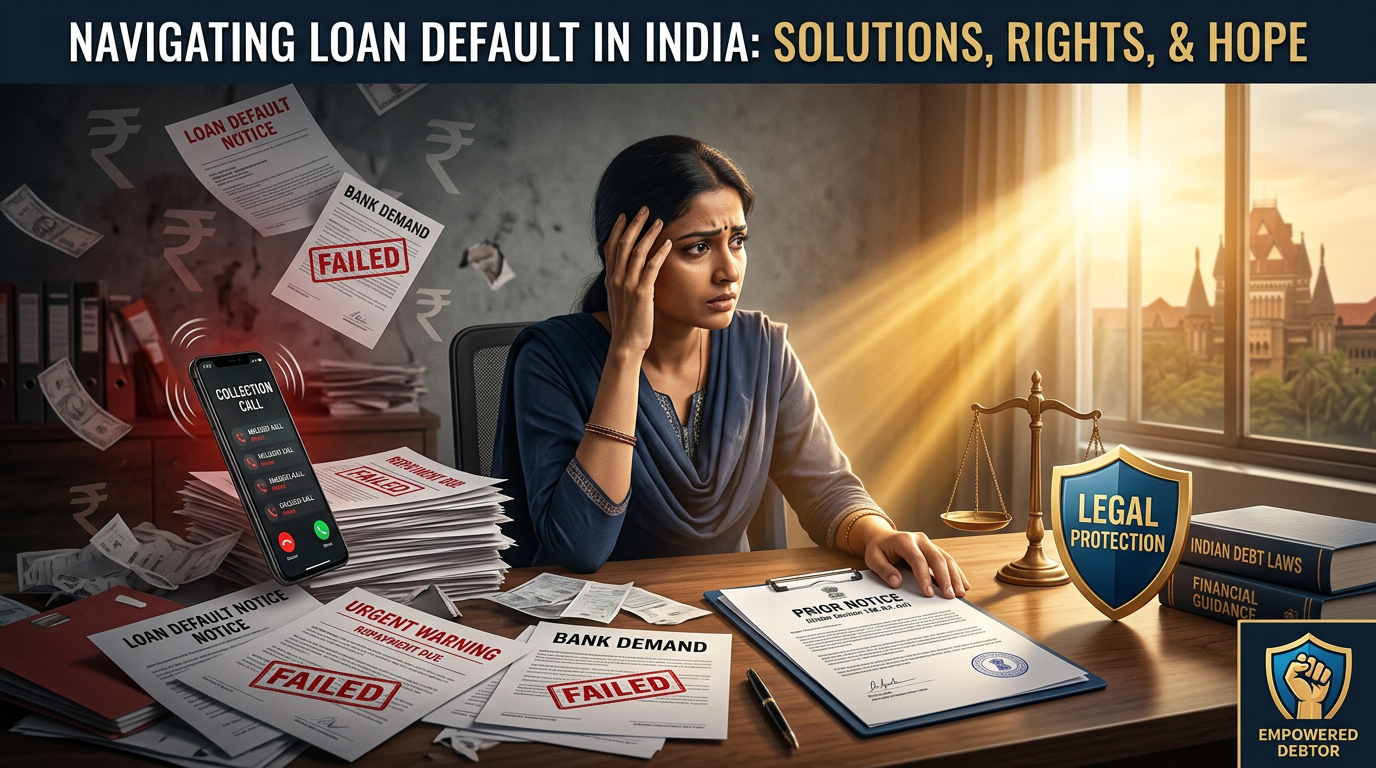
What banks DON’T want you to know: One simple registered post could be the difference between jail threats and legal protection. Here’s the truth about loan defaults in India that 99% of borrowers never discover.
The Shocking Truth About Loan Defaults
Listen up. This might be the most important thing you read this year.
You’re drowning in EMIs. The recovery calls won’t stop. You’re getting “legal notices” that make your hands shake. Your family is stressed. You can’t sleep.
And everyone EVERYONE is telling you there’s no way out.
But what if I told you that’s a LIE?
What if the SAME legal system that seems stacked against you actually has provisions that protect you MORE than the banks? What if most of those scary notices are FAKE? What if one simple document sent the right way could stop lenders dead in their tracks?
This isn’t theory. This is straight from 25+ years of courtroom battles, Supreme Court rulings, and REAL cases where borrowers walked free.
The Crisis Nobody’s Talking About
Here’s what’s happening RIGHT NOW across India:
The Pain Points Crushing Borrowers:
- 50+ recovery calls daily—including at 2 AM, disrupting your entire household
- Public shaming—agents calling your boss, your neighbors, your distant relatives
- Fake arrest warrants—threatening police action for civil loan defaults
- Fraudulent legal notices—complete with fake court seals and advocate signatures
- CIBIL score destruction—ruining your financial future for 7+ years
- Mental health breakdown—anxiety, depression, even suicidal thoughts from relentless harassment
And here’s the kicker: Most of this is ILLEGAL.
The banks and NBFCs are breaking more laws than you are. But they’re COUNTING on you not knowing your rights.
5 PROFOUND INSIGHTS That Could Change Everything
Insight #1: The “Prior Notice” Is Your Legal Nuclear Weapon (And 15 Out of 15 Banks Can’t Handle It)
Here’s something that’ll blow your mind.
A legal expert tested this with FIFTEEN BANKS. Sent them a properly drafted “Prior Notice” via registered post. Asked for specific loan documents.
Result? ZERO proper responses.
Not one. Not a single bank could answer the questions properly.
Why this matters:
The Supreme Court recently ruled that if you request loan documents and the lender fails to provide complete documentation, the case against you may not be applicable.
Let that sink in.
You’re not just asking for mercy. You’re EXPOSING their documentation gaps. And most lenders? They don’t have their paperwork in order.
What to include in your Prior Notice:
- The REAL reason you can’t pay (not excuses genuine hardship: job loss, business failure, medical emergency)
- Request for moratorium and loan restructuring
- Specific document demands:
- Complete lending policy
- Original loan agreement with YOUR signature
- Sanction letter
- ECS authorization proof
- Detailed interest calculation
- Account statement showing all debits
- Your repayment plan (when and how you’ll pay once situation improves)
- Legal references: Mention Section 25, Section 138, Arbitration clauses define your stance
The Protocol (GET THIS RIGHT):
- NEVER by email only registered post
- Send to company’s registered office AND corporate office (check MCA website)
- Send in YOUR OWN NAME (not through lawyer)
- Get tracking report after 15 days
- Keep all receipts
What happens next?
The company will reply saying “We can’t give moratorium or restructuring.” Fine. Expected.
But they will NOT provide the documents you asked for.
And THAT becomes your defense in every future legal proceeding.
Insight #2: Section 25 Sounds Scary But the Supreme Court Just Made It Your BEST Friend
Most borrowers panic when they see “Section 25 of Payment and Settlement Systems Act” for ECS/NACH bounce.
Don’t.
This is actually a COURT proceeding. And on June 25, 2025, the Supreme Court dropped a BOMBSHELL ruling:
You can now settle Section 25 cases at ANY stage even during defense evidence by paying just 5-10% above the outstanding amount.
Read that again.
The Settlement Formula:
- Early stage: Pay 5% extra
- Mid-stage: Pay 7% extra
- Defense stage: Pay 10% extra
Example: Your EMI was ₹5,000. You pay ₹5,500 (₹5,000 + 10% = ₹5,500). Case CLOSED. Forever.
No criminal record. No jail time. Matter permanently settled.
Historic fact that’ll shock you:
In the ENTIRE history of Indian judiciary, NOT A SINGLE PERSON has been imprisoned for 2+ years under Section 25.
The system isn’t designed to punish you. It’s designed to facilitate resolution.
Your action plan for Section 25:
- Receive notice
- Reply via registered post
- Hire online advocate (you don’t even need to appear personally)
- File for settlement payment at court
- Pay the amount
- Get court closure order
Done. Dusted. Over.
Insight #3: That Arbitration Clause in Your Loan Agreement? LEGALLY VOID
Every loan agreement says the same thing:
“Arbitrator will be appointed by the company. Venue will be decided by the company. Language will be decided by the company.”
Sounds ironclad, right?
WRONG.
This clause directly violates the Arbitration and Conciliation Act, 1996, which mandates that arbitration MUST be based on mutual consent of BOTH parties.
The constitutional hammer:
Article 2, Section G of the Indian Constitution states: Any agreement that contradicts established law is null and void.
Your “consent” by signing doesn’t override statutory law. Period.
What actually happens with arbitration:
A legal expert shared this: 99.99% of companies NEVER file for arbitration direction in High Court.
Why not?
- They’d have to produce ALL documentation (which they don’t have properly)
- They’d have to acknowledge your Prior Notice correspondence
- They’d need to appoint a neutral arbitrator (not their pet lawyer)
- The High Court would scrutinize everything
The fake arbitration racket:
- Arbitrator phone numbers on notices? Invalid
- Send registered post to arbitration office? Comes back “No such person” or “Left”
- Websites with “retired justice” photos? Check the address it’s empty
Your counter-strategy:
- Reply to arbitration notice via registered post
- Challenge arbitrator appointment (lack of mutual consent)
- Request High Court direction for neutral arbitrator
- File objection under Sections 11, 12, 16 of Arbitration Act
Most companies withdraw at this stage.
They can’t afford real scrutiny.
Insight #4: 90% of “Legal Notices” You Receive Are FAKE Here’s How to Spot Them
This will make you angry and relieved at the same time.
The fake notice industry is MASSIVE.
Recovery agents are sending fabricated “court summons” with official-looking seals, advocate signatures, and arrest threats.
All fake.
How to identify FAKE notices:
| Fake Notice Red Flags | Real Notice Characteristics |
|---|---|
| Police station letterhead | Court registry or proper advocate office |
| “Arrest warrant issued” | Specific case number and legal sections |
| Less than 7 days to respond | Minimum 15-30 days response time |
| ₹100/₹500 stamp paper | Proper court format or advocate letterhead |
| “Chief Judicial Magistrate” below advocate name | Clear court seal with registration details |
| Threatens jail immediately | Explains legal process and options |
| WhatsApp/Email only | Registered post with acknowledgment |
Real examples from the field:
- Advocate PJ Shah scam: Fake notices on ₹100 stamp papers claiming court hearing happened and you’re fined ₹10,000
- Kolkata High Court symbol misuse: Generic notices with court logo but zero case details
- Police FIR threats: Loan EMI default does NOT result in police FIR
How to verify:
- Check Advocate Narendra Joshi’s WhatsApp channel—he posts verified fake notices
- Google reverse image search the notice
- Call the court directly (NOT numbers on the notice)
- Remember: Genuine court documents arrive at your home automatically
Critical truth from 25 years of legal practice:
NO legitimate advocate calls you saying “Solve this in 15 days or I’ll hang you upside down”.
That’s harassment, not law.
Insight #5: RBI Guidelines Protect YOU More Than the Banks (But They’ll Never Tell You That)
Recovery agents love saying: “RBI guidelines say you MUST pay.”
Complete nonsense.
RBI guidelines are FOR financial institutions, NOT for borrowers.
When agents quote RBI rules at you, they’re usually VIOLATING those same guidelines.
Your enforceable rights under RBI (2025):
- Right to dignity: No harassment, intimidation, or abuse
- Right to privacy: NO disclosure of your debt to third parties
- Right to reasonable contact: Calls only between 8 AM – 7 PM
- Right to proper notice: 30 days written notice before any recovery action
- Right to information: Clear breakdown of outstanding amount and interest
- Right to restructuring consideration: Banks must evaluate genuine hardship cases
What to do when your rights are violated:
- Document everything: Date, time, agent name, threats made
- Record calls: Legal in India for self-protection
- File RBI Banking Ombudsman complaint: https://cms.rbi.org.in
- File police complaint: For criminal intimidation (Section 506 IPC)
- Seek civil damages: You can sue for harassment
The restructuring window:
While pandemic-era blanket moratoriums are gone, major banks (SBI, ICICI, HDFC, Axis, Kotak) still offer case-by-case restructuring for GENUINE hardship.
Requirements:
- Formal written application
- Hardship proof (termination letter, medical bills, business closure evidence)
- Loan not overdue by more than 90 days (ideally)
- Demonstration of TEMPORARY (not permanent) inability to pay
Success rate?
Low. But combined with your Prior Notice and documentation requests? Your leverage increases dramatically.
Your Step-by-Step Action Plan (The EXACT Process)
Phase 1: Immediate Shield (Days 1-7)
Step 1: STOP all verbal communication
- Don’t argue with recovery agents
- Don’t make promises you can’t keep
- Don’t pay partial amounts under pressure
- DO document: Every call, every threat, every contact
Step 2: Draft your Prior Notice
Use this structure:
textTo: [Company Name]
[Registered Office Address]

Subject: Prior Notice for Loan Account No. [Your Account Number]

Dear Sir/Madam,

I, [Your Name], borrower of loan account [Account Number] sanctioned on [Date], hereby serve this Prior Notice under relevant provisions of law.

**Reason for Default:**
[Explain genuine hardship: job loss, business failure, medical emergency—be specific and honest]

**Request:**
1. Loan Moratorium for [X] months
2. Loan Restructuring with revised tenure and interest rate

**Document Requests (Please provide within 15 days):**
1. Complete Lending Policy
2. Original Loan Agreement with my signature
3. Sanction Letter
4. ECS/NACH Authorization Form
5. Detailed Interest Calculation Breakdown
6. Complete Account Statement

**Repayment Plan:**
[Outline when and how you plan to resume payments]

**Legal Stance:**
This notice serves as my good-faith effort to resolve this matter amicably. Any future proceedings under Section 25 PSS Act, Section 138 NI Act, Arbitration clauses, or recovery actions should consider this documented attempt at resolution.

Yours sincerely,
[Your Signature]
[Your Name]
[Date]
Step 3: Send via Registered Post
- Get 3 copies made
- Send to registered office
- Send to corporate office
- Keep receipt and tracking number
- After 15 days, get tracking report showing delivery
Phase 2: Defense Building (Days 8-30)
Step 4: Ignore fake notices
Use the table above to identify fakes. Ignore them completely. Save energy for real legal matters.
Step 5: Respond to REAL notices only
- Reference your Prior Notice
- Request documents again
- Send via registered post ONLY
- Keep copies of everything
Step 6: File harassment complaints
If calls don’t stop:
- RBI Banking Ombudsman: Online complaint at https://cms.rbi.org.in
- National Consumer Helpline: 1800-11-4000
- Local Police: For criminal intimidation
Step 7: Explore restructuring
Formal application to lender:
- Attach hardship proof
- Reference your Prior Notice
- Request specific terms (moratorium + tenure extension + rate reduction)
- Get everything in writing
Phase 3: Court Strategy (If Legal Action Happens)
Step 8: Identify the proceeding type
For Section 25 (ECS bounce):
- Don’t panic
- Hire local advocate
- File for settlement (5-10% extra payment)
- Pay through advocate
- Get court closure order
For BNS Section 316/318 (criminal breach):
- File application under Section 91 CrPC
- Request ALL loan documents
- Specifically ask for lending policy
- Companies rarely produce this—creates dismissal grounds
For Arbitration notice:
- File objection under Sections 11, 12, 16 of Arbitration Act
- Challenge arbitrator appointment (no mutual consent)
- Demand High Court direction
- Most companies withdraw
For Section 138 (cheque bounce):
- Rare in digital loans (99% are online)
- Usually clubbed with Section 25
- Follow Section 25 strategy above
For DRT (Debt Recovery Tribunal) – loans above ₹20 lakh:
- File written statement within timeline
- Request complete documentation
- Explore mediation options
- DRT favors resolution
Step 9: The documentation trap
In EVERY court proceeding, ask for the lending policy.
Why?
Legal experts report: NO company ever brings their lending policy to court.
Not one.
This alone can derail their case.
Also request:
- Original application form with YOUR signature
- Proof that signatures weren’t “thrown on later”
- ECS authorization (many don’t have proper forms filled)
Phase 4: Settlement & Recovery
Step 10: Negotiate settlement
Once legal proceedings start, settlement window opens.
Typical settlements: 30-70% of outstanding amount
Negotiation leverage:
- Your Prior Notice (shows good faith)
- Their lack of documentation
- Court backlog (they want quick resolution)
- Your genuine hardship proof
Settlement must include:
- Exact payment amount and schedule
- Waiver of penal interest and late fees
- “No Dues Certificate” in writing
- CIBIL update clause (status changed to “Settled/Closed”)
Step 11: Payment execution
- Pay EXACTLY as per agreement
- Get official receipts
- Obtain No Dues Certificate
- Request CIBIL update confirmation
Step 12: Credit repair
- Download CIBIL report after 45 days
- Check settlement reflection
- If not updated, file CIBIL dispute with proof
- Build new positive credit slowly
Real Stories: What Actually Happened
Case 1: The 15-Bank Prior Notice Test
Background: Borrower sent properly drafted Prior Notice to 15 banks requesting specific loan documents.
Company response: Zero proper replies. Not one bank could answer the documentation requests properly.
Outcome: Created legal shield for future proceedings. Banks’ inability to provide documents became defense foundation.
Case 2: The Section 25 Settlement Win
Background: Multiple loan defaults, ECS bounces, ₹5,000 monthly EMI.
Action: Hired online advocate after receiving Section 25 notice. Filed for settlement payment. Borrower didn’t even appear in court.
Outcome: Paid ₹5,500 (₹5,000 + 10%). Case permanently closed under Supreme Court’s June 2025 order.
Case 3: The Fake Arbitration Exposure
Background: Received arbitration notice from “retired justice” firm. Phone number invalid. Couldn’t reach arbitrator for a week.
Action: Sent reply via registered post to arbitrator’s listed address.
Outcome: Post returned marked “No such person” / “Left.” Exposed fake arbitration. Company never pursued further.
Common Mistakes That Cost Borrowers THOUSANDS
Mistake #1: Paying 100% under panic
Settlement windows exist. Companies often accept 40-60% of outstanding. Panic payments mean you pay full amount + penalties unnecessarily.
Mistake #2: Ignoring genuine court summons
While 90% are fake, 10% are real. Ignoring actual court documents leads to ex-parte orders against you.
Mistake #3: Not documenting harassment
No evidence = no complaint. Record everything.
Mistake #4: Email/WhatsApp only communication
Agents claim they “never received” your messages. Registered post creates legal proof.
Mistake #5: Not requesting lending policy
This is THE document companies can’t produce. Ask for it in every proceeding.
Resources You Need RIGHT NOW
Legal Support:
- RBI Banking Ombudsman: https://cms.rbi.org.in (file complaints against banks/NBFCs)
- National Consumer Helpline: 1800-11-4000 (consumer rights violations)
- Legal Services Authority: Free legal aid (district-level offices—search “[Your District] Legal Services”)
- CIBIL Dispute: https://www.cibil.com (credit report corrections)
Verification Platforms:
- Advocate Narendra Joshi & Associates: WhatsApp channel for fake notice verification
- India Code: https://www.indiacode.nic.in (read actual laws Arbitration Act, PSS Act)
- District Court Website: Search “[Your District] district court case status” to verify real cases
Knowledge Sources:
- RBI Guidelines: https://www.rbi.org.in (search “Fair Practices Code for Lenders”)
- Supreme Court Judgments: https://main.sci.gov.in (search case laws)
- Consumer Forum: https://consumerhelpline.gov.in (file grievances)
What’s NEW in 2026: Regulations You Must Know
RBI Digital Lending Directions (2025-2026):
Increased transparency requirements for:
Supreme Court Clarifications:
Recent rulings on:
- Document disclosure mandates
- Settlement windows at all case stages
- Recovery agent code of conduct
Co-Lending Guidelines:
New framework for default loss guarantees between banks and NBFCs.
FAQs: Your Burning Questions
Q: Can I go to jail for loan default?
A: For civil defaults (personal loans, credit cards), NO. Criminal provisions require proof of FRAUD/CHEATING at the time of borrowing. Simply being unable to repay is NOT a crime. Imprisonment is extremely rare and requires full court proceedings.
Q: Will I lose my house/car immediately?
A: NO. Secured loans require SARFAESI Act procedures (60-day notice, response opportunity). Unsecured loans need court order. Illegal seizure is punishable.
Q: How long does default stay on CIBIL?
A: Typically 7 years from first default date. However, “Settled” status looks better than “Written-Off.” Negotiate CIBIL correction in settlement terms.
Q: Can agents contact my family/employer?
A: Legally, NO. Violates RBI guidelines and privacy rights. Document such calls and file formal complaints.
Q: What if I genuinely can’t pay even settlement?
A: Apply for restructuring with hardship proof. If truly insolvent, explore Insolvency and Bankruptcy Code provisions for individual debtors. Legal aid available for representation.
The TRUTH About This Guide
This isn’t clickbait. This isn’t theory.
Every strategy here comes from:
Primary Source:
Legal discussions by Advocate Narendra Joshi and Associates and practicing legal experts with 25+ years of courtroom experience across Indian High Courts and District Courts.
These are REAL strategies used in REAL cases with REAL outcomes.
Supporting Research:
- Reserve Bank of India (RBI) guidelines on loan recovery and borrower protection (2025)
- Supreme Court judgment on Section 25 PSS Act (June 2025)
- Arbitration and Conciliation Act, 1996 analysis
- Legal frameworks from debt recovery specialists
- Banking law and financial stability research
Disclaimer: This blog is for educational purposes only and does not constitute legal advice. Laws vary by state and individual circumstances. Consult a qualified advocate for your specific situation before taking legal action.
The Bottom Line: You Have MORE Power Than You Think
Financial hardship doesn’t make you a criminal.
It makes you human.
Nearly 40% of Indians face loan repayment challenges at some point in their lives.
You’re not alone. The legal system despite what it seems has protections FOR you.
Your power comes from:
✅ KNOWING your rights (this guide)
✅ DOCUMENTING everything (registered post, call logs, notices)
✅ FOLLOWING procedure (Prior Notice, proper responses)
✅ STAYING CALM (pressure is not law)
✅ SEEKING HELP (advocates, RBI Ombudsman, legal aid)
Remember:
Pressure is NOT law.
Noise is NOT a court order.
Fear is NOT a valid legal strategy.
The banking system NEEDS borrowers more than you need them.
That’s why settlement exists. That’s why restructuring is possible. That’s why the Supreme Court keeps issuing borrower-friendly judgments.
Your Turn: Share Your Story
Have you faced loan default situations?
Did any of these strategies work for you?
What questions do you still have?
Drop your experiences or questions in the comments below. Your story might be the lifeline someone else desperately needs.
Genuine hardship deserves genuine solutions.
Not harassment. Not fear. Not fake threats.
Just clear, legal, ACTIONABLE steps forward.
🔥 TAKE ACTION NOW 🔥
💬 Comment “HELP” below and I’ll send you:
- FREE Prior Notice format template (ready to use just fill your details)
- Harassment documentation checklist (exactly what to record)
- State-wise legal aid contact list (free legal support near you)
- Fake notice identification guide (PDF download)
👥 TAG a friend or family member
Who’s struggling with loan default. This information could literally save their mental health and financial future.
📲 FOLLOW for more updates on:
- Consumer rights in India
- Legal protection strategies
- Financial recovery tips
- RBI guideline changes
- Supreme Court judgments that affect YOU
🔗 SUBSCRIBE to our newsletter:
Monthly updates on:
- New RBI guidelines
- Recent Supreme Court rulings
- Practical debt management
- Real case study outcomes
- Expert Q&A sessions
💾 SAVE this post
You might not need it today. But when a friend calls you panicking about recovery threats, you’ll have the EXACT roadmap to share.
📢 SHARE this post if you found it helpful.
Knowledge is the BEST protection against financial harassment.
Every share could save someone from making a ₹1 lakh mistake or worse, a decision they can’t undo.
💪 Together, We Fight Financial Injustice
The system works when borrowers know their rights.
Let’s make sure EVERY genuine borrower in India knows these strategies.
Are you with me?
SEO Keywords:
loan default India 2026, what to do when cannot repay loan India, RBI guidelines loan default borrower rights, prior notice loan default format, Section 25 Payment Settlement Act India, fake legal notice loan default, arbitration loan default India 1996 Act, loan restructuring India genuine hardship, debt recovery tribunal India process, loan harassment protection RBI, personal loan default legal rights India, CIBIL score after loan default, loan settlement negotiation India, recovery agent harassment complaint, genuine loan defaulter help India
Meta Description (160 characters):
Can’t repay your loan in India? Complete legal guide (2026): Prior Notice strategy, Section 25 settlement, fake notice identification, RBI rights & court procedures. Expert insights from 25+ years practice.
Source Link Attribution:
Regulatory Framework: Reserve Bank of India (RBI) guidelines, Supreme Court judgments, and statutory provisions under Payment and Settlement Systems Act, Arbitration and Conciliation Act 1996, and Bharatiya Nyaya Sanhita (BNS).
For verification and updates, visit:
- RBI Official Website: https://www.rbi.org.in
- India Code (Laws): https://www.indiacode.nic.in
- Supreme Court Judgments: https://main.sci.gov.in
✨ This is YOUR roadmap out of loan default hell. Use it. Share it. Save lives with it. ✨
Leave a Reply