
Category: Money & Banking
-

The Secret Wealth Game: Why You’re Poor and They’re Rich
What if everything you believed about wealth was a carefully constructed lie? While billions of people grind away believing hard work creates riches, the ultra-wealthy are playing a completely different game — one built on monopoly power, control of money creation, and permanent legal privileges embedded in law. This isn’t conspiracy theory. This is documented history. From Jakob Fugger controlling 80% of Europe’s copper supply in the 15th century, to modern tech giants eliminating competition through regulatory capture, the playbook has never changed. In 2024 alone, billionaire wealth grew by $2 trillion — at $5.7 billion per day. Sixty percent of that wealth came from inheritance, monopoly power, or crony connections — not merit, not innovation, not hard work. This article reveals the three pillars of elite wealth that business school will never teach you, five profound insights most people never realize, and a practical step-by-step guide to navigating a system that was rigged long before you arrived.
-

BROKE & CAN’T PAY YOUR LOAN? This Legal Loophole Could Save You from Financial Ruin
🔴 URGENT: If you’re facing loan default in India, READ THIS BEFORE making ANY payment or decision. The Truth Nobody Tells You: → 90% of “legal notices” you receive are FAKE → Prior Notice via registered post creates legal protection (15/15 banks couldn’t properly respond) → Supreme Court’s June 2025 ruling: Settle Section 25 cases with just 5-10% extra payment → RBI guidelines protect YOU more than banks (but recovery agents will never tell you this) → That arbitration clause in your agreement? Legally VOID under 1996 Act What You’ll Discover in This Complete 2026 Guide: ✅ Step-by-step Prior Notice format (that exposes lender documentation gaps) ✅ How to identify fake vs. real legal threats (with comparison table) ✅ Section 25 settlement strategy (₹5,000 EMI = ₹5,500 case closure) ✅ Your enforceable rights under RBI guidelines ✅ Court procedures for each type of legal action ✅ Real case studies with actual outcomes Sourced from 25+ years of legal practice across Indian High Courts. Every strategy tested in real courtrooms. Financial hardship doesn’t make you a criminal. It makes you human. And the law protects genuine borrowers more than you realize. Time to fight back—LEGALLY. 💪
-
The Biggest Legal Heist in History: What Central Banks REALLY Do to Your Money
“Your money loses value DAILY not from spending, but because central banks print it out of NOTHING. The Cantillon Effect transfers wealth from YOU to elites FIRST. They CAUSE recessions through fake interest rates. They fund endless wars with debt. 5 truths they hide + the FREE BANKING fix Austrian economists have championed for decades.”
-
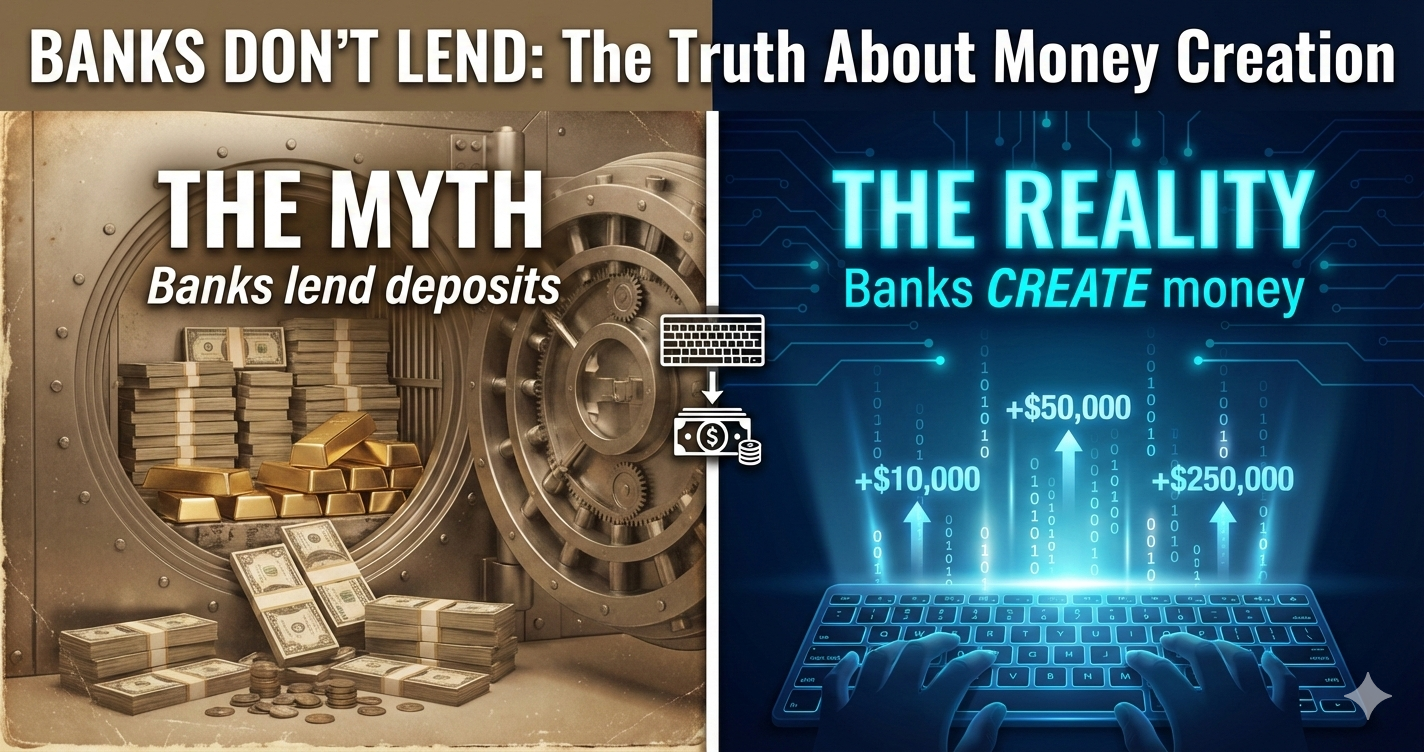
BANKS DON’T LEND YOU MONEY THEY TYPE IT INTO EXISTENCE
Banks DON’T Lend Money They CREATE It Out of Thin Air Your bank balance isn’t “stored cash.” Legally, it’s a loan TO the bank. When you borrow, banks don’t lend deposits—they type NEW money into existence. The Shocking Banking Truth Central Banks Finally Admitted You’ve heard the story your whole life: You deposit money → Bank lends it → Economy grows. WRONG. That’s the textbook fairy tale. Here’s the legal + economic reality: Your “deposit”? Not cash in a vault. It’s YOUR loan to the bank you’re their unsecured creditor. Bank “loans”? Not lending pre-existing money. Banks BUY your promissory note (IOU) and CREATE a matching digital deposit on the spot. Result: 97% of all money is bank-created deposits, not physical cash or savings. Bank of England (2014): “Commercial banks create money, the reverse of the sequence described in textbooks.” Professor Richard Werner (first empirical proof): “Banks don’t take deposits and don’t lend money. They’re in the business of purchasing securities.” Why This Creates Endless Debt + Housing Bubbles When banks create money mainly for: ✅ Productive businesses → Real jobs, growth ❌ Real estate speculation → Price bubbles, inequality Most lending today? Mortgages + asset flips. Result: House prices 8-10x average incomes. Debt grows 3x faster than wages. The fix? Channel credit to productive uses, not asset gambling. 3 Immediate Actions You Can Take TODAY Reframe your bank balance It’s the bank’s IOU, not “your money stored safely” Diversify banking Use credit unions/community banks that lend locally/productively Borrow strategically Only for income-generating assets, never consumption Want the full 2,800-word breakdown + 9-step action plan? Keep reading below 👇 What blew YOUR mind most? “Deposits = loans TO banks” Banks create 97% of money supply Or something else? Drop it in comments + tag a friend still believing the banking myth! 👇
-

Do Banks Really Create Money From Nothing?
In today’s banking system, most of the money in circulation is created not by governments but by commercial banks when they issue loans. Instead of simply lending out existing deposits, banks create new deposit balances in borrowers’ accounts, expanding the money supply in the process. This modern view of money creation, now acknowledged by central banks and supported by empirical research, challenges traditional textbook stories about banks as mere intermediaries and reveals how credit, regulation, and monetary policy actually shape our economies.