
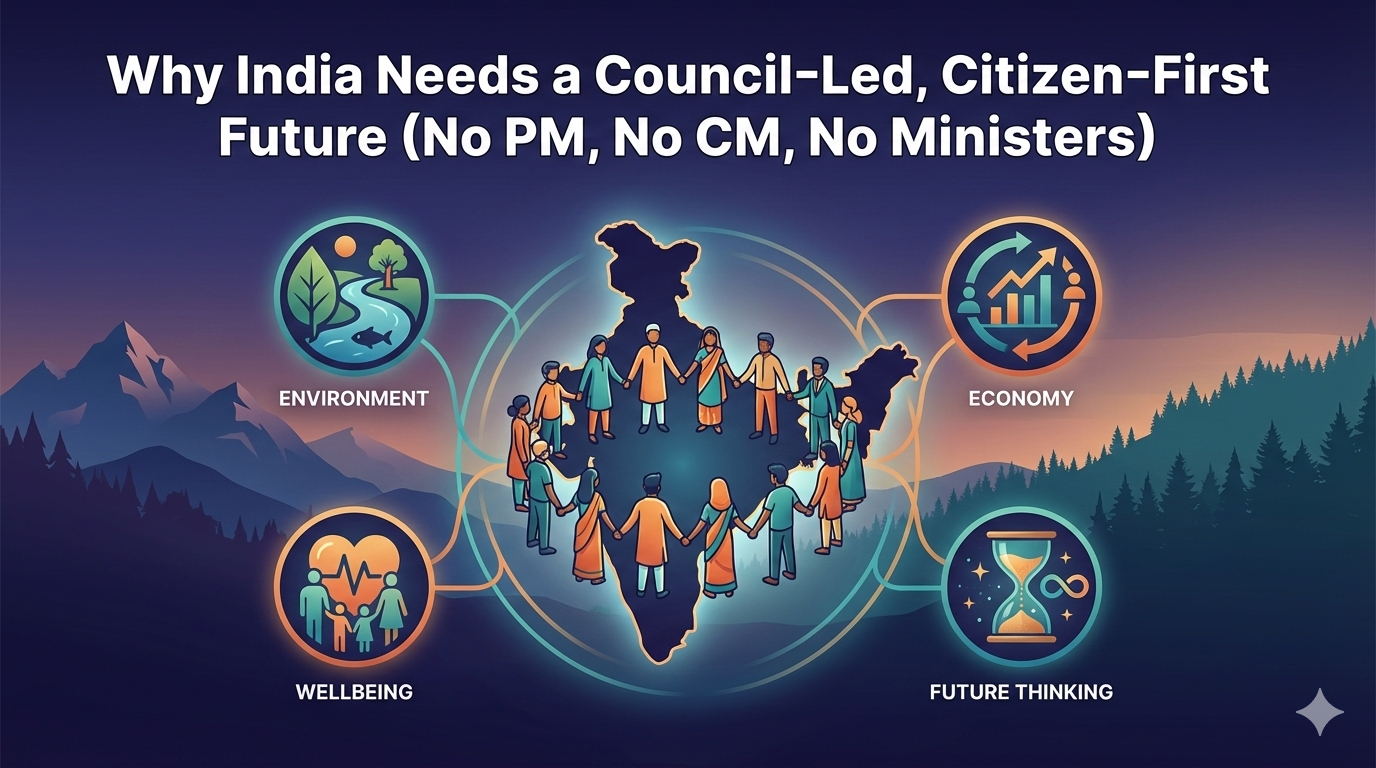
What if India had NO Prime Minister, NO Chief Ministers, and NO “Ministers” at all and citizens truly sat at the top?
A bold governance reboot is possible: a federal India run by rotating councils, guided by wellbeing and the future, with citizens holding the ultimate veto. Not fantasy this draws real inspiration from Switzerland’s collegial Federal Council and Finland’s wellbeing‑economy and futures governance work.
Why This Idea Matter
You can feel it.
The “strong leader” model is breaking down.
We have: centralised power, personality politics, and short‑term decisions that often ignore wellbeing, environment, and the long‑term future. Budgets chase growth; citizens chase survival.
Meanwhile, some countries are quietly experimenting with something VERY different:
- Switzerland has no Prime Minister; a 7‑member Federal Council acts as a shared head of state and government, with a president who rotates yearly and is only first among equals.
- Finland is building an “Economy of Wellbeing”, where economic policy must support human and ecological wellbeing, with dedicated governance tools to make that real.
- The Finnish Parliament even has a Committee for the Future that reviews long‑term issues and responds to the government’s Future Report essentially, a built‑in futures think‑tank inside Parliament.
Now imagine combining these ideas for India
But going further:
No PM.
No CMs.
No individual “ministers”.
Just federal councils, citizen power, and wellbeing‑driven, future‑oriented governance.
What’s Actually New Here?
Here’s what this model does differently from what India has today:
- Replaces single heads with rotating councils at Centre and States, like Switzerland’s Federal Council but adapted to India’s scale.
- Hard‑wires wellbeing and environment into economic planning, following Finland’s wellbeing‑economy work and indicator frameworks.
- Builds permanent “Future” institutions that force every big decision to face long‑term questions drawing on Finland’s Committee for the Future model.
- Empowers citizens directly with Swiss‑style referendums and initiatives plus citizen assemblies and participatory budgeting.
- Removes “government vs opposition” theatre and replaces it with consensus‑driven, power‑sharing federal councils.
If you read this aloud, it should feel like this:
Less drama.
More dignity.
Less personality cult.
More shared responsibility.
Let’s break it down step by step.
1. Why Opt for “No Prime Minister, No Chief Minister, No Ministers”?
1.1 The problem with one‑person executive power
When you centralise power in one person (PM/CM) and their tight inner circle, several patterns tend to repeat:
- Personality over policy: Charisma and media presence overshadow slow, systemic thinking.
- Short‑termism: Election cycles push quick wins over decades‑long wellbeing or climate outcomes.
- Overload: One office becomes a bottleneck; complex federal country, single executive nerve centre.
- Adversarial politics: The “ruling side vs opposition” structure rewards conflict, not collaboration.
Even in well‑run systems, this structure makes it easy to personalise blame and hero‑worship, instead of building shared responsibility.
1.2 What we learn from Switzerland’s collegial executive
Switzerland took a different route.
- The Federal Council is a 7‑member collegial cabinet, elected by Parliament; together they form the collective head of state AND government.
- There is no Prime Minister. The president of the Swiss Confederation rotates annually and is merely first among equals.
- Each member runs a federal department, but decisions are taken collectively and supported collectively.
This structure:
- Dilutes personality cult and centralised ego.
- Forces power‑sharing between parties and regions.
- Works well with direct democracy tools, because citizens can correct or guide decisions collectively.
1.3 What we learn from Finland’s wellbeing‑focused governance
Finland is doing something equally radical but in the content of decisions, not just the structure:
- It is building a governance model for a wellbeing economy, where policy and budgets are tested against wellbeing impacts, not just GDP.
- The Ministry of Social Affairs and Health and the Finnish Institute for Health and Welfare (THL) are creating steering models and indicator sets for wellbeing, integrating social, economic, and environmental sustainability.
- The Parliament has a Committee for the Future, mandated to respond to the Government’s Future Report and to examine long‑term issues like energy, climate, and Agenda 2030.
Finland shows that you can institutionalise long‑term thinking and wellbeing instead of relying on “good leaders” to suddenly become visionary.
1.4 So why should India adopt a no‑PM/no‑CM model?
Because a federal, diverse, 1.4‑billion‑strong India needs:
- Shared leadership instead of centralised charisma.
- Wellbeing‑driven budgets instead of growth at any cost.
- Future‑proof institutions instead of reactive politics.
- Citizens as the true head of the system, not just voters every five years.
Removing PMs/CMs and replacing them with rotating councils tied to wellbeing and future‑oriented institutions aligns structure with values.
2. The Proposed Model: Citizen‑First Federal Councils for India
Let’s give this a name:
The Citizen‑First Federal Council Model.
2.1 Core principles
- Federalism with real decentralisation
- Collegial councils instead of single heads
- Rotation instead of permanent “top posts”
- Wellbeing and environment integrated into budgeting
- Future‑oriented institutions embedded in Parliament and States
- No formal opposition only shared responsibility and citizen oversight
2.2 System overview at three levels
Central (Union)
- A Union Collegial Council (UCC) of 7–9 members, elected by a joint sitting of Parliament using proportional representation of national vote shares.
- The chair rotates yearly among UCC members no Prime Minister.
- The UCC is the collective head of state and government.
States
- Each State has a State Collegial Council (SCC) with 5–7 members, elected by the State Assembly by proportional representation of parties.
- The state chair rotates yearly no Chief Minister.
Local bodies
- Districts, municipalities, and panchayats have small executive boards (3–5 members) instead of “one Mayor/one Sarpanch as supreme boss”.
3. How Wellbeing, Social, and Environmental Factors Enter the Heart of Power
3.1 From “Economy” to “Wellbeing Economy”
Inspired by Finland’s work on a wellbeing economy, India can redesign how decisions are evaluated.
Key innovation:
- Create a Wellbeing Economy Framework Law at the Union and State level:
3.2 Wellbeing Impact Assessments (WIAs)
Finland is developing tools to assess the broad wellbeing impacts of policy decisions.
India could:
- Require WIAs for all major laws and budget lines.
- Publish WIAs openly on a public platform, so citizens and researchers can scrutinise them.
Imagine reading the Union Budget and seeing, alongside revenue and deficits:
- Effects on child nutrition.
- Effects on air quality.
- Effects on mental health and community cohesion.
That’s a different game.
4. Future‑Oriented Governance: Bringing Tomorrow into Today’s Politics
4.1 A National Council for the Future (NCF)
Finland’s Committee for the Future is a powerful reference point.
For India, we design:
- A National Council for the Future, established by the Constitution.
- Members: MPs from all major parties, representatives from States, scientists, youth, and citizen delegates.
- Duties:
4.2 State Futures Committees
Each State Assembly gets its own Futures Committee, modelled on Finland’s Parliament committee.
They:
- Analyse long‑term impacts of state decisions (water, land use, urbanisation, migration).
- Ensure state budgets and laws align with intergenerational justice and sustainability.
This makes “future thinking” a routine part of state politics, not a side conference.
5. Putting Citizens on Top: Direct Democracy + Assemblies
5.1 Swiss‑inspired citizen tools
Switzerland gives citizens strong instruments to shape and block laws.
For India, adapted carefully:
- Citizen‑Initiated Referendums
- Citizens can propose a law or constitutional amendment with a defined threshold of signatures.
- Optional Referendum on Passed Laws
- Mandatory Referendums on major constitutional changes
This shifts the system from “citizens can complain later” to “citizens can veto and initiate”.
5.2 Citizens’ Assemblies and Participatory Wellbeing Budgeting
Building on global examples of citizens’ assemblies and participatory policy design:
- National and State Citizens’ Assemblies
- Randomly selected, demographically representative citizens.
- Deliberate on big issues (climate, education reforms, health priorities, digital rights).
- Provide recommendations that Parliament must debate in public.
- Participatory Budgeting for Wellbeing
- A fixed share of Union, State, and local budgets is allocated through citizen input (online and offline), focused on wellbeing projects.
This is where citizens stop being “data points” and become co‑designers.
6. No Opposition – But Stronger Accountability
“No opposition” doesn’t mean “no criticism”.
It means no structural incentive to block everything just because it comes from “the other side”.
6.1 Consensus instead of confrontation
Drawing from consensus democracy theory and Swiss practice:
- The UCC and SCCs include all significant political forces by design (proportional election by assemblies).
- Decisions often require super‑majorities or consensus, not a narrow 51%.
6.2 Where does accountability come from?
- Courts and Ombuds institutions for legality and rights.
- Direct democracy for citizen veto and initiative.
- Future and wellbeing bodies (NCF, Futures Committees, WIAs) for long‑term scrutiny.
- Radical transparency: open data, public WIAs, recorded and accessible council debates.
So you lose the performance politics of opposition walkouts, but gain structured, continuous oversight built into the system.
7. Step‑by‑Step Actionable Roadmap for India
This is where it gets practical.
Let’s talk HOW, not just WOW.
Phase 1: Design & Pilot (Years 1–3)
1. Build a National Commission on Federal Futures & Wellbeing
- Include constitutional experts, economists, environmentalists, public health experts, technologists, and citizen representatives.
- Task: draft
2. Pilot Wellbeing Budgeting and Futures Committees in a Few States
- Choose 2–3 volunteer states.
- Introduce:
- State‑level WIAs for key policies.
- State Futures Committees in Assemblies.
- Collaborate with research bodies and think‑tanks for indicators and methodologies, mirroring Finland’s THL projects.
3. Build a Digital Participation Platform
- National “India Wellbeing & Future Portal”:
- Hosts WIAs, futures reports, draft bills.
- Allows petitions, feedback, and pilots of citizen deliberation.
- Design following global e‑democracy practices of open, collaborative platforms.
Phase 2: Constitutional & Legal Change (Years 4–7)
4. Constitutional Amendments
- Introduce amendments to:
5. Wellbeing Economy & Transparency Laws
- Pass a Wellbeing Economy Act:
- Pass a Citizen Participation and Transparency Act:
6. State‑Level Council Pilots
- A few states formally transition from CM + Cabinet to SCC‑based governance under the new constitutional provisions.
- Evaluate impacts on stability, policy quality, and citizen satisfaction.
Phase 3: Full System Transition (Years 8–12)
7. Nationwide Move to Councils (No PM, No CM)
- The Union transitions to a UCC with rotating chair; the office of PM ceases.
- All States shift to SCCs; CMs become history.
- Ministries reorganised into Thematic Wellbeing Departments reporting to councils collectively.
8. Full Rollout of Direct Democracy and Futures Governance
- Citizen initiative and referendum rights come into effect nationally and in all states, with thresholds calibrated by population.
- NCF and State Futures Committees fully active; every major budget/yaw must pass future scrutiny and wellbeing assessments.
Phase 4: Deepening and Refinement (Years 13+)
9. Strengthen Local Autonomy & Participatory Budgeting
- Gradual increase of fiscal autonomy for local governments, linked to wellbeing performance indicators.
- Participatory budgeting scaled across large cities and districts, driven by citizen assemblies and digital tools.
10. Continuous Learning & International Networking
- India collaborates with wellbeing‑economy and futures‑governance frontrunners Finland, Scotland, New Zealand, Wales, others.
- Regular independent evaluations of the governance model, with adjustments made publicly and transparently.
Sources of Inspiration (with Credit)
This vision doesn’t come out of thin air. It stands on the shoulders of serious work already happening around the world:
- Switzerland’s Federal Council and Direct Democracy – a collegial executive with no Prime Minister, rotating president, and strong citizen tools for referendums and initiatives.
- Finland’s Wellbeing‑Economy Governance – efforts led by the Ministry of Social Affairs and Health and THL to create governance models, indicator sets, and decision tools for a wellbeing economy.
- Finland’s Committee for the Future – a permanent parliamentary committee that handles government Future Reports and long‑term policy perspectives.
These examples show that pieces of this model are not utopian they already exist and are evolving in real countries today.
So… Would India Be Ready for This?
A council‑led, citizen‑first, wellbeing‑driven India would be a massive shift in political culture.
But the payoff?
Less drama, more depth.
Less personality cult, more shared wisdom.
Less short‑termism, more future‑proofing.
What do you think should India seriously explore a no‑PM, no‑CM, council‑based model where citizens truly sit at the top?
Comment below with your thoughts and questions
and if you’d like to go deeper into this model, comment “COUNCIL” and I’ll share a detailed community resource link.
Tag a friend who loves governance, policy, or big ideas.
And follow for more future‑of‑democracy breakdowns and India‑focused governance frameworks.
Leave a Reply