
You Can Choose
Any Lane — But The
Road Only Goes
One Way.
How systems control your behaviour without ever removing your freedom of choice — and the 5 profound insights most people never realise.
Here’s the thing nobody tells you — freedom and control are not opposites. They are partners. And they have been working together this entire time, keeping you productive, compliant, and pointed in a very specific direction.
This isn’t a conspiracy theory. It’s systems architecture. And once you see it — you cannot unsee it.
The most sophisticated form of control doesn’t restrict your choices. It designs your environment so that your free choices naturally produce a specific outcome. Welcome to the world of structured freedom.
The Highway Nobody Told You About
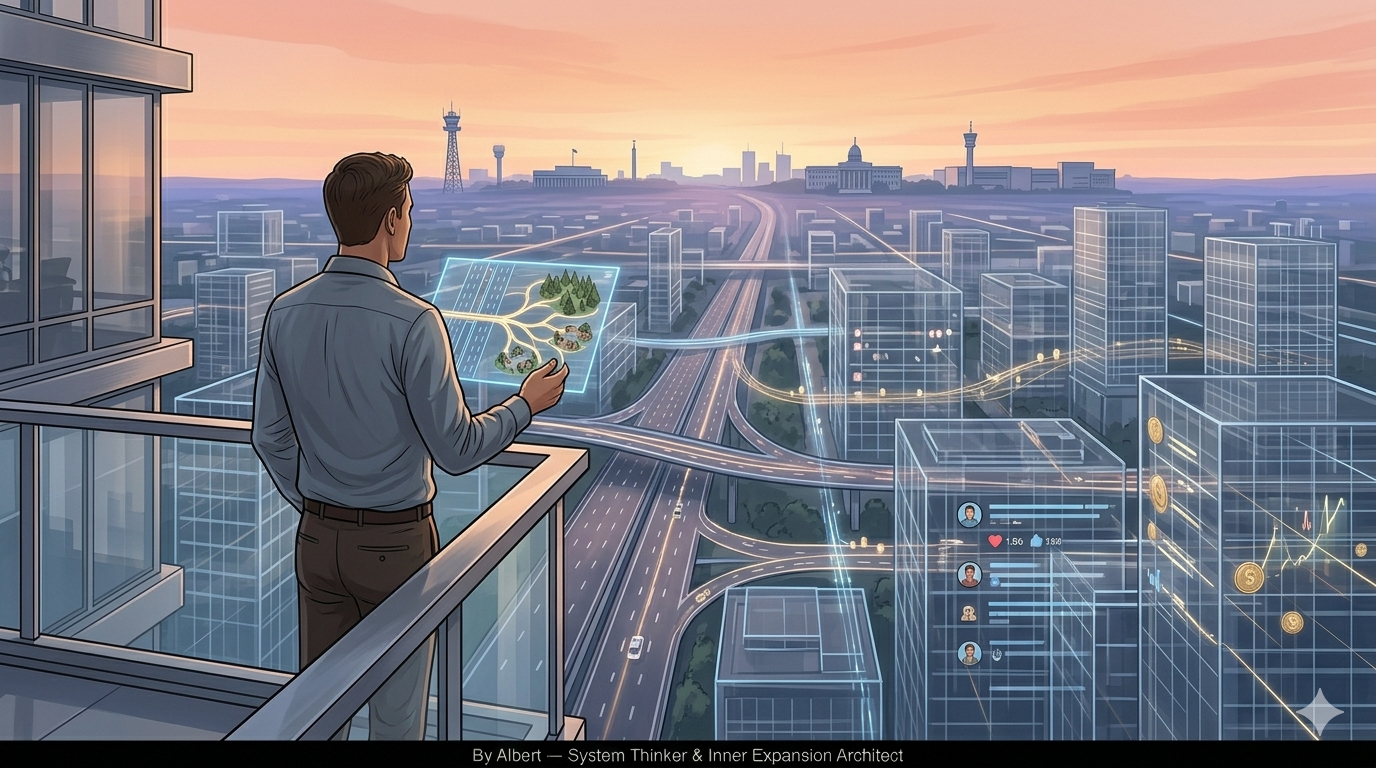
Picture a six-lane highway. You pick your car. You pick your lane. You choose your speed. You decide when you switch lanes, which music plays, whether you stop for gas at Shell or BP.
Complete freedom. Total autonomy.
But here’s the catch — the road only goes one direction. North. Always north. The destination was never your decision.
Ezekiel Bread?
🍞 Your call.
Always
toward GDP
or evening grind?
⏰ Your call.
or Walmart?
🛒 Your call.
Always
toward consumption
Android?
📱 Your call.
This metaphor — clean, devastating in its simplicity — is the lens through which every social system, economic policy, and institutional design makes total sense. They don’t want to tell you what to do. They want to build roads that only go where they need you to go.
What Most People Never Realise
These are not surface-level observations. These are the structural truths hiding under every system you participate in — economic, social, digital, biological. Read slowly.
Most people think control and freedom are binary — you’re either free or you’re controlled. This is the first and biggest misconception.
The truth: Systems grant genuine freedom at the level of options, while controlling outcomes at the level of structure. You genuinely get to choose which grocery store, which brand, which career path inside your industry. But the system only offers grocery stores, brands, and industries that serve its macro-objectives.
Governments don’t dictate that you buy Wonder Bread. They build an entire agricultural subsidy structure, a retail distribution network, and a food marketing ecosystem that ensures you’ll buy some bread — and that someone profits when you do. Your individual choice is real. The economic outcome is predetermined.
The insight: You are most controllable precisely when you feel most free. Real agency requires understanding the structure of the road, not just the lane you’re in.
Here’s where people get confused. They hear “control” and they think “manipulation.” But the system doesn’t need to manipulate you if it designs the terrain correctly.
Consider tax policy. You’re “free” to spend your income however you like. But mortgage interest deductions incentivise homeownership. 401(k) tax advantages incentivise retirement savings. These aren’t orders. They’re architectural nudges — structural rewards for moving in a particular direction.
The insight: Power doesn’t command. It architects incentives. The most elegant form of control requires no enforcement — just design. When the incentive landscape is shaped correctly, the masses self-organise in the desired direction, voluntarily and happily. This is why nudge theory (Thaler & Sunstein) won a Nobel Prize. It formalised what systems have known for centuries: you don’t need to tell people what to do — just make the desired behaviour the path of least resistance.
The most invisible form of control is curation. Not selecting what you choose — but selecting what you get to choose from.
Think about a restaurant menu. You’re free to order anything on it. But the chef decided what’s on the menu. The restaurant decided what ingredients to stock. The distributor decided what to supply. The agricultural industry decided what to grow. You experience pure freedom at the point of ordering. You never see the thousand upstream decisions that shaped your “free” menu.
This operates at every level of modern life. The jobs that “exist” in an economy are pre-curated by capital flows. The political candidates you “freely” vote for are pre-filtered by party structures and donor economics. The content your algorithm “recommends” is curated by engagement metrics optimised for platform profit.
The insight: The menu is the message. Before you make a single choice, the system has already made a thousand choices about what choices you get to make. Awareness of the menu-design process is the prerequisite to actual freedom.
Direct coercion creates resistance. Resentment. Rebellion. But give someone genuine choice within a structured channel — and they defend the system that contains them.
This is the masterstroke of structured freedom: people who feel they chose their lane don’t question whether the road was their choice too.
This psychological phenomenon is well-documented. When we make a choice — even a small one — we feel ownership. We feel agency. We feel responsible. This feeling of ownership inoculates us against questioning the broader structure. “I chose this career.” “I chose to buy this house.” “I chose this lifestyle.” The micro-choices feel so real that the macro-direction goes unquestioned.
The fast-food industry doesn’t tell you to eat there. It gives you 47 items on the menu and calls it freedom. Political systems don’t tell you which party to support. They give you two nearly identical options and call it democracy. Digital platforms don’t tell you what to think. They give you an infinite scroll of algorithmically curated content and call it personalisation.
The insight: The more choices you have within a system, the less likely you are to question the system itself. Choice is simultaneously the gift and the cage.
Here’s the part this blog is really about. Because understanding the problem is only valuable if it points toward something actionable.
Systems are not inherently malevolent. Many of the structures we live inside — healthcare incentives, traffic systems, economic markets — produce genuinely useful outcomes for most people most of the time. The highway gets you somewhere. That somewhere might even be where you want to go.
But awareness is the difference between a passenger and a driver. Between someone who ends up somewhere and someone who chose to go there.
The insight: You cannot exit a highway you don’t know you’re on. Awareness doesn’t automatically free you from systems — but it gives you the ability to evaluate whether this particular road is going where YOU want to go. And if it isn’t, to find, build, or design the off-ramp. This is inner expansion work. It’s the hardest, most countercultural thing a person can do in a world architecturally designed to keep you productive, consuming, and heading north.
So What Do You Actually Do About It?
Awareness without action is just anxiety with a vocabulary. Here is a practical, step-by-step framework for developing genuine agency inside systems — not by destroying them, but by understanding them clearly enough to move intentionally within them.
Think of it as learning to read the road sign before you’re already three exits past where you needed to turn.
-
01
Map the Highway You’re Currently On
For each major life domain — career, finances, relationships, health, identity — write down the structure you’re operating inside. What are the rules? What is the assumed destination? Who built this road and why? Most people have never explicitly named the systems governing their choices. Name them first. You cannot work with what you cannot see.
-
02
Audit Your Incentive Landscape
For every domain, ask: What behaviours am I rewarded for? What behaviours are penalised? Who designed those rewards and penalties? Your salary structure, your social media engagement, your tax bracket — all of these are incentive architectures. Write them down. When you see your incentive landscape clearly, you’ll understand why you do 80% of what you do without “deciding” to.
-
03
Question the Destination, Not Just the Lane
This is the most uncomfortable step. Instead of asking “Which job should I take?” — ask “Why does a career ladder point in this direction, and do I actually want to go there?” Instead of “Which house should I buy?” — ask “Who benefits from me being a homeowner, and is that aligned with how I want to live?” This isn’t nihilism. It’s due diligence on your own life.
-
04
Deliberately Design Your Own Incentive Architecture
Once you understand external systems, build internal ones. What environment do YOU need to naturally move toward your actual goals? This might mean changing your social circle (because humans are profoundly incentivised by social belonging), your information diet, your physical space, your financial structure. Build the road that goes where you want to go. This is what high-performance people do intuitively — and what systems thinkers do deliberately.
-
05
Find Your Off-Ramp — Then Help Others See Theirs
Some highways are worth staying on. Some need you to exit. The point isn’t to reject all systems — it’s to choose consciously which ones you participate in and on what terms. Once you’ve done this work, share it. Not preachily. Just by living as a demonstration that the road has exits, and that you used one. People who’ve never seen an off-ramp can’t imagine one exists. Be visible evidence that it does.
The deepest freedom isn’t found by escaping systems. It’s found by understanding them so completely that you can move through them on your own terms. You can drive north on the highway by choice — or you can take the exit that everybody else missed.
The Real Revolution Is Perceptual
Let me be direct: the people who designed these systems aren’t your enemy. They’re doing exactly what any entity with power, reach, and objectives would do — building roads that move the largest number of people in the most useful direction, as efficiently as possible.
Your government isn’t evil for wanting GDP. Your employer isn’t sinister for wanting productivity. The algorithm isn’t conspiring — it’s optimising. For THEM. As it should, from their perspective.
The question is simply whether you are also optimising for yourself.
Because here’s the thing — you get to. Nobody’s stopping you from asking where this road goes. Nobody’s stopping you from finding the exits. Nobody’s preventing you from building a different vehicle, or even a different road.
The only barrier is seeing it clearly. And now you do.
So here’s your question — and I genuinely want to know your answer: Which highway are you on right now? And when did you last check where it was taking you?
“You Can Choose Any Lane But The Road Only Goes One Way” — Medium
— and from the broader systems framework developed at albertyzacharia.in/not-the-official-guide
Academic grounding: Thaler & Sunstein, Nudge (2008) | Kahneman, Thinking, Fast and Slow (2011) | Foucault, Discipline and Punish (1975) | Barry Schwartz, The Paradox of Choice (2004).
Ready to Find
Your Off-Ramp?
If this essay cracked something open for you — you’re not alone. This is the beginning of a much deeper conversation about systems, self-design, and genuine freedom.
💬 Comment below — tag a friend who needs to see this — or follow for more systems thinking you won’t find in the mainstream.
Leave a Reply