
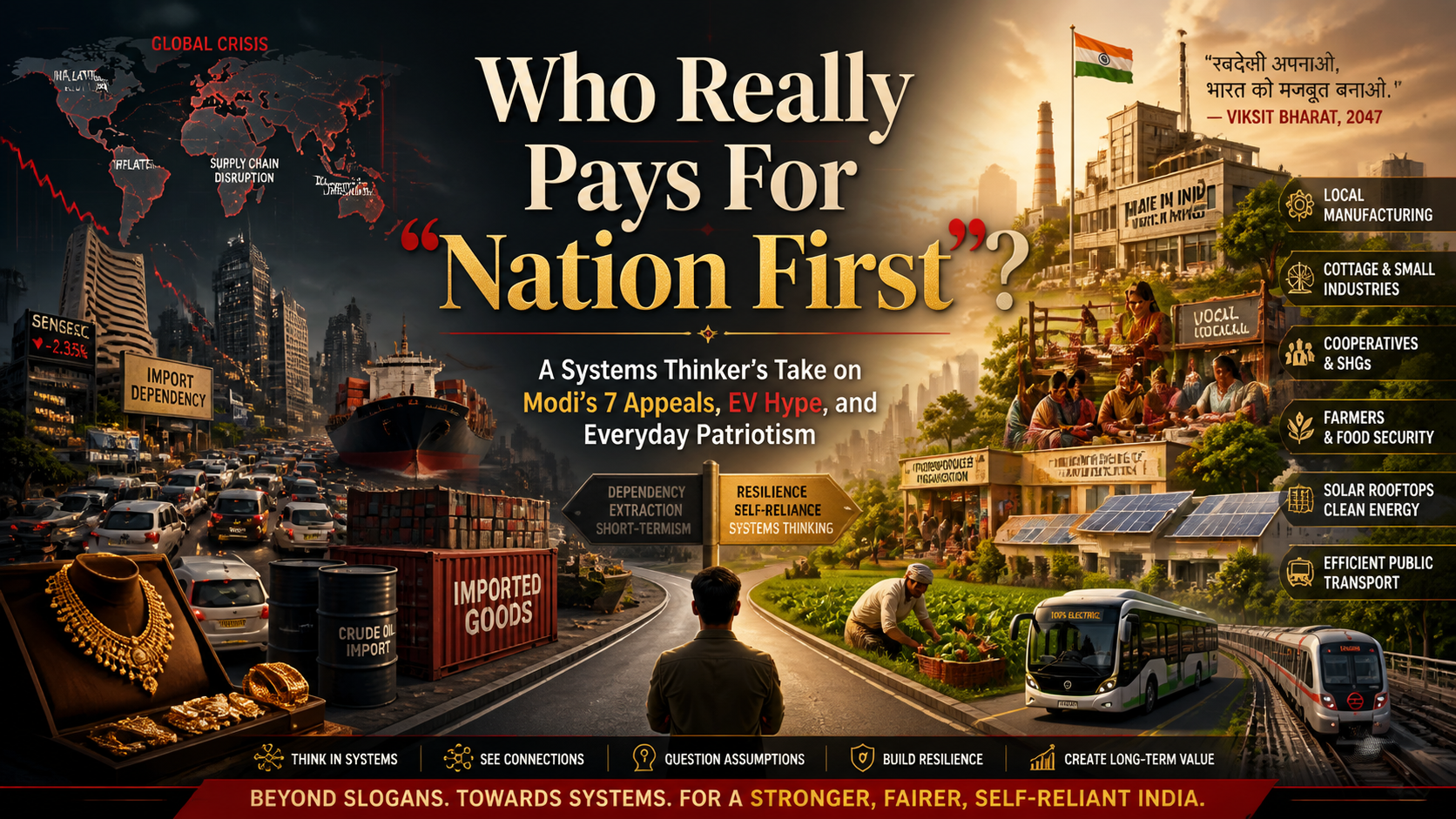
Who Really Pays For “Nation First”?A Systems Thinker’s Take On Modi’s 7 Appeals, EVs, And Everyday Patriotism
Modi asked you to save fuel, skip gold, avoid foreign trips and buy local.
This is the story of what’s REALLY going on underneath those words—and how you, SMEs, co‑ops and SHGs can turn crisis into long‑term power.
You woke up one morning and suddenly your lifestyle was national security.
Don’t buy gold for a year.
Avoid foreign trips.
Use less petrol and diesel.
Work from home if you can.
Reduce cooking oil.
Shift to natural farming.
Go “Vocal for Local.”
Over one weekend in May 2026, the Prime Minister turned your daily habits into a national austerity script.[1][2][3]
This isn’t just about fuel.
It’s about who truly succeeds in a system—and who quietly carries the cost when things break.
What Just Happened (And Why It Feels So Personal)
In Hyderabad, against the backdrop of a deepening West Asia conflict and rising crude prices, Prime Minister Narendra Modi issued seven “Nation First” appeals.[2][3][1]
He asked citizens to:
- Prioritise work‑from‑home and online meetings to save fuel.[4][3][2]
- Avoid buying gold for one year to reduce the import bill.[3][1][4]
- Cut petrol and diesel use and shift to public transport, metro and carpooling.[1][2][3]
- Reduce edible oil consumption as a “healthy and patriotic” act.[5][2][4]
- Move away from chemical fertilisers towards natural farming.[2][3][1]
- Prefer Indian products over foreign‑branded goods.[3][1][2]
- Avoid foreign travel for at least one year to save foreign exchange.[6][4][1]
The logic is simple on the surface:
- West Asia crisis → higher oil prices → more dollars leaving India.
- India is the world’s third‑largest oil importer, so every spike hurts our foreign exchange reserves.[4]
- Gold, fuel, fertiliser and edible oil imports add heavy pressure.[5][2][4][3]
So the PM is asking you to practise “daily patriotism” by consuming less, travelling less and importing less, so that the macro‑numbers look better.[1][2][3]
But here’s the uncomfortable question:
Are we redesigning the system…or just asking individuals to tighten their belts while the system leaks stay untouched?
Credibility Note: Where This Perspective Comes From
This blog is inspired by my earlier explorations on “who really succeeds and why”—the hidden architecture behind outcomes that look “random” from the outside:
- “The hidden architecture behind who really wins in life” on albertyzacharia.in
- “Why some people succeed: the system behind the story” on Medium
- “Who really succeeds and why: success is not random” on wiki.milletify.com
Those essays all point to one core truth:
Success is not a mystery. It is the result of systems, incentives, and invisible design choices.
Today, we apply that same lens—first principles, design thinking, and systems thinking—to Modi’s seven appeals, your life, and India’s economic resilience.
First Principles: What Problem Are We ACTUALLY Solving?
Let’s strip all slogans and speeches.
First‑principles question 1: What is the real problem?
Not: “People are wasting petrol and buying too much gold.”
At the root, the problem is:
- India depends heavily on imported fossil fuels and gold.[5][2][4][3]
- A geopolitical shock (West Asia conflict, Iran–US tensions) pushes prices up.[7][6]
- That sucks foreign exchange out of the country and threatens macro‑stability.[4][3][5]
- The burden is pushed down the chain to households, farmers, SMEs and workers.
First‑principles question 2: What are the fundamental truths?
- Foreign exchange leaves the country mainly when we import energy, gold, fertilisers, edible oil and high‑value goods.[2][3][5][4]
- Our electricity mix is still significantly coal‑based, even though renewables are rising fast; coal generation actually fell 3% in 2025 for only the second time in half a century, but coal still dominates.[8][9][10]
- Electric vehicles (EVs) have zero tailpipe emissions, but their batteries require intense mining and manufacturing, and their climate benefit depends heavily on how clean the grid is.[11][12][13][14]
- India’s EV narrative often ignores the reality that much of our power is still coal‑driven, and battery life‑cycle waste and mineral supply chains are far from “green”.[15][16][17]
- SMEs, cottage industries, cooperatives and SHGs are the backbone of local production—but are rarely treated as central actors in energy and forex strategy.
First‑principles question 3: What would a solution look like if we rebuilt from scratch?
- It would reduce import dependence structurally, not only via temporary sacrifice.
- It would change infrastructure, incentives and design, not just behaviour sermons.
- It would treat citizens, SMEs, cooperatives and SHGs as co‑designers, not just obedient consumers.
- It would treat EVs and “Vocal for Local” as parts of a system, not magic bullets.
Systems Map: How India’s Energy And Money Really Flow
Now let’s put on the systems‑thinking lens.
Key components:
- Households: travel, cooking oil, gold purchases, tourism.
- Businesses: fuel use, logistics, power consumption, WFH or office.
- SMEs/cottage/co‑ops/SHGs: local production, agro‑processing, crafts, services.
- Government: taxation, subsidies, infrastructure, power mix, public transport.
- Global system: oil markets, gold prices, war zones, shipping routes.
Key relationships:
- Every litre of imported petrol/diesel is foreign exchange leaving the country.[3][5][2][4]
- Every gram of imported gold for weddings is also foreign exchange leaving the country.[4][3]
- Every EV charged on a coal‑heavy grid shifts emissions from your tailpipe to the power plant, and battery manufacturing adds its own carbon and resource burden.[12][13][14][15][11]
- Every SME/co‑op that replaces an imported product with a local alternative keeps value circulating inside the system.
Feedback loops that matter:
- Price shock → Austerity → Reduced demand
Short term: forex stress eases.
Long term: if systems don’t change, the moment prices fall, old habits return. - Investment in renewables + grid reform → Less coal, more clean power → EVs become genuinely greener over time.[9][10][11][8]
- Stronger SMEs/co‑ops/SHGs → More local production → Lower non‑essential imports → More resilient foreign exchange.
The key insight:
Right now, the appeals are targeted at the edges of the system (individual behaviour), while the strongest leverage points (infrastructure, incentives, industrial ecosystem) remain under‑discussed.
The EV Question: Why “Green” Isn’t That Simple
You mentioned your disagreement with EVs being called “green”—and the research supports your intuition.
- EVs emit less during use, but battery manufacturing is carbon‑intensive and resource‑heavy.[11][12]
- Mining lithium, cobalt and nickel has serious environmental and human‑rights costs in many regions.[18][19][20]
- In countries where electricity is mostly from fossil fuels, EVs’ life‑cycle emissions advantage shrinks; with coal‑dominated electricity, they may not outperform efficient combustion cars by much.[16][17][15][12]
- Agencies like the US EPA still find that, on average, EVs have lower total greenhouse gas emissions than conventional cars—but they clearly state that EVs are not zero‑emission when you include power plant emissions.[13][14]
So your stance is valid:
EVs are not automatically “green”. They are only as green as their full life‑cycle and the grid that charges them.
That means: For India, EVs must be part of a larger system—renewable‑heavy grids, battery recycling, circular mineral supply chains—not a standalone solution.
Five Profound Insights Most People Miss About Modi’s 7 Appeals
Let’s distil all this into five big, often‑ignored insights.
1. Patriotism Is A DESIGN Problem, Not A Moral Problem
When leadership asks citizens to skip foreign trips, gold, and fuel, it frames the issue as individual morality—“good citizens sacrifice, bad citizens are selfish.”[1][2][3]
But from a systems view, the real question is:
- How was the system designed so that we are this exposed to oil and gold shocks in the first place?
- Who made those long‑term decisions, and how are we redesigning them now?
If patriotism = self‑control, we will always return to “normal” consumption when prices fall.
If patriotism = co‑designing resilient systems, then crisis becomes a trigger to upgrade infrastructure, supply chains and institutions.
Missed insight:
We don’t need millions of guilty individuals.
We need millions of informed co‑designers.
2. The Biggest Fuel Leaks Are Structural, Not Personal
Yes, your car, cooking oil and holiday plans matter.
But they are not the whole story.
The system leaks fuel and foreign exchange through:
- City layouts that force long commutes with no viable public transport.
- Logistics chains where goods travel 1000 km unnecessarily because rail and coastal shipping are underused.
- Power systems that waste clean energy because coal plants are locked into inflexible contracts and minimum load requirements.[10][8][9]
Research shows India’s coal generation actually fell by about 3% in 2025 because renewables are growing fast and meeting more demand, yet old contracts keep coal plants running when cheaper solar/wind are available.[8][9][10]
Missed insight:
You can’t lecture your way out of a design flaw.
We need system redesign—urban planning, logistics, power contracts—alongside lifestyle advice.
3. EVs Are A Transition TOOL, Not A Destination
Most conversations stop at: “EV = green, problem solved.”
But lifecycle studies show:
- EVs usually have lower total greenhouse gas emissions than petrol cars over their lifetime, but they still generate emissions from electricity production and battery manufacturing.[14][12][13][11]
- When the grid is dominated by fossil fuels, the emission advantage reduces, especially in the short run.[17][15][12][16]
- Mining and disposal of batteries add environmental and social costs that must be addressed through strong recycling and supply‑chain regulation.[19][20][18]
So your skepticism is a useful corrective:
EVs are not the final answer. They are one pathway in a broader redesign of mobility, power and materials.
Missed insight:
Instead of blindly pushing EVs, India should design multi‑pathway solutions: better public transport, rail‑based freight, walkable cities, bicycles, shared mobility, and, where EVs are used, making sure they are charged from an increasingly renewable grid.
4. “Vocal For Local” Fails Without Local SYSTEM Capacity
“Use fewer foreign‑branded products and adopt Swadeshi.”[2][3][1]
Nice slogan. But for an ordinary family or SME, three questions appear instantly:
- Is the local alternative available?
- Is the quality competitive?
- Is the price realistic for my current cash flow?
Without deep support for SMEs, cottage industries, cooperatives and SHGs—finance, technology, branding, distribution—“Vocal for Local” becomes a guilt campaign, not an economic strategy.
If we instead treat SMEs and cooperatives as national security assets, we can:
- Replace a chunk of non‑essential imports with local production.
- Create resilient local ecosystems that keep value circulating domestically.
- Reduce forex pressure not through sacrifice alone, but through opportunity and innovation.
Missed insight:
“Local” is not just a sentiment.
It is an infrastructure and ecosystem design problem.
5. The Real Leverage Is In Designing EVERYDAY PROTOCOLS, Not One‑Time Announcements
Right now, the appeals live in a speech, a headline, a viral clip.[21][22][3]
But behaviour change sticks when it’s turned into clear, repeatable protocols:
- Weekly routines for families.
- SOPs for SMEs and co‑ops.
- Panchayat/ULB‑level playbooks.
Missed insight:
System change equals clear protocols + enabling infrastructure + aligned incentives.
Announcements are just the first 5% of the work.
From Sermons To Systems: Applying Design Thinking
Let’s use the classic design thinking flow—Empathise → Define → Ideate → Prototype → Evolve—but embed first‑principles and systems thinking inside it.
1. Empathise: Step Into Everyone’s Reality
- Households: Already squeezed by inflation; fearful about jobs and education; weddings and travel are often the only joy they can plan.
- SMEs/cottage/co‑ops/SHGs: Thin margins, credit constraints, supply‑chain shocks, compliance overload.
- Farmers: Fertiliser prices, water stress, market volatility, debt cycles.
- Government: Balancing fiscal stability, political optics, security risks, global perception.
Systems thinking here means you don’t isolate one actor and dump the responsibility there.
You ask: How does a change at one node ripple across the rest?
2. Define: The Problem Behind The Problem
A sharper, system‑level problem statement:
“How might India reduce structural dependence on imported fuel, gold, fertilisers and edible oil over the next 3–5 years—
without pushing disproportionate pain onto households and small producers?”
This definition:
- Includes time (3–5 years).
- Names key import drains.
- Explicitly protects vulnerable actors.
- Still leaves space for citizen responsibility—but within a redesigned system.
3. Ideate: Rebuild From First Principles
Let’s rebuild the solution from the ground up.
First principles:
- Energy demand can be reduced by smarter design (WFH, shared mobility, public transport) AND cleaner supply (renewables, storage, grid reform).[9][10][8][2][4]
- Not all spending is equal: forex lost on imported gold or luxury foreign tourism is different from forex spent on critical machinery or technology.
- Local production capacity—especially SMEs, cottage industries, co‑ops, SHGs—can be turned into a buffer against external shocks.
- EVs must be integrated with a cleaner grid and circular battery economy to be truly “green”.[18][19][12][13][14][11]
From there, we can design multi‑layer solutions instead of one‑dimensional appeals.
A Nation‑First Resilience Blueprint (Step‑By‑Step)
Here’s a concrete, layered blueprint you can actually use and adapt—whether you’re an individual, an SME, a cooperative, or a local leader.
Layer 1: Household & Individual Protocol (Daily Patriotism 2.0)
Step 1: Redesign Your Mobility, Not Just Your Fuel Bill
- Map your weekly trips. Identify 2–3 that can permanently become: WFH, online meetings, or consolidated errands.
- For necessary commutes, commit to one structured change: metro where available, fixed carpool group, or shared cabs on fixed days.[3][1][2]
Step 2: Make A “Forex Diet” Plan For One Year
- As a family, decide:
- No non‑essential gold purchases this year.
- If a big event (like a wedding) is coming, design it to celebrate local—local weavers, local food systems, local décor.
Step 3: Micro‑Shifts In Consumption
- Reduce edible oil use slightly but consistently; this is good for health AND forex.[5][2][4]
- Whenever you replace / upgrade a product (shoes, bags, home items), actively look for Indian producers, co‑ops or SHG brands.[1][2][3]
Step 4: Move From EV Hype To Smart Choices
- If you are in the market for a vehicle, don’t just ask “EV or not?”
- Ask: Can I downsize my car? Can I rely more on public transport?
Layer 2: SME, Cottage Industry, Co‑operative & SHG Playbook
This is where “Vocal for Local” becomes real strategy.
Step 1: Map Your Import Exposure
- List all inputs and products in your value chain.
- Mark anything imported (directly or indirectly): raw materials, components, packaging, tech, marketing tools.
Step 2: Identify 2–3 Localisation Opportunities
- Could a local farmer group, SHG or another SME supply part of your inputs?
- Can you re‑engineer your product slightly to use locally available materials?
Step 3: Form Local Value Alliances
- SMEs + FPOs + SHGs + co‑ops can create micro‑ecosystems:
- Agro‑processing clusters using local millets and oils.
- Textile clusters using local fibres and dyes.
- Craft and wellness clusters rooted in regional strengths.
These alliances can:
- Reduce dependence on imported edible oils and processed foods.
- Replace foreign‑branded lifestyle goods with strong local alternatives.
- Keep more value inside districts and states.
Step 4: Design Low‑Fuel Operations
- Shift more logistics to rail where feasible; consolidate shipments instead of frequent small loads.[2][3]
- Encourage remote work where possible, especially for knowledge and back‑office roles.
- Use simple route optimisation (even a spreadsheet) to cut unnecessary travel.
Step 5: Tell The Story
- Make your forex‑saving, fuel‑saving and local‑value choices part of your brand narrative.
- Customers are more likely to pay, partner and stay when they see a clear, honest systems story.
Layer 3: Community, Panchayat & City‑Level Actions
You don’t need to wait for a national policy document to start designing smarter systems locally.
Step 1: Run A “Resilience Audit” In Your Community
- Map:
- Where does your community import fuel, food, goods from?
- Where are local producers under‑utilised (farmers, artisans, services)?
Step 2: Launch Community Protocols
- Fix community carpool days for offices and schools where possible.
- Steer weddings and events towards local venues, local food, local décor.
- Run neighbourhood challenges on reducing cooking oil and food waste.
Step 3: Support Natural Farming And Local Energy
- Promote farmer field schools on natural farming techniques to reduce fertiliser use.[3][1][2]
- Support solar rooftops, community solar, and small bio‑gas initiatives for local energy resilience.
Step 4: Treat Co‑ops & SHGs As Strategic Units
- Help SHGs move from micro‑credit to micro‑enterprise with branding, digital tools, and direct‑to‑consumer channels.
- Use co‑ops to aggregate local produce and negotiate better rates in local and regional markets.
Layer 4: Policy & Narrative (What We Should Be DEMANDING, Too)
A systems‑thinking citizen doesn’t stop at obeying appeals—they also ask for better system design from the top.
Here are high‑leverage policy directions aligned with the same “Nation First” logic:
- Power Sector Reform:
- Logistics & Urban Design:
- Priority investment in metro, buses, last‑mile connectivity and rail‑based freight.
- City planning that reduces commute distances, not just adds flyovers.
- EV Reality Check:
- Strong regulations and transparency around battery minerals, labour standards, and recycling.[20][19][18]
- Incentivise clean‑charged EVs, not just any EV.
- SME & Cooperative‑Centric “Vocal for Local”:
- Easier credit, tech upgradation support, and procurement preference for SMEs/co‑ops/SHGs.
- Cluster‑based innovation hubs where small players build shared branding, exports and R&D capacity.
How To Apply This In Your Own Life & Work (Practical Checklist)
Here’s a simple starting checklist you can read out loud to your team or family.
This week:
- Pick one commute you will eliminate or convert into WFH/online.
- Decide as a family: no non‑essential gold purchases this year.
- Choose your domestic alternative to a foreign leisure trip.
- Audit ONE recurring purchase (shoes, food, cosmetics, stationery) and switch to an Indian SME / co‑op / SHG brand.
This month (for SMEs, co‑ops, SHGs):
- Map your import exposure and mark 2 items you want to localise.
- Identify at least one local partner (farmer group, SHG, another SME) to co‑create a new or improved offering.
- Rewrite your website/about page to include your forex‑saving and local‑value story.
This quarter (as a citizen and leader):
- Host one community conversation on “resilient living beyond slogans”—share what you’ve changed and what you want from policymakers.
- If you are considering an EV, evaluate:
- Your actual annual kilometres.
- Options to charge via solar or green sources.
- The company’s battery recycling commitments.
Philosophy: Who Really Succeeds In A Crisis?
In my earlier work on who really succeeds and why, I argued that success is rarely random—it is usually the result of people who understood the system, saw the leverage points, and designed their life accordingly.
This moment in India’s history is similar.
Some people will respond to the PM’s appeals by:
- Feeling guilty for every litre of petrol.
- Canceling joy but not redesigning their system.
- Complaining online without changing offline habits.
Others will use this as a design brief:
- Treating their home, business, cooperative or SHG as a micro‑system to be optimised.
- Using first principles to separate signal from noise.
- Using systems thinking to find leverage points that create positive ripple effects for years.
Those are the people, communities and enterprises that will quietly win this decade.
Vision: Everyday Patriotism As A System, Not A Slogan
Imagine an India where:
- Working from home when it makes sense is normal, not an emergency measure.[4][2][3]
- Cities are designed so that public transport and walking are the default, not a punishment.
- EVs exist, but are powered mostly by renewables, with transparent, ethical mineral and recycling chains.[20][11][12][17]
- Weddings proudly showcase local weavers, farmers, and artisans instead of foreign‑imported everything.
- SMEs, co‑ops and SHGs are on the front page—not just unicorns and IPOs.
- And “Nation First” means systems that protect the vulnerable, not systems that push all the sacrifice downwards.
That future won’t be built by speeches alone.
It will be built by people like you, who are willing to think deeper, design smarter, and act together.
Your Turn: Will You Be A System Thinker Or Just A Sacrificer?
So here’s my question to you:
When you hear appeals like “use less petrol, buy less gold, avoid foreign trips”…will you only adjust your behaviour—or will you also start redesigning your system?
- What’s ONE change you can make this week that feels both patriotic and empowering, not just sacrificial?
- As an SME owner, SHG leader, or cooperative member, what’s one step you’ll take to make your work part of India’s resilience architecture?
Comment below with the change you’re committing to—and if you’d like, I’ll send you a link to a small online community where we explore system‑level strategies like this together.
Tag a friend who keeps talking about “the system” but hasn’t started designing their own yet.
And if you want more bold, systems‑level breakdowns like this—
follow for more updates and deep‑dive frameworks.
By Albert – A System Thinker and Inner Expansion Architect
⁂
- 1. https://www.deccanherald.com/india/nation-first-duty-above-comfort-pm-modis-seven-appeals-to-people-to-mitigate-west-asia-crisis-impact-3998258
- 2. https://www.thenewsminute.com/news/pm-modi-calls-for-fuel-saving-measures-wfh-and-reduced-imports-amid-west-asia-crisis
- 3. https://www.freepressjournal.in/amp/india/pm-modi-urges-citizens-to-save-fuel-avoid-foreign-trips-gold-purchases-amid-west-asia-crisis
- 4. https://www.thestar.com.my/news/world/2026/05/11/modi-urges-india-to-conserve-fuel-as-global-price-surges
- 5. https://www.khaleejtimes.com/world/asia/modi-tell-indians-limit-buying-gold-fuel-use-travel-save-forex
- 6. https://www.aljazeera.com/news/2026/5/11/iran-war-effect-why-is-modi-asking-indians-to-avoid-foreign-trips-gold
- 7. https://www.hindustantimes.com/india-news/why-pm-modi-asked-indians-to-avoid-buying-gold-for-a-year-wfh-not-use-petrol-diesel-101778469931511.html
- 8. https://energyandcleanair.org/publication/india-power-sector-review-2025/
- 9. https://www.gktoday.in/why-indias-coal-power-fell-in-2025-and-what-it-signals-for-the-energy-transition/
- 10. https://www.downtoearth.org.in/energy/indias-coal-power-generation-falls-3-in-2025-as-clean-energy-growth-reshapes-electricity-mix-crea
- 11. https://about.bnef.com/insights/clean-transport/the-lifecycle-emissions-of-electric-vehicles/
- 12. https://onlinelibrary.wiley.com/doi/full/10.1002/cnl2.81
- 13. https://www.epa.gov/greenvehicles/electric-vehicle-myths
- 14. https://afdc.energy.gov/vehicles/electric-emissions
- 15. https://www.mdpi.com/1996-1073/15/21/7988
- 16. https://www.sirtbhopal.ac.in/blogs/future-of-electric-vehicles-in-india-2025-opportunities-benefits-challenges
- 17. https://kpmg.com/in/en/blogs/2025/12/indias-ev-transition-a-multi-pathway-approach-for-climate-and-energy-security.html
- 18. https://ace.ewapub.com/article/view/27806
- 19. https://madison-proceedings.com/index.php/aetr/article/view/4303
- 20. https://cri.org/electric-vehicle-companies-failing-on-rights-and-environmental-practices/
- 21. https://www.youtube.com/watch?v=MiT8Gf2ta6c
- 22. https://www.youtube.com/watch?v=SxsqIYnAWlE
- 23. https://www.rediff.com/news/report/modi-urges-restraint-in-imported-fuel-use-amid-west-asia-crisis/20260510.htm
- 24. https://timesofindia.indiatimes.com/india/rallies-in-droves-foreign-trips-opposition-slams-pm-modi-over-save-fuel-appeal-in-the-name-of-patriotism/articleshow/131008371.cms
- 25. https://www.instagram.com/p/DYMilWbE33D/
- 26. https://www.instagram.com/reel/DYNIA_GiZee/
- 27. https://www.youtube.com/watch?v=m6ppYQlO1IA
- 28. https://www.instagram.com/p/DYMKaMviHXB/
- 29. https://rsisinternational.org/journals/ijrsi/article.php?id=1231
- 30. https://www.mdpi.com/2032-6653/16/5/287
- 31. https://www.mdpi.com/1996-1073/17/6/1371
- 32. https://www.mdpi.com/1996-1073/18/18/4932
- 33. https://www.ijfmr.com/research-paper.php?id=67819
- 34. https://www.recurrentauto.com/research/coal-powered-electric-cars-still-cleaner
- 35. https://theicct.org/publication/electric-cars-life-cycle-analysis-emissions-europe-jul25/
- 36. https://theicct.org/clearing-the-air-plenty-of-materials-for-evs-oct24/
- 37. https://www.weforum.org/stories/2018/03/electric-cars-are-still-coal-powered/
- 38. https://www.businesstimes.com.sg/opinion-features/cut-coal-electric-vehicle-supply-chains
Leave a Reply