
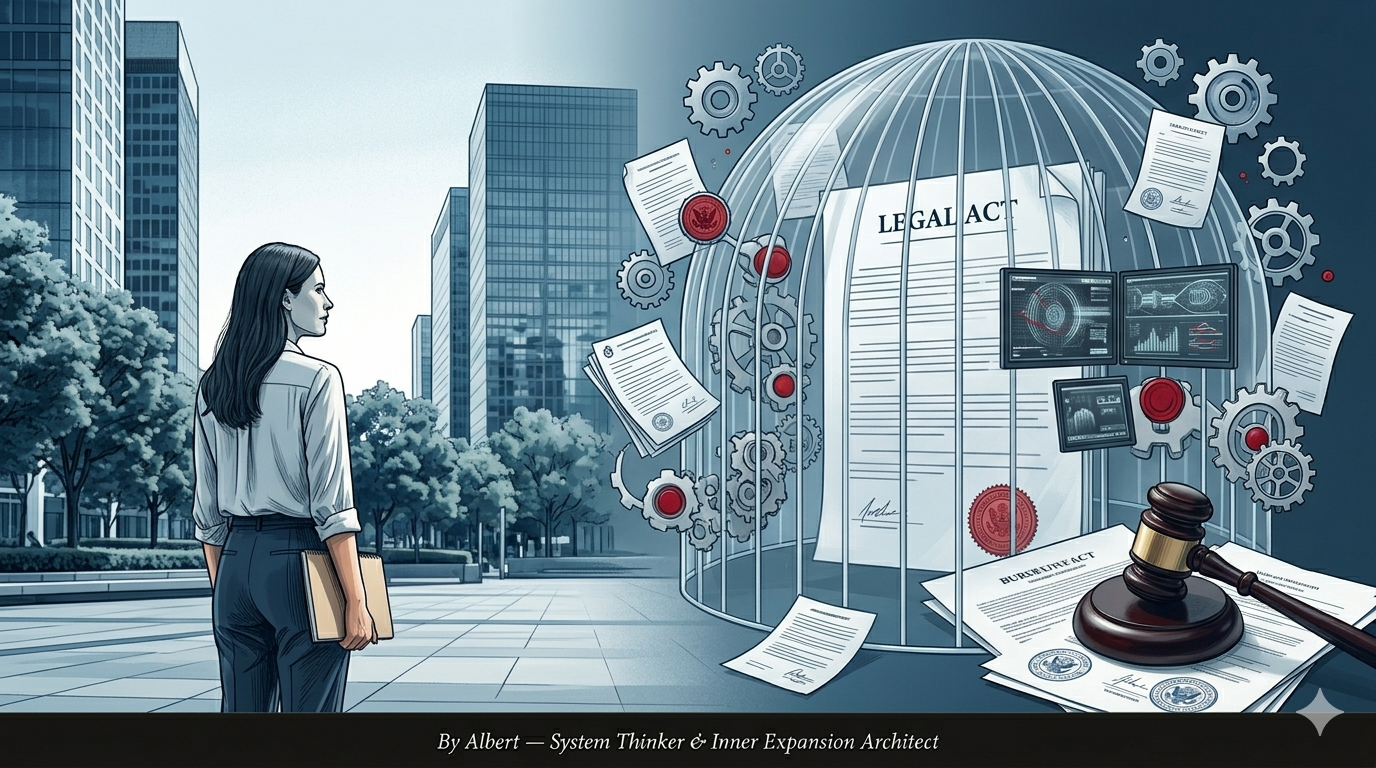
When Law Turns Against The People
You don’t lose a democracy in one midnight knock.
You lose it in court orders, circulars, and “routine investigations.”
On paper, everything looks legal.
In practice, the system slowly turns against you.
No tanks. No coups. Just paperwork.
That is the new face of repression: lawfare — using the law not to protect citizens, but to punish them. Cyanne Loyle, a political scientist at Penn State who researches how states weaponise courts and legal systems, calls this the quiet way governments consolidate power while still looking “constitutional” to the world.
In India, we’ve been living inside this shift for at least a decade. Most people feel the fear. Very few can see the system.
This blog is my attempt — as a system thinker and Inner Expansion Architect — to map that system, distil 5 deep insights most people miss, and rebuild a path forward from first principles.
By the end, you’ll have:
- A plain-language understanding of lawfare
- A systems map of how Indian laws, agencies, narratives, and incentives interlock
- Five non-obvious insights about how this machine really works
- A step-by-step playbook you can start using today
- A design blueprint for how law could be re-architected to protect human flourishing
What’s Actually Going On?
Let’s strip away the drama and say it plainly.
Lawfare is when governments change how laws are used: from a shield for citizens to a weapon against them. It looks boring — new amendments, fresh guidelines, financial probes, “anti-terror” cases, licence cancellations. It hides in complexity: acronyms like UAPA, PMLA, FCRA, ED, CBI, FATF.
Globally, research shows that after the Universal Declaration of Human Rights, overt mass state killings declined — but states shifted to quieter, more legalistic forms of repression. Instead of jailing critics with open brutality, they swamp them with cases. Instead of banning protests outright, they redefine them as “unlawful assemblies” or “terror funding.”
In India, this shows up as:
- Counter-terror laws used against students, activists, journalists, and community leaders, with conviction rates as low as 2.2% in some years — but with people jailed for years while trials drag on.
- Money-laundering and foreign funding laws deployed to freeze accounts, cancel licences, and paralyse civil society groups seen as inconvenient.
- Explosive growth in enforcement raids — ED money-laundering cases jumped from 1,797 (2005–14) to 5,155 in the following decade.
On paper: “fighting corruption” and “protecting national security.”
On the ground: process as punishment.
What’s Different About This Era?
- Violence is outsourced to the process. Years in jail without conviction, endless hearings, frozen accounts, licence cancellations.
- Repression is branded as responsibility. Crackdowns are framed as “cleaning up NGOs,” “controlling black money,” or “neutral enforcement.”
- The law looks neutral, but effects are targeted. The same clauses somehow keep catching students, journalists, minority leaders, and rights groups first.
- Global compliance is used as cover. International bodies like FATF are cited to justify harsher laws, even when implementation clearly overreaches.
- Citizens are overwhelmed. Acronyms + legalese + 24/7 news make it hard to even name what’s happening, let alone resist it.
First Principles: What Is Law For, Really?
Forget Article numbers for a moment. At first principles, any legitimate legal system should:
- Protect life and dignity
- Prevent arbitrary power
- Resolve conflicts fairly
- Provide predictability so people can plan their lives
In simple terms: law exists so that an ordinary person is safer with the state than without it.
When a government starts using law primarily to intimidate critics, insulate itself from accountability, or pre-empt legitimate dissent under labels of “terror,” “money laundering,” or “foreign hand” — it has quietly switched operating systems: from rule of law to rule by law.
That is the essence of lawfare.
5 Profound Insights Most People Never Realise
Insight #1 — The Playground Truth: Laws Are Not Neutral
In her TEDx talk, Cyanne Loyle uses a simple image: children on a playground inventing rules that magically privilege the kid in charge. “Today we’re all hamsters.” “You can only play if I say so.” The rules are not neutral — they are designed. Adults do the same thing, just with better stationery.
Laws don’t float above politics. They are frozen decisions made by people with incentives. Whoever writes the rules designs the field of power. A counter-terror law with a very broad definition of “terror” is not an accident — it is pre-loaded discretion.
When we treat the law as a neutral hero, we never ask: Neutral for whom? Protected for whom? Targeted at whom?
Insight #2 — From Bullets to Bail Conditions: Repression Went Quiet
After World War II, overt mass violence became costlier. International institutions, global media, and citizen documentation made visible brutality hard to get away with. So governments adapted — exactly as systems always do.
The goal — control — didn’t change. Only the interface changed: from bullets to bail, from firing squads to financial enforcement, from death camps to detention under “special laws.” Today, a state can keep activists in jail for years under special acts, freeze NGO accounts, and choke independent research — and still walk into international forums saying, “We are simply following due process.”
No tanks in the street. No emergency declaration. Just a permanent low-level emergency hidden in ordinary procedure.
Insight #3 — “Nation First” as a Control Operating System
Over the last decade, a familiar pattern has emerged in India. The story goes: “The nation is under threat — from anti-nationals, urban Naxals, foreign-funded NGOs, information warfare. Therefore, we need stronger tools. If you oppose these tools, maybe you have something to hide.”
“Nation first” here doesn’t just mean love for country. It becomes a sorting mechanism: whoever questions power can be re-labelled as a national security risk and pushed outside the moral circle. Once that mental switch flips in the public mind, lawfare becomes easier. The burden of proof subtly shifts — the state no longer has to prove you are a threat; you have to prove you are not.
Insight #4 — Lawfare Is a System, Not Just a Bad Law
It’s tempting to think: “If we just fix this one Act or change that one agency head, things will improve.” That’s silo thinking. It treats each law as independent. But lawfare is a system — a web of interlocking components:
- Broad laws with vague definitions that provide wide prosecutorial discretion
- Powerful enforcement agencies whose career incentives reward aggressive action
- Slow courts overwhelmed with cases, where delay itself becomes punishment
- Media ecosystems that often amplify the accusation and bury the acquittal
- Chilling effects that make civil society self-censor before any case is filed
- Legitimising narratives that frame critics as threats rather than citizens
You can’t fix a system by tweaking one lever. You need to map the whole machine — incentives, feedback loops, narrative infrastructure, and institutional design — and intervene at multiple leverage points simultaneously.
Insight #5 — Fear Is the Product, Not a Side Effect
Here’s the most important thing lawfare produces that most people miss: it’s not primarily about the person who is targeted. It’s about everyone watching.
Chronic, ambient fear is itself a governance strategy. When journalists self-censor, when activists “scale down,” when researchers avoid certain topics, when ordinary citizens hesitate before joining a legal protest — the system has already won, without filing a single case against them. Fear is the product. Silence is the output. Control is the goal.
The System Map: How It Actually Works
Apply systems thinking and you see it clearly: lawfare is not random. It’s a self-reinforcing loop.
- Input: Broad laws + powerful agencies + weak bail standards
- Process: Selective prosecution → slow trials → pre-trial detention
- Output: Chilling effect on dissent + public normalisation of “security measures”
- Feedback loop: Chilled dissent → fewer challenges → laws get broader → agencies get bolder
- Reinforcer: Narrative infrastructure labels critics as threats → public accepts each new overreach
Design Thinking Applied: Empathise → Define → Ideate → Prototype
Step 1: Empathise — Feel the System from the Inside
Imagine four people living inside this system right now:
Student. Joins a peaceful protest. Finds herself named in an “anti-terror” FIR. Shocked that normal dissent carries such risk.
Mid-level enforcement officer. Career built on “big” cases and media-visible raids. Rewarded for aggression, not restraint.
Judge buried in thousands of cases. Fears public backlash if she grants bail in high-profile security matters.
Runs a small rights-focused NGO. Wakes to an FCRA suspension and frozen accounts. Decides it’s safer to scale down.
The system is generating behaviours none of them would consciously design together. That’s what makes it powerful — and that’s what makes individual blame miss the point entirely.
Step 2: Define the Problem (The Real One)
Now we can work with it. The real problem points us to: incentives (what is rewarded or punished), opacity (what we cannot see or measure), and feedback (what can or cannot push the system back toward balance).
Step 3: Leverage Points — Where Small Changes Create Big Ripple Effects
- Legal definitions and thresholds — narrowing what counts as “terror,” “unlawful activity,” or “money laundering”
- Data transparency dashboards — public, regularly updated data on arrests, raids, conviction rates, and case duration
- Judicial practices — clearer bail guidelines; faster constitutional review of controversial amendments
- Narrative infrastructure — media and civic content that helps citizens distinguish genuine threats from weaponised “national security” rhetoric
- Local governance — panchayat-level awareness programmes on rights, legal aid, and documentation
- Institutional design — embedding CAPABLE governance: Citizen-Anchored Legitimacy, Accountability by Design, Balanced Power Architecture
Step 4: Rebuild from First Principles — What a Healthy System Looks Like
If law exists to protect dignity, limit arbitrary power, resolve disputes fairly, and enable stable planning — then a healthy legal-governance system would have:
- Narrow, precise laws — tightly scoped, with strict definitions and sunset clauses
- High-friction for state overreach, low-friction for citizen protection — hard for the state to detain without strong evidence; easy for citizens to access legal aid
- Radical transparency — open data on arrests, raids, convictions, and asset attachments
- Independent, empowered judiciary — swift on bail and constitutional challenges; insulated from political pressure
- Citizen-anchored legitimacy — governance along CAPABLE lines: citizen participation, accountability, performance metrics, adaptive learning, balanced power, long-term orientation, ethical statecraft
- Human flourishing as the systems goal — institutions evaluated not just by “security” but by health, trust, civic space, and inclusion
A Practical Step-by-Step Playbook for Citizens
What can you actually do in a world of lawfare? Here’s a staged playbook — individually, with friends, or through organisations.
Step 1: Learn to spot patterns, not just headlines. Notice where laws meant for terror or money laundering are being used on students, journalists, or community organisers. Track conviction rates and case durations — low conviction + long detention = process-as-punishment.
Step 2: Build a simple “lawfare checklist.” Ask of any high-profile case: Is this law proportionate to the alleged act? Is the same law regularly used against critical voices? How long is the person likely to be held before trial?
Step 3: Become a micro-monitor. Use RTI, public court records, and credible reports to track local UAPA cases, ED action, FCRA cancellations, and bail outcomes. Even a simple spreadsheet maintained by a small group can reveal patterns over time.
Step 4: Support organisations already tracking these patterns. Partner with rights groups, legal aid organisations, and data collectives that document misuse of laws; amplify their findings in your networks.
Step 5: Create small, trusted circles in your community — 5 to 15 people who commit to sharing verified information, attending local hearings, pooling resources for legal support, and standing with targeted individuals and families.
Step 6: Pair pods with local lawyers and law students. Encourage pro bono engagement; support them with documentation and logistics, not just emotional appeals.
Step 7: Use data to demand better laws. Write to MPs and MLAs with specific asks — tighter legal definitions, independent review of UAPA/PMLA/FCRA misuse, and mandatory publication of annual enforcement statistics.
Step 8: Advocate for judicial reforms as a rights issue. Bail guidelines and time-bound trial requirements are as important as any rights charter. Support campaigns for faster constitutional benches on civil liberty issues.
Step 9: Create content that reframes “nation first.” Use blogs, reels, podcasts, and local events to push a different story: A strong nation protects dissent. A confident state doesn’t fear questions. Security without rights is just fear with a flag.
Step 10: Take care of your nervous system. Chronic fear is a governance strategy. Use breathwork, community spaces, nature, and reflective practices to stay grounded — so you can act from clarity, not panic. This is system maintenance for the one system you always control: your own body-mind.
Why This Matters Now — Not “Someday”
Lawfare doesn’t announce itself. There is no banner saying: “From tomorrow, your rights will be technically intact but practically unusable.” It creeps in through each “exceptional” case, each “one-time” raid, each “temporary” restriction, each news debate that equates criticism with betrayal.
By the time everyone sees it, the system is already hard-wired.
The good news? Systems can be rewired. But only when enough people understand how they work, see themselves as agents inside the system — not just victims of it — and act together at key leverage points. That’s the real invitation of first principles and systems thinking: stop reacting to symptoms. Start redesigning the architecture.
- Cyanne E. Loyle, TEDxPSU: “How Governments Turn Against Us — Without Breaking the Law” — introduced lawfare and the idea that governments increasingly change laws rather than break them
- Amnesty International & Human Rights Watch — documented India’s use of UAPA, FCRA, and PMLA against civil society
- Public data on ED cases, raids, and asset attachments under PMLA
- Albert Zacharia’s ongoing work on Project India, the CAPABLE governance model, and human flourishing architecture
- Reference: albertyzacharia.in — Manifesto · Signature Framework · Doctrine
Your Turn: What Will You Do With This?
You don’t have to become a full-time activist or lawyer. But you can watch the next “national security” case and ask: Is this proportionate? You can start a legal immunity pod. You can use your skills — writing, design, data, community organising — to map and expose patterns.
The law can still be the hero of our story — but only if we insist on being the heroes behind it.
What part of this system are you willing to rewire first — in your own life, your community, or your institution?
Tag a friend who needs to understand this before the next headline hits. 👇
Leave a Reply