
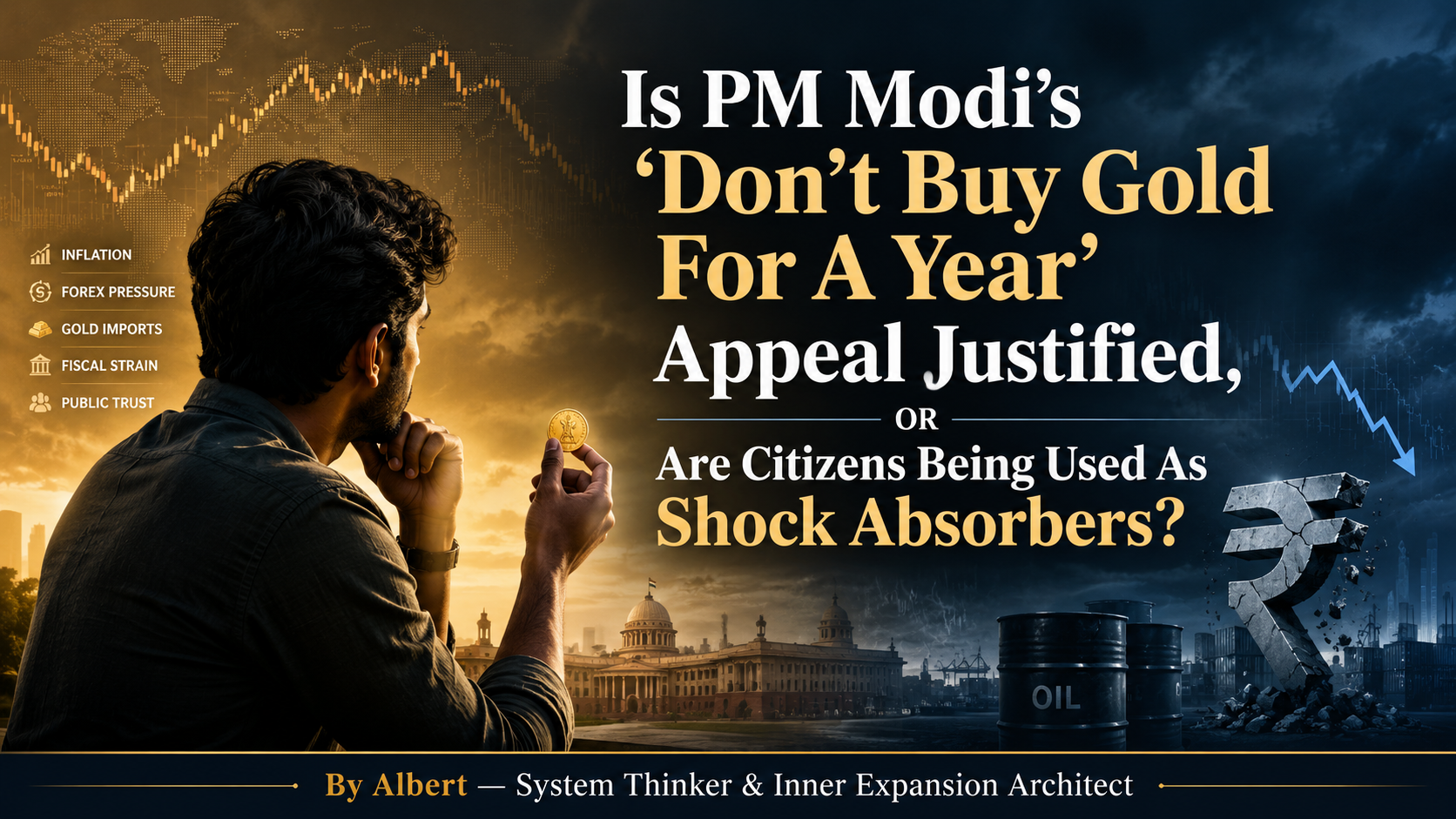
Is PM Modi’s “Don’t Buy Gold For A Year” Appeal Justified, Or Are Citizens Being Used As Shock Absorbers?
- Is PM Modi’s “Don’t Buy Gold For A Year” Appeal Justified? A Systems Thinking Breakdown
- PM Modi asked Indians to avoid buying gold for a year to save forex and protect the rupee. This systems thinking analysis unpacks the macro logic, emotional blackmail, and what genuine economic patriotism should look like.
India’s Prime Minister wants you to pause gold purchases for a year to “protect the rupee” and “save foreign exchange”. The macro worry is real. The way responsibility is being shifted onto you is not. Let us unpack the system, not just the slogan.
You already fund the state for months every year, then you are told the currency will fall unless you sacrifice your safety net too.
Context + Problem: What Modi Asked, And The Official Story
In early May 2026, the Prime Minister appealed to citizens to avoid buying gold for a year and to postpone nonessential foreign travel, framing this as a way to conserve foreign exchange and protect the rupee. The macro logic is straightforward: India imports most of its gold and nearly all of its crude oil, both paid for in dollars, so surges in those imports raise dollar outflows and can put pressure on reserves and the rupee. At the same time, India’s import cover has been described as robust, which makes the moral intensity of the appeal feel disproportionate to many citizens.
From the document: “The rupee is in freefall. Not a slow drift—an outright collapse. In 2024 alone, the Indian currency has lost over 7% against the dollar, erasing years of painstaking stability.”
First Principles: Currency, Gold, And The Social Contract
Strip away the rhetoric and you have three primitives: a currency, a hedge, and a social contract. A currency is a collective story backed by institutions. When that story frays, people seek assets that feel less political and less printable. Gold plays that role. Protecting the currency is structurally the state’s job. Protecting accumulated savings is the household’s job. Confusing those roles creates moral and functional mismatch.
From the document: “Gold is a hedge against institutional failure.”
Systems Thinking: The Rupee, Oil, Gold, LRS, And Gift City
Map the core feedback loops:
- Loop A (Trust loop): Government mismanagement or external shocks → rupee weakens → households hedge with gold → gold imports rise → dollar outflows increase → perceived pressure on reserves → government signals controls.
- Loop B (Control loop): Government imposes TCS/LRS limits or moral appeals → households feel punished → trust erodes further → hedging increases via informal channels.
- Leverage points: transparency of spending, visible state austerity, legal hedging instruments, and credible enforcement of fiscal discipline.
The system invites citizens into global capital markets (LRS, GIFT City) and then punishes or taxes those same channels when stress appears. That contradiction is a trust amplifier.
Design Thinking: The Inner Experience Of Economic Blackmail
Empathize with two short personas:
- Rajesh and Priya, retired couple: Pension in rupees, fixed incomes, son abroad sending remittances. A 20% TCS on transfers above a threshold makes family support costlier.
- Salaried urban earner: Pays income tax, GST, petrol duties, and watches purchasing power erode. Gold is psychological insurance.
Design insight: policy that ignores dignity and agency will be felt as emotional blackmail. People do not react to abstract macro models; they react to whether the system respects their agency and protects their savings.
The 5 Profound Insights (headline, explanation, implication)
- Gold is a trust barometer.
When institutional trust weakens, gold demand rises. Implication: Restricting gold suppresses a signal that could guide corrective policy. - Taxation makes citizens silent partners.
Citizens already fund the state heavily; asking them to absorb currency risk without reciprocity is a broken contract. Implication: Policy must align burdens with visible state discipline. - Example is a policy instrument.
Leaders who demand sacrifice but do not visibly reduce discretionary excess undermine compliance. Implication: Visible austerity (reduced VVIP travel, convoy cuts) is a low-cost trust lever. - Rules reveal narratives.
TCS and LRS thresholds are not neutral technicalities; they narrate who can move capital freely and who cannot. Implication: Design thresholds to avoid class-based distortions. - Inner security is the ultimate hedge.
People hedge because they do not feel fundamentally safe. Implication: Rebuilding trust is more effective than punitive controls.
A New Model of Economic Patriotism
A practical sequence that aligns incentives:
- State discipline first: immediate, visible cuts in discretionary spending and a public dashboard of major discretionary items.
- Transparency: publish a real-time ledger of major spending categories and foreign travel costs.
- Legal hedging: remove punitive TCS on regulated gold ETFs and SGBs, make legal hedging accessible.
- Citizen oversight: create a statutory Citizen Oversight Board with audit powers for discretionary spending.
- Conditional appeals: only after steps 1–4 should the state ask citizens for voluntary restraint.
This sequence changes the narrative from “obey” to “co‑author.”
Seven Stage Citizen Design Moves (practical, non-prescriptive civic steps)
- Awareness: calculate your tax burden and hidden inflation costs.
- Diagnosis: map how policy changes affect your household cash flows.
- Reframing: shift conversations from blame to design (how should the social contract work?).
- Intervention: file RTIs, join citizen audit groups, petition local representatives.
- Feedback: demand public dashboards and measurable targets.
- Iteration: refine demands based on outcomes.
- Scaling: support candidates and policies that institutionalize transparency.
These are civic design moves, not individualized financial advice.
Real World Snapshot: Today’s Policy Mix
- TCS: 20% on remittances above ₹10 lakh (rumored threshold changes discussed).
- LRS: $250,000 annual cap per individual (subject to policy review).
- Hedging options: Sovereign Gold Bonds, Gold ETFs, digital gold on regulated platforms.
- Contradiction: GIFT City and LRS encourage global capital flows while TCS and moral appeals penalize the same behavior when it becomes politically inconvenient.
The mixed signals create perverse incentives and erode trust.
Future Implications: Two Scenarios
- Compliance Trap: continued moral appeals, tighter controls, more informal hedging, erosion of middle-class wealth, democratic fatigue.
- Empowered Citizen: visible state discipline, legal hedging, citizen oversight, restored trust, healthier capital allocation.
Key indicators to watch: gold import volumes, remittance flows, public trust surveys, and discretionary spending transparency.
Conclusion
The Prime Minister’s appeal is a short-term macro signal that has a kernel of rationality. It becomes morally incomplete when it asks households to absorb systemic risk without visible state-side reform. The real leverage is trust, and trust is rebuilt by transparency, accountability, and co-created policy, not by moral lectures.
Call to Action
Comment below with your biggest frustration about the system. Audit one tax or spending item this week. File an RTI or join a citizen audit group. Small civic moves scale into systemic pressure.
By Albert, A System Thinker and Inner Expansion Architect
FAQ (5 Q&As)
- Q: Is buying gold illegal after the appeal?
A: No, the appeal is a request, not a legal ban. Policy tools like TCS or import duties can change incentives, but they do not criminalize private ownership. - Q: What is TCS and how does it affect remittances?
A: TCS is Tax Collected at Source; when remittances cross specified thresholds, a portion is collected at source, increasing the effective cost of transfers. - Q: Are Sovereign Gold Bonds (SGBs) a safe alternative?
A: SGBs are government-issued and carry different tax and interest features; they are a regulated hedging instrument worth considering for long-term exposure. - Q: Will the rupee stabilize if people stop buying gold?
A: Stopping gold purchases may reduce one source of dollar demand, but without state-side reforms and restored trust, the effect is likely temporary. - Q: How can ordinary citizens influence policy?
A: File RTIs, join citizen audit groups, vote for transparency-focused candidates, and use public dashboards to hold officials accountable.
Leave a Reply