
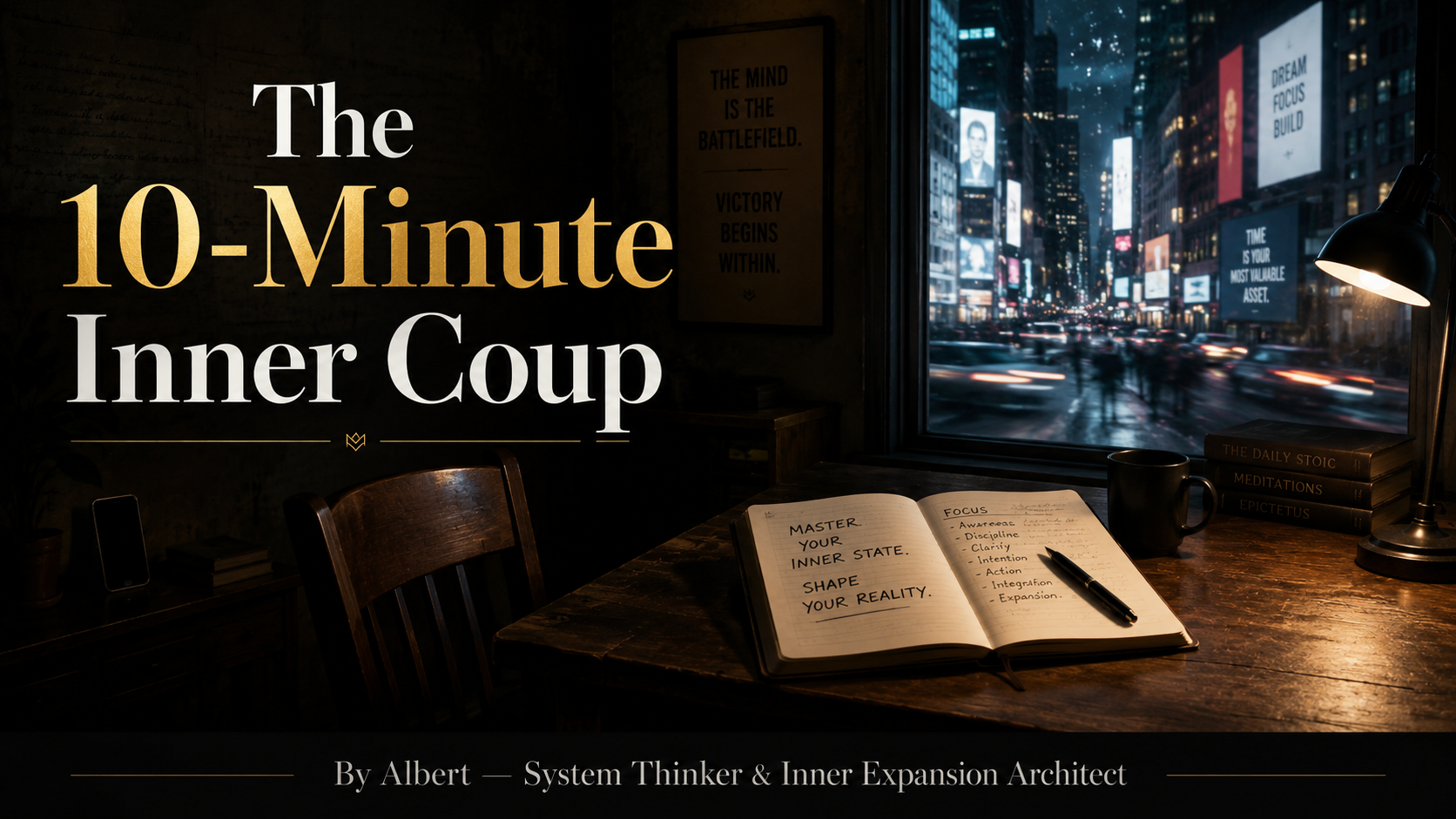
The 10-Minute Silent Writing Practice That Changes Everything
Most people change jobs, routines, or partners but never their inner operating system. This article shows how a 10-minute nightly silent writing practice can surface the unconscious, reduce self-sabotage, and create real inner change.
Transformation is not hiding in a new morning routine, a productivity app, or one more course. It is waiting in the one space you almost never enter: ten silent minutes with a pen in your hand while your unconscious finally speaks without being interrupted.
By Albert, A System Thinker and Inner Expansion Architect
You are not stuck because your life is too complicated. You are stuck because your operating system is invisible.
You already know how this goes.
You improve your diet, redesign your morning routine, switch jobs, move cities, upgrade your task manager, and listen to three podcasts about reinventing yourself. For a few weeks the graph of your life looks different. Then your emotional weather quietly returns to default. The same patterns, the same reactions, the same recurring arguments, the same subtle self-sabotage, just now wearing a different outfit.
From the outside it looks like change. On the inside it feels like déjà vu.
Most self-improvement culture sells surface rearrangements. Change your habits, your environment, your calendar. All of that matters. But none of it touches the place from which your choices actually emerge.
Carl Jung put it bluntly: “Until you make the unconscious conscious, it will direct your life and you will call it fate.”[2]
The uncomfortable truth is simple. Most lives are not shaped by conscious decisions. They are shaped by unconsciously inherited scripts.
If you strip transformation down to first principles, three claims remain.
First, most of what drives you is unconscious.
Second, the unconscious cannot be argued into changing. It has to be related to.
Third, relationship requires a channel, an actual, repeatable way to listen and respond.
Everything else is decoration.
Most people assume that if they understand the concept, they will change. You can understand boundaries, attachment styles, trauma, habits, and dopamine. Yet your life does not update in proportion to your understanding. That is because understanding lives in the conscious mind. Your unconscious does not speak in concepts. It speaks in images, memories, fragments, sensations.
People also assume the right system will make them consistent. If they can just find the right planner, framework, or habit stack, everything will click. But many “discipline problems” are really relationship problems. A part of you is not on board. That part is not persuaded by a prettier calendar.
Finally, there is the assumption that transformation must be expensive, complicated, or guided by an expert. Complexity comforts the conscious mind because it makes the conscious mind feel important. The unconscious is older than any framework. It responds to something much simpler: attention, permission, and repetition.
Once these assumptions fall away, the real issue becomes clear. Your life is being run by an operating system you never wrote, never reviewed, and almost never listen to.
If your psyche is a system, then you are living inside feedback loops.
Internal state shapes behaviour. Behaviour shapes consequences. Consequences shape meaning. Meaning updates internal state.
Beliefs about yourself shape what you attempt. What you attempt shapes what you avoid. What you avoid shapes the data you collect about who you are. That data then reinforces the original belief.
Emotional patterns shape relationships. Relationships trigger reactions. Reactions confirm the pattern. The loop closes again.
This is why most people are not really living their lives. They are running a closed-loop simulation.
Consider a simple example. A child learns that expressing anger leads to withdrawal of love. The system adapts. A rule is installed: “anger is unsafe.”
Years later, the adult swallows anger, avoids conflict, says “it is fine” when it is not, and ends up feeling unseen. The unconscious says “this is how we survive.” The conscious mind writes essays about better communication.
Most advice attacks behaviour at the edge of the system. Speak up. Set boundaries. Just say no. That is useful, but incomplete. In systems thinking, pushing on symptoms without changing the rules often strengthens the pattern.
The real leverage point is not at the behavioural edge. The leverage point is at the layer where the rules are written.
That layer is the unconscious.
So the question is not “How do I push harder on myself?”
The question is “How do I enter into dialogue with the part of me that wrote these rules in the first place?”
Now shift lenses. Forget pathology for a moment. Apply design thinking.
Design thinking begins with three moves: empathise, define, and prototype.
Who is the “user” in this system? Not your public persona. Not the version of you that performs on social media or in meetings. The user is the part of you that carries your actual experience. The frightened child. The exhausted caretaker. The angry teenager. The creative soul you parked in a corner.
What is the real problem for that user? It is not motivation, information, or willpower.
The problem is that this user has no safe, regular channel to speak.
Most of your day is full of input. Messages. Meetings. Reels. Notifications. Podcasts. Headlines. Your inner world never gets the microphone.
From a design standpoint, the unconscious is operating in a hostile environment. There is no dedicated interface. No agreed ritual. No predictable space where it can surface without being immediately overruled or monetised.
So it does what any neglected user does. It hacks the system.
It leaks through your dreams. It appears as anxiety. It hijacks your body with fatigue. It repeats relationship dynamics until you finally notice.
You call that self-sabotage. From a design perspective, it is a feedback signal trying to get through bad UX.
So the redesign question becomes very simple:
What is the minimal, repeatable, low-friction ritual that removes external input, lowers the performance mask, and gives the unconscious a direct channel?
The answer looks almost embarrassingly small.
Sit in silence. Pick up a pen. Write whatever arises.
Not as journaling for productivity. Not as a gratitude list. As interface design.
1. Your first five minutes are almost always a performance
The first layer that appears when you start writing in silence is not your truth. It is your performance.
You write what you think a thoughtful, self-aware person should write. You summarise your day. You list your worries. You repeat familiar complaints. It looks coherent and feels familiar. It is also mostly useless for deep change.
That is not failure. That is warm-up.
Real-world implication: never judge the practice by the first five minutes. The value lives in the boredom that arrives just after you run out of polished material and feel like stopping. That is the moment the real voice finally has room to appear.
2. The unconscious speaks in fragments, not essays
When deeper material begins to surface, it will not arrive as a complete story. It might be a sentence. An image. A memory from school. A line like “I am still angry about what happened at 12.”
Most people dismiss these fragments because they do not feel profound or complete. In reality, fragments are the raw packets of the unconscious.
Real-world implication: treat fragments as data, not noise. Your job is not to make them pretty, structured, or wise. Your job is to let them land on the page. Integration comes later.
3. The psyche relaxes when it truly believes no one else will read this
You were trained from childhood to perform. At home. In school. In exams. On social media. Even in your journal.
Many people secretly write as if a future audience is watching. They imagine someone reading these pages one day. That fantasy alone is enough to distort what appears.
The practice only becomes transformative when something in you accepts that no one else will read this.
That is when censorship begins to fall away.
Real-world implication: make privacy a non-negotiable rule. No screenshots. No excerpts on Instagram. No reading out sections to impress your therapist or your friends. This notebook is not content. It is a container.
4. You do not need to interpret everything to be changed by it
Self-development culture often over-rewards analysis. What does this mean? What is the symbol? What is the lesson?
Analysis has its place, but not all material needs to be solved on contact. Jung’s own private writings, later collected in The Red Book, were a long internal experiment in direct dialogue with his unconscious, not a real-time self-help manual.[3][2]
Much of the transformation happens simply because something that was unconscious is now held in awareness. It moves from shadow into light.
Real-world implication: after you write, resist the urge to dissect everything. Close the notebook. Sit in silence for a minute. Let the psyche integrate on its own timetable.
5. Tiny daily contact changes the system more than rare dramatic breakthroughs
We love peak experiences. Retreats. Intensives. Ceremonies. “Life-changing” weekends. They can open doors, but they rarely maintain them.
Systemic rewiring happens through small, repeated contact.
Ten minutes a night is not glamorous. Which is exactly why it works.
Real-world implication: design for boring consistency, not fireworks. Treat this ritual like brushing your psychic teeth. You feel the difference most when you stop.
New Solution Model: The Silent Writing Protocol
Now we can name the practice clearly.
The Silent Writing Protocol is a minimal, private, nightly practice for opening a deliberate channel between conscious awareness and the unconscious through handwritten silence.
It operates at a systems level because it works on the rule-writing layer of the psyche rather than on isolated behaviours.
It is scalable because it requires no institution, no teacher, and no subscription. A notebook and a pen are enough.
It is behaviourally aligned because it works with how the nervous system naturally responds to ritual, place, and repetition.
It is governance-aware because it builds a stable inner institution of listening. Over time, you become less governed by hidden rules you never chose.
This is not a journaling hack. It is quiet institutional reform inside your own psyche.
See the difference between surface change and operating-system change.
Tonight, make a simple list called “Patterns that keep repeating even when I change my environment.” Do not judge yourself. You are mapping the system.
Identify how you avoid hearing yourself.
Notice how you outrun your own inner world. Constant input. Overwork. Endless scrolling. Permanent background noise.
Write one honest paragraph about the specific ways you block silence. Treat it as a technical audit, not a moral failure.
Redefine writing as dialogue, not performance.
On the inside cover of your notebook, write:
“I am not writing to impress anyone. I am writing to stop lying to myself.”
Read that sentence once before each session. Let it reset the frame.
Run the nightly 10-minute protocol.
Choose a fixed location. The same chair, the same corner, the same table. Over time, your nervous system will learn that “when I sit here, the channel opens.”
Remove input. No phone in your hand. No music. No external stimulation if you can avoid it.
Use pen and paper. Handwriting slows the mind, involves the body, and separates this ritual from the rest of your screen-saturated day.
Set a timer for 10 minutes. This removes negotiation. You are not waiting to feel like writing. You are holding a container.
Begin with whatever is true. “I do not want to be doing this.” “My mind is blank.” “This feels pointless.” Start exactly where you are.
Stay past the first wave of boredom. That is usually around minute five to seven. On the other side of that boredom is the point where the performer gets tired and a quieter voice can enter.
Let the psyche respond in its own channels.
In the days and weeks after you begin, you may notice more vivid dreams, random memories surfacing, sudden clarity about old situations, or emotional spikes that seem disproportionate.
This is not malfunction. It is feedback. Your system is routing previously suppressed data into consciousness.
You do not need to chase every signal. Simply notice and, if needed, make a brief note in your next session.
Adjust the container, not the content.
If the practice starts feeling heavy, resist the urge to complicate it with prompts and structures.
Instead, remove friction. Move the ritual earlier or later in the evening. Keep the notebook visible as a cue. Protect a small pocket of uninterrupted time.
You are iterating on the ritual design, not on your unconscious. The unconscious knows what it wants to say. Your work is to keep the doorway open.
Allow outer life to reorganise.
Over time, you may notice small but decisive shifts.
You say no once where you always said yes.
You set a boundary that used to terrify you.
You walk away from a situation that has quietly drained you for years.
You take one small step toward a possibility you have been pretending not to want.
Do not force massive life changes. Let behaviour update in proportion to clarity. This is how the system scales without burning anything down.
Carl Jung is the clearest reference point for this kind of work. In the early twentieth century, during a period of deep personal and professional crisis, he began a long experiment. He entered into direct dialogue with images and figures from his unconscious and recorded those dialogues in words and paintings.
Over roughly sixteen years this work became what we now call The Red Book. Jung did not write it for publication. He treated it as a private laboratory of the soul.[2][3]
From that period emerged the core ideas that shaped depth psychology: the collective unconscious, archetypes, the shadow, and the individuation process.
He did not arrive at these theories through detached abstract reasoning. He arrived there by repeatedly sitting with his own unconscious and documenting what came.
Your nightly practice is not meant to copy Jung in style or scale. It shares something much simpler with his approach: a refusal to outsource the study of your own soul.
If you never do this work, your life will still move forward. You will work, earn, love, and age. From the outside, everything may look normal.
Inside, something quieter happens. Patterns deepen into grooves. Regrets form around unlived parts of you. Relationships orbit unspoken truths. A subtle sense of absence grows, as if you are not fully inhabiting your own days.
At a collective level, a culture that refuses inner contact becomes easier to manipulate. People who never meet their own depths become more vulnerable to algorithms, propaganda, and shallow narratives.
The alternative is not dramatic revolution. It is quiet self-governance.
Millions of people spending ten silent minutes a night in honest contact with themselves would not look like a revolution. But it would be one.
The thing that changes your life is smaller than you have been trained to look for.
Not a perfect system. Not a new identity. Not a five-figure program.
It is the decision to stop treating your unconscious as a problem to control and start relating to it as an ancient ally that has been waiting for you to listen.
Ten minutes. One notebook. One pen. One honest page at a time.
That is not a hack. It is an inner coup.
If something in you recognised itself in these lines, do three things.
Comment with one pattern you are finally ready to stop calling fate.
Tag one person who has been quietly searching for something deeper than hacks.
Follow for more system-level practices that respect your depth instead of exploiting your pain.
Tonight, do not save this as inspiration. Sit. Write. Listen. Let the operating system begin to rewrite itself.
1. Is this just “morning pages”?
Not exactly. Morning pages are a morning freewriting practice to clear creative blocks. The Silent Writing Protocol is a nightly ritual for contact with the unconscious, held in silence, with privacy and integration built into the design.
2. What if I have a trauma history?
If you carry significant trauma, intense material can surface. Start gently, keep sessions short, and seek support from a qualified therapist if you feel overwhelmed. This practice is not a substitute for therapy. It is a complementary way to build gentle contact with your inner world.
3. Can I type instead of writing by hand?
You can, especially if handwriting is physically difficult. But handwriting changes the quality of attention. It slows your thinking and differentiates this ritual from everyday screen use. If you must type, strip away formatting, notifications, and any sense of audience.
4. How long before I notice change?
Some people notice subtle shifts right away, often in the form of dreams or a sense of inner exhale. For more structural changes in behaviour and choices, think in weeks rather than days.
5. What if I miss a night?
Nothing is broken. This is not a streak to maintain. It is a relationship to return to. A simple sentence is enough when you come back: “I stopped. Now I am here again.”
- Carl Jung, The Red Book (Liber Novus), for the original record of Jung’s inner writings and imaginal dialogues.[3][2]
- International Association of Analytical Psychology, essays and materials on Jungian concepts such as individuation, shadow, and the role of the unconscious.[2]
- Public lectures and explanations of active imagination as a structured method for engaging with the unconscious.[4]
⁂
- 1. give-you-right-now-is-the-fuller-article-text-itse.docx
- 2. https://iaap.org/jung-analytical-psychology/short-articles-on-analytical-psychology/the-red-book-2/
- 3. https://www.scribd.com/document/956067698/Red-Book
- 4. https://www.youtube.com/watch?v=PomC7WS7us8
- write-in-silence-transform-the-self-a-jungian-practice-guide
Leave a Reply