
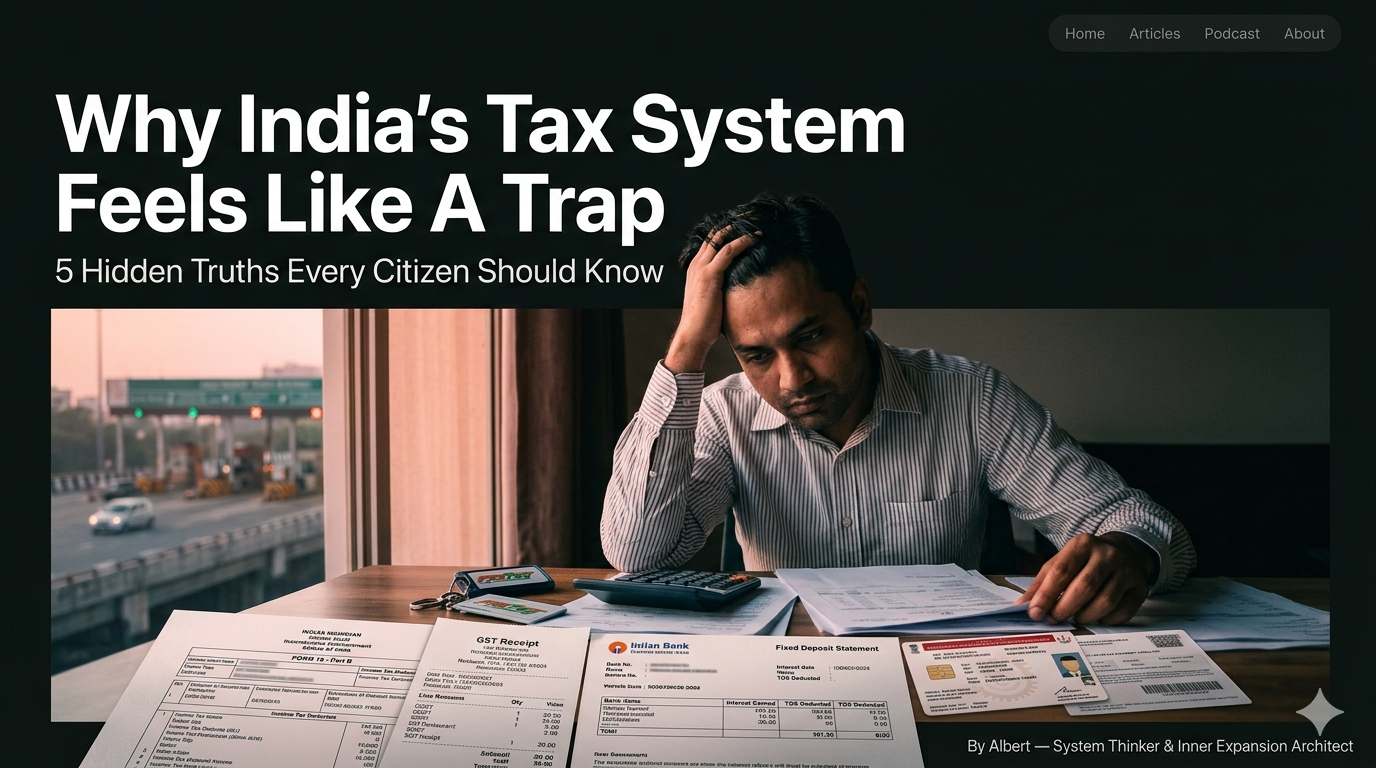
TAX, TAX, TAX:
The Hidden Cost of
Being Honest in India
You work hard. You save wisely. You spend carefully. And at every single step — the system takes a cut. Here is what they never taught you in school.
STOP. Before you scroll — answer this one question honestly: Every rupee you earn gets taxed. Every rupee you spend gets taxed. Every rupee you save gets taxed. So… what exactly do YOU keep?
Let me paint you a picture that millions of Indians live through every single day — but almost never stop to examine.
You wake up. You commute. You work 9 to 6. You earn a salary. The government immediately slices off income tax. What remains hits your bank account.
You go to the market. GST kicks in. You just got taxed AGAIN on money that was already taxed.
Feeling smart? You decide to save. You open an FD. The interest you earn? Taxed. Again.
You bought a car — so you paid road tax. And then every time you drive on that very road you already paid for? Toll tax.
Tax on earning. Tax on spending. Tax on saving. Tax on moving. The pockets of the honest Indian are never truly full.
📊 The Numbers That Should Make You Uncomfortable
- India’s GST has 5 rate slabs — everyday items attract 12–18%, and some luxury items hit 28%.
- A ₹15 lakh earner in the 30% bracket loses ₹2.6 lakh+ in income tax — before a single grocery bill.
- Fuel prices in India include 50–60% in central and state taxes — you’re mostly paying taxes when you fill your tank.
- India’s tax-to-GDP ratio is ~11–12% — one of the lowest among major economies — yet the honest, salaried middle class carries a disproportionate share.
- Over 70% of Indians don’t file income tax returns. The compliant minority funds the majority of direct tax revenue.
You Are Being Taxed in a Loop — Not Just Once
Most people think of tax as a one-time event: earn money, pay tax, move on. But India’s tax architecture is actually a LOOP — and the honest, salaried citizen is running in it 365 days a year.
Here’s the loop in plain terms:
- Earn → Pay Income Tax (direct tax on what you earn)
- Spend → Pay GST (indirect tax on already-taxed money)
- Save → Pay TDS on FD interest (tax on the returns of your savings)
- Invest → Pay capital gains tax (tax on wealth you tried to grow)
- Move → Pay fuel excise + road tax + toll (tax on how you physically live)
This is called tax cascading — the same rupee getting taxed across its entire lifecycle. For anyone without sophisticated tax planning tools (read: most of the middle class), this is a slow, silent wealth drain.
Road Tax + Toll Tax Is NOT a Glitch — It’s a Design
Here’s a question that should bother every car owner in India:
You pay road tax when you register your vehicle. Then every time you use a National Highway, you pay toll tax AGAIN. Aren’t you paying twice for the same road?
The official answer: Road tax goes to state governments for local roads. Toll goes to NHAI or private concessionaires who build national highways. Technically separate.
But here’s what they don’t tell you:
- Many toll highways were supposed to become toll-free after their cost-recovery period ended — but the tolls continue indefinitely.
- There’s no transparent public audit of where toll revenue actually goes after cost recovery.
- The state of roads in most Indian cities and rural areas suggests neither tax is being optimally deployed.
- Citizens have almost no mechanism to challenge this double payment in practice.
The Real Tax Isn’t Money — It’s Your Silence
This is the insight that hits the deepest. Every system sustains itself not just through force, but through the consent of the governed. Not always active consent. Often just silence.
In India, we’ve been culturally conditioned to:
- Accept tax as inevitable and non-negotiable
- Distrust the system — but comply anyway
- Complain among friends — but never at forums where it matters
- Believe that asking questions makes you “difficult” or “anti-national”
- Feel that one voice doesn’t matter — so why bother?
This silence IS the tax. Because when citizens don’t demand accountability, governments don’t have to provide it.
The Middle Class Is the Most Exploited Taxpayer — By Design
The wealthy have chartered accountants, shell companies, family trusts, and sophisticated tax structuring. The very poor are largely outside the formal tax net.
The middle class? They’re salaried. Their income is visible, documented, and automatically deducted. TDS happens before they can even plan.
- The salaried employee has the least flexibility in legal tax avoidance
- They consume goods at GST rates designed for mass markets
- They can’t claim the sophisticated deductions available to business owners
- Their savings are modest enough that tax on FD interest actually hurts
- They are the backbone of formal India — and they are squeezed the hardest
Change Doesn’t Come From Rage — It Comes From Organised, Informed Questions
Here’s what most angry social media posts about taxes miss:
Rage is energy. But rage without direction is just noise. The government doesn’t fear angry tweets. It fears organised, persistent, specific questions — asked at the right forums, by citizens who know their rights.
History proves this works in India:
- RTI has exposed civic fraud, road fund misuse, and bureaucratic corruption — filed by ordinary citizens
- Public Interest Litigations by private citizens have changed tax policy and toll practices
- Consumer Forum cases have forced accountability where the state failed
- The Jan Lokpal movement showed that organised civic demand CAN change political calculus
Your 5-Step Action Plan
From Silent Taxpayer → Responsible, Empowered Citizen
Know Your Full Tax Architecture
This week, sit down and map every single tax you pay. Not just income tax. All of it:
- Income Tax / TDS on salary
- GST on daily purchases (check your bills — it’s printed right there)
- Fuel excise duty (roughly 50–60% of petrol’s retail price is tax)
- Road tax (check your vehicle registration certificate)
- Monthly toll spend (calculate your commute)
- TDS on FD interest or dividend income
- Capital gains tax if you hold mutual funds or stocks
When you actually see the total — the awareness alone changes everything.
Use Legal Tax Optimization — Not Evasion
You have every right to legally minimise your tax. Tools available RIGHT NOW under Indian law:
- Section 80C: Up to ₹1.5 lakh via PPF, ELSS, NPS, life insurance
- Section 80D: Health insurance premiums for self and parents
- Section 24(b): Home loan interest deduction
- NPS 80CCD(1B): Additional ₹50,000 deduction
- HRA Exemption: If you pay rent — claim it properly
- New vs Old Tax Regime: Compare both for your specific income profile — many overpay simply by not running the numbers
File an RTI — Ask Where Your Money Goes
The Right to Information Act is one of the most underused tools in India. Some questions you can ask:
- How much toll revenue was collected on a specific highway last year?
- What is the cost-recovery status of this toll road — has its debt been repaid?
- How is road tax collected in your state being spent?
- What is your municipality’s road-maintenance budget this year?
File at: rtionline.gov.in — Takes 15 minutes, costs ₹10, and the government is legally required to respond within 30 days.
Participate in Budget Consultations and Civic Forums
Most citizens don’t know these exist:
- Write to your MP at loksabha.nic.in with specific tax reform suggestions
- Submit pre-budget suggestions at MyGov.in — the government actively collects these
- Follow organisations like CBGA India (Centre for Budget and Governance Accountability) for deep analysis
- Participate in state-level Ward Committee or Gram Sabha meetings where local tax use is discussed
Share, Educate, Build the Informed Citizen Movement
Individual awareness is good. Collective awareness is power.
- Share this article with 3 people who are silent taxpayers — break the cycle of uncritical compliance
- Have ONE real conversation about taxes this week — at dinner, at the office, with friends
- Follow civic journalism: IndiaSpend, PRS Legislative Research, The Wire — they track exactly how tax money moves
- Teach your children about taxes early — financial literacy is the first form of civic empowerment
- Vote for candidates — across party lines — who have clear, specific tax-accountability platforms
The Fight Is Not Against Government. It Is For Your Rights.
The original message that inspired this blog said it with rare clarity: This fight is not with our government. This fight is for our rights.
Paying taxes is not wrong. Paying taxes without accountability — without knowing where that money goes, without demanding it works for you — THAT is wrong.
The government is made by the people. It runs by the people. And it should serve the people. But only if the people demand it.
So here’s my question to YOU: Which of these 5 insights surprised you the most? And what’s ONE thing you’ll do differently after reading this? Drop it in the comments — I read every single one.
Leave a Reply