
They Told You Wars Are About
Politics. They Lied.
Wars Are About Profit — And Always Have Been.
5 brutal financial truths hidden inside every major conflict — from World War I to the IMF debt machine — that most people never stop to think about.
— Dismantle The Mic, Nicknamed Bree
Let me ask you something. When you think about World War I or World War II — what images come to mind? Trenches? Heroism? Geopolitical rivalries? National pride?
What if those are just the stories on the surface?
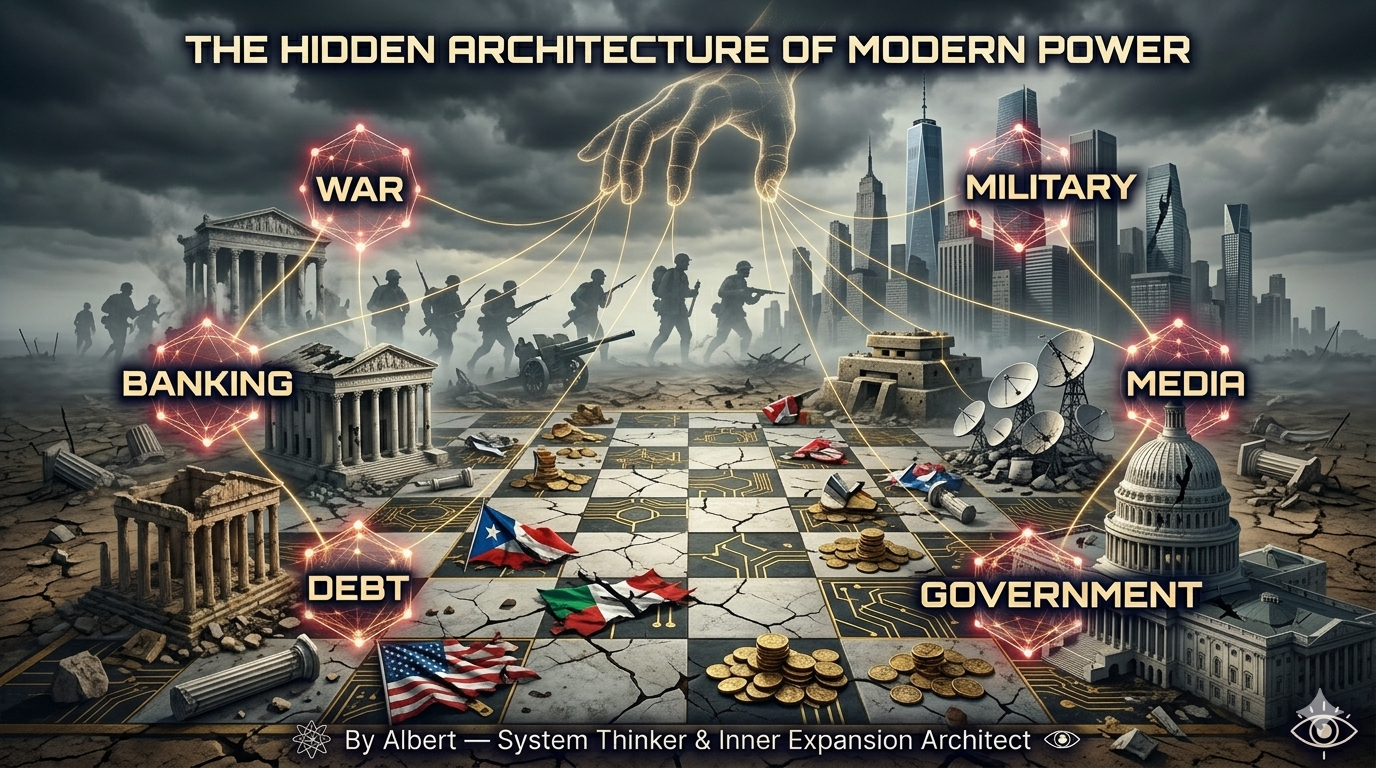
What if, underneath every major conflict of the last 120 years, there was a quieter, more calculated story — one about who funded the wars, who profited from them, and what institutions were built on the rubble to ensure it could happen again?
That’s what this blog is about. Not conspiracy theories. Not paranoia. DOCUMENTED HISTORY — backed by declassified documents, economic records, and the work of researchers like Naomi Klein, Smedley Butler, and others who dared to follow the money instead of the headlines.
There are 5 deep insights most people never connect. And once you see them, you can’t unsee them.
The 5 Insights Nobody Joins the Dots On
Deep truths sitting in plain sight — if you’re willing to look at the full picture.
Wars Are Funded by Banks — And Banks Profit No Matter Who Wins
Here’s something that should stop you cold: before WWI even ended, J.P. Morgan and the Rockefeller banking network had extended loans to BOTH Britain AND Germany. Not one side. Both.
Think about what that means. The bankers didn’t care which flag was planted at the end. They cared about repayment with interest. War is, from their perspective, a guaranteed revenue event — because governments with their backs against a wall will borrow anything, at any rate, to survive.
This isn’t a radical new theory. Major General Smedley Butler — the most decorated Marine in US history at the time of his death — said it plainly in the 1930s: he had been “a high-class muscle man for Big Business, for Wall Street and for the bankers.” He called himself “a racketeer, a gangster for capitalism.”
Britain borrowed $4 billion from American banks during WWI. That single transaction transferred the axis of global financial power from London to Wall Street. The war didn’t just redraw national borders — it redrew the map of who controlled money on Earth.
The Treaty of Versailles Was Engineered to Guarantee a Second War
The Treaty of Versailles in 1919 is taught in schools as the formal end of WWI. What is rarely taught is that many historians — including John Maynard Keynes, who famously resigned from the British delegation in protest — argued that its terms were so punishing toward Germany that a second catastrophe was being built in real time.
Germany was saddled with war reparations so enormous that it effectively destroyed their economy. Hyperinflation. Mass unemployment. National humiliation. These are precisely the social conditions that breed extremist movements. It’s not a coincidence that Adolf Hitler rose to power using German economic despair as his fuel.
Whether this was deliberate engineering or catastrophic negligence almost doesn’t matter. The result was the same: the financial architecture of peace guaranteed another war — and those positioned in financial markets benefited enormously from both.
WWII’s True Outcome Wasn’t Victory for Any Nation — It Was the Institutionalisation of US Financial Dominance
When WWII ended in 1945, the headline story was the defeat of fascism. The real structural story is what was built while everyone was celebrating.
- The US dollar became the world’s reserve currency via the Bretton Woods Agreement (1944)
- The International Monetary Fund (IMF) was created — with the US holding veto power
- The World Bank was created — same structure, same power distribution
- The United Nations was created in 1945 — with a Security Council architecture that permanently favours founding powers
- NATO and the military-industrial complex became permanent fixtures of US foreign policy
Every single one of these institutions was framed as “global governance” or “international development.” But as economist and author William Robinson notes, the US-led transnational capitalist class built these structures to manage global capital accumulation — not to equitably distribute wealth.
The Cold War that followed was the logical extension of this: an arms race that kept military spending permanently elevated, required no actual hot war to profit from, and provided ongoing justification for the military-industrial complex that Eisenhower himself warned about in his 1961 farewell address.
The IMF and World Bank Are Debt Machines — Not Development Institutions
This is perhaps the most important insight for the world we live in RIGHT NOW.
The pitch is generous: struggling nations receive loans to develop infrastructure, stabilise their economies, lift people out of poverty. The reality, as documented by economists like Joseph Stiglitz (former World Bank Chief Economist), is far darker.
Loans from the IMF come loaded with “structural adjustment conditions” — requirements that borrowing nations must privatise public services, deregulate financial markets, cut social spending, and open their economies to foreign capital. These aren’t optional suggestions. They’re non-negotiable terms.
In 2018, the IMF issued Argentina a $57 billion loan — the largest in IMF history at the time. The attached conditions helped trigger an inflation spiral that crossed 100%. Argentina, unable to repay, entered a perpetual cycle of debt restructuring that continues today. The country has been squeezed to the bone — while foreign creditors continue to extract.
Countries are required to adopt Western capitalism to receive aid. That’s not development. That’s economic colonialism with a press release.
Disaster Capitalism Is the Business Model — And It Requires Permanent Crisis
Canadian author Naomi Klein coined the term “disaster capitalism” in her landmark 2007 book The Shock Doctrine. The core thesis: financial and political elites deliberately — or opportunistically — exploit moments of collective shock (wars, economic crashes, natural disasters, pandemics) to push through policies that would never survive democratic scrutiny during calmer times.
Privatisation of public utilities. Deregulation of financial markets. Gutting of labour protections. Forced austerity for ordinary people while capital flows freely upward. These policies don’t get voted in — they get slipped in while the population is overwhelmed, grieving, or afraid.
- After 9/11: the Patriot Act, mass surveillance infrastructure, and the privatisation of military and intelligence functions
- After the 2008 financial crisis: bank bailouts for the institutions that caused the crash, austerity for the public
- After COVID-19: historic wealth transfer from the middle class to billionaires — the largest in modern history
- After Ukraine war: massive global arms spending increases, benefiting the same defence contractors
The military-industrial complex doesn’t need a war to be won. It needs war to continue. As the Truthout analysis of global capitalism and war-making documents: military-industrial complex profits quadrupled during the post-9/11 period. Global weapons sales by the top 100 arms manufacturers increased by 38% between 2002 and 2016.
The logical conclusion of disaster capitalism is a world where permanent crisis is not a failure of the system — it IS the system. The machine needs the shock to run.
OK, So What Do We Actually Do?
Understanding a broken system is step one. Here are 9 practical, actionable moves — from personal to structural — that you can start today.
Follow the Money — Make It a Habit
Before accepting any narrative about a war, conflict, or economic crisis — ask: who holds the debt? Who profits if this escalates? Use tools like OpenSecrets, SIPRI’s arms trade database, and the IMF’s own loan documents (they’re public). Financial literacy is the first line of defence against manufactured consent.
Diversify Your Information Diet Radically
Mainstream media is largely funded by the same corporate structures that benefit from the wars it covers. This doesn’t mean all reporting is lies — but it does mean critical gaps exist. Add independent economists, investigative journalists, and global sources (Al Jazeera, The Intercept, GRAIN, CADTM) to your reading list alongside conventional outlets.
Understand How Money Is Created — Not Just Earned
Most people are taught to earn money and spend money. Very few are taught how money is created — through debt issuance by central banks and commercial banks. Reading books like “Debt: The First 5,000 Years” by David Graeber, or the Bank of England’s own 2014 paper “Money Creation in the Modern Economy,” will permanently shift how you see economics and war financing.
Divest Personally From the War Economy
Check where your pension, savings, or investments are allocated. Many index funds hold significant positions in defence contractors like Lockheed Martin, Raytheon, and Northrop Grumman. ESG (Environmental, Social, Governance) investing options exist that exclude weapons manufacturers. Collectively, consumer capital redirection matters.
Support Debt Justice Movements
Organisations like Jubilee Debt Campaign, CADTM (Committee for the Abolition of Illegitimate Debt), and Debt Justice actively campaign for the cancellation of illegitimate sovereign debt. Sharing their work, signing petitions, and donating amplifies pressure on the institutions that run the debt trap system.
Engage Locally With Economic Policy
Systemic change starts at the municipal and national level. Attend town halls. Vote in local elections — where economic policy is often set. Support candidates who understand monetary sovereignty, oppose privatisation of public goods, and resist austerity narratives uncritically handed down from IMF or World Bank frameworks.
Build Community Economic Resilience
Credit unions over commercial banks. Local food systems over global supply chains. Community land trusts. Time banks. Worker co-operatives. Every economic structure you participate in that exists outside the extractive financial system is a small act of structural resistance. They scale. They compound.
Develop Your Own Inner Sovereignty First
This is deeper than it sounds. The systems described in this blog run partly on manufactured fear, tribal identity, and emotional reactivity. The person who has done the inner work to recognise their own fear responses, to question inherited narratives, to act from clarity rather than panic — is far harder to manipulate. Inner expansion is political work.
Have Uncomfortable Conversations — Calmly, Persistently
Share this information not with outrage but with curiosity. Ask people questions rather than presenting conclusions. “Did you know the Federal Reserve was created the year before WWI?” lands differently than “The Fed was created to fund wars!” One invites inquiry. The other triggers defensiveness. Be the bridge, not the sledgehammer.
The Bigger Vision
I want to be clear about something. This blog is not written from a place of hopelessness or nihilism. The point is not to make you feel powerless — it’s the opposite.
UNDERSTANDING THE MACHINE IS HOW YOU STOP BEING FUEL FOR IT.
We live in one of the most information-rich periods in human history. The documents that prove financial institutions funded both sides of WWI are declassified and available. The IMF’s loan conditions are public record. Naomi Klein’s research is peer-reviewed and widely read. The question isn’t access to information — it’s the willingness to connect dots that the mainstream narrative works hard to keep separate.
The old colonial model required physical armies. The modern model runs on debt, on monetary architecture, on trade agreements with fine print that strips national sovereignty quietly and legally. It is subtler, but it is not invisible — not if you’re looking.
— Albert Zacharia
The world I want to see — and that I believe is possible — is one where sovereign nations can develop economically on their own terms. Where citizens understand enough about monetary systems to hold institutions accountable. Where inner personal freedom and outer structural freedom reinforce each other.
That world is built one conversation, one awakened mind, one connected dot at a time.
And it starts here.
Sources & Inspiration
Credit where it’s due — the shoulders this post stands on.
“Dismantle The Mic” — viral video series by Nicknamed Bree
Hashtags: #dismantlethemic #capitalism #newworldorder #ww1 #History #ponzischeme #econ
This blog post was inspired by and written in response to the analysis presented in that series.
• The Shock Doctrine: The Rise of Disaster Capitalism — Naomi Klein (2007)
• War Is A Racket — Major General Smedley D. Butler (1935)
• Debt: The First 5,000 Years — David Graeber (2011)
• The Global Police State — William I. Robinson (2020)
• “Money Creation in the Modern Economy” — Bank of England Quarterly Bulletin (2014)
• Truthout — Global Capitalism and War-Making
• Wikipedia — The Shock Doctrine
• Wikipedia — Military–Industrial Complex
• Editorial Ape — Capitalism and War
• IMF Extended Fund Facility — Argentina Programme Documentation (2018)
albertyzacharia.in — Essays, frameworks, and tools for system thinkers and inner expansion architects.
Did This Shift Something For You?
If even one of these five insights made you stop and think — you’re already thinking differently than most people.
Comment below: Which insight hit hardest for you?
And if someone in your life needs to read this — tag them. Share it.
Want access to the deeper framework? Drop a comment and I’ll send you the community link.
Leave a Reply