
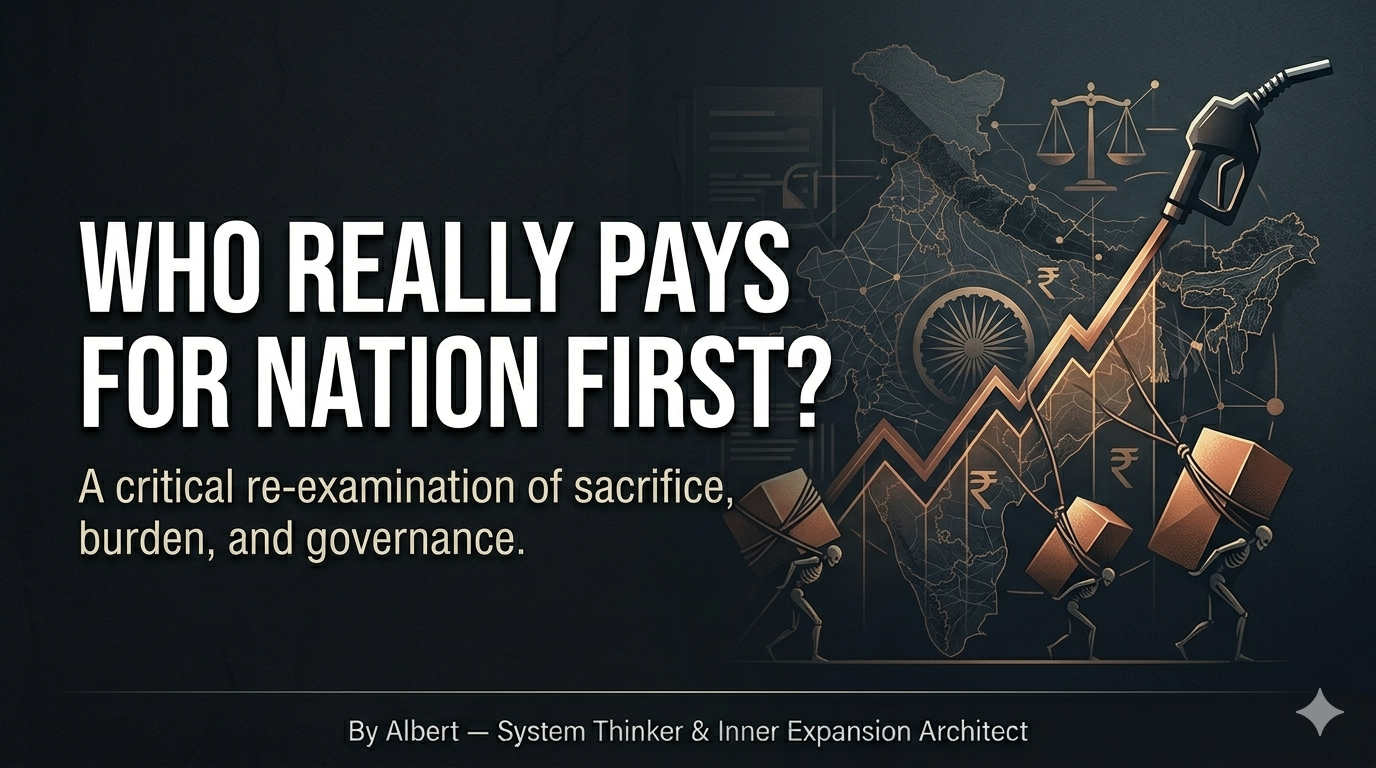
Is PM Modi’s Appeal Justified? Or Is “Nation First” Becoming a One-Way Contract?
A Systems Thinking Analysis of Governance, Duty, and the Great Fiscal Betrayal
Is PM Modi’s Appeal Justified? Why “Nation First” Is a One-Way Contract
India collected 36 lakh crore rupees in fuel taxes. It still imports 88% of its crude oil. PM Modi is now asking citizens to cut back on petrol, gold, and foreign travel. Before we talk about duty, let us talk about who broke the contract first.
The Uncomfortable Truth Nobody Is Saying
Asking a citizen to sacrifice when the state has already consumed their sacrifice, without return, is not patriotism. It is extraction dressed as virtue.
That is what we need to sit with before this conversation goes any further.
Context and Problem: The Appeal That Demands an Audit
In early 2026, amid rising crude oil prices, forex pressure, and a rupee losing ground, Prime Minister Narendra Modi made a now-viral appeal. He asked Indian citizens to reduce petrol consumption, avoid unnecessary gold purchases, and limit foreign travel, all in the name of national duty.
The immediate social media reaction was predictable. Supporters called it visionary sacrifice. Critics called it tone-deaf. But both sides missed the deeper question:
Has the government earned the moral authority to ask for sacrifice?
Let us strip away the emotion and look at the data.
The Numbers That Cannot Be Ignored
During the COVID-19 pandemic of 2020, Brent crude oil crashed below $20 per barrel. US WTI crude briefly traded at negative prices. India imported crude oil at historically cheap rates.
Here is what happened next:
- The central government increased excise duty on petrol from Rs. 19 to Rs. 33 per litre.
- State governments added their own VAT increases on top.
- The result: petrol crossed Rs. 100 per litre in many Indian cities, even when crude was at a 20-year low.
Between 2012 and 2024, the central government collected Rs. 36 lakh crore in excise duty from fuel alone.
The UPA-era oil bond obligation that is frequently cited as justification? That was Rs. 3.25 lakh crore. The government collected more than ten times that amount in excise. The oil bonds have been paid. Then paid again. Then paid seven more times.
Yet today, India imports 88% of its crude oil. That dependency has not decreased. It has increased since 2012.
36 lakh crore collected. 88% import dependence. 9.5 days of strategic fuel reserves. This is the balance sheet of “Nation First.”
Three Structural Failures That Rs. 36 Lakh Crore Should Have Fixed
- Hydrocarbon Exploration and Licensing Policy (HELP): Despite the policy’s existence, India has made negligible progress in discovering and developing new domestic oil fields. The infrastructure for energy sovereignty was simply not built.
- Strategic Petroleum Reserves (SPR): India’s emergency reserves can hold just 9.5 days of crude supply. Comprehensive storage, including refinery stock, extends this to 60 to 74 days. But when oil was trading at $20, the government had a once-in-a-generation window to fill reserves cheaply. That window was not used.
- EV Ecosystem: A credible electric vehicle ecosystem, charging infrastructure, battery manufacturing, and grid readiness, would have reduced the very petrol dependency Modi now asks citizens to address voluntarily. After 12 years and 36 lakh crore in fuel revenue, the ecosystem remains fragmented.
First Principles Breakdown: What Is Governance Actually For?
Strip everything away. Remove the speeches, the ideology, the slogans. Ask the most basic question:
What is the fundamental purpose of a government?
Here is the answer from first principles: Government exists to organize collective resources in ways that increase the freedom, security, and capability of its citizens over time.
That is it. Not to collect taxes for the sake of fiscal optics. Not to issue moral appeals without accountability. Not to centralize revenue and decentralize blame.
Every tax collected from a citizen is a transfer of their productive energy to the state, with an implicit promise: we will invest this toward a future that serves you.
When that promise is broken, the contract of citizenship is broken. Not legally. Not visibly. But fundamentally.
The question we must ask is not: “Is Modi wrong to ask citizens to sacrifice?” The real question is: “Has the state fulfilled its side of the contract first?”
First principles say the answer is no. And when the state has not fulfilled its obligation, its moral authority to demand sacrifice evaporates.
Systems Thinking Analysis: The Feedback Loops Nobody Mapped
Let us trace the actual feedback loops at work here.
Loop 1: The Centralization-Dependency Spiral
Tax revenue concentrates at the center. The center allocates, with political considerations shaping outcomes. Local governments lack resources to build energy infrastructure. Citizens remain dependent on imported oil. Global oil prices fluctuate. Tax revenue is used to plug fiscal gaps, not to invest in independence. Citizens are asked to reduce consumption to manage the next crisis. Taxes remain high to fund the next budget. The citizen is still dependent. The loop repeats.
This is not a governance system. It is a dependency machine with a civic virtue veneer painted over it.
Loop 2: The Decentralization-Resilience Spiral
Contrast that with what a decentralized, participatory model would produce:
- Fuel tax revenues are partially devolved to state and local bodies for targeted infrastructure investment.
- Local governments build EV charging networks, solar micro-grids, and public transport alternatives.
- Citizens have visible, proximate evidence that their taxes are building energy independence.
- Voluntary behavior change becomes organic because citizens see the return on their contribution.
- Strategic reserves are built during low-price windows via a mandate with local accountability.
- Import dependence begins to fall. Foreign exchange pressure eases. The crisis that prompted the appeal does not materialize at the same scale.
The difference between these two loops is not ideology. It is institutional design. One design creates resilience. The other creates dependency and then blames citizens for being dependent.
The Accountability Inversion
There is a particularly destructive pattern in centralized governance that systems thinkers call accountability inversion. It works like this:
- The state collects resources and makes promises.
- The state fails to deliver on those promises.
- A crisis emerges from that failure.
- The state issues a moral appeal asking citizens to solve the crisis through personal sacrifice.
- Citizens who do not comply are implicitly framed as unpatriotic.
This inversion is not unique to India. But in India, it is particularly acute because the constitutional framework already provides the corrective: participatory federalism. The 73rd and 74th Constitutional Amendments gave panchayats and urban local bodies the mandate to govern themselves. That mandate has never been fully funded or empowered.
Design Thinking Application: When Systems Fail Real People
Let us move from abstraction to a human being.
Meet Kavitha. She runs a small tailoring business in a tier-2 city. She uses a two-wheeler to source fabric and deliver finished garments. Petrol is her largest variable cost. She has no EV alternative because the charging infrastructure does not exist in her city. Public transport is inadequate for her delivery routes.
When Modi asks Kavitha to reduce petrol consumption for the sake of the nation, what exactly is he asking?
He is asking her to absorb the cost of a policy failure that was funded by her own tax payments. Her petrol taxes, collected over years, should have built the EV ecosystem or public transport network that would give her an alternative. They did not. Now she is asked to sacrifice on top of that prior sacrifice.
This is not duty. This is double taxation: once at the pump, once through the curtailment of your livelihood.
Participatory Design Changes the Outcome
Now imagine a different system. Kavitha’s local ward committee has a participatory budgeting process. A portion of fuel tax devolution is used to install EV charging points and expand last-mile delivery routes. Kavitha helped vote on the priorities at a town hall six months ago. She chose the charging infrastructure because she understood her own business needs.
When fuel prices rise, Kavitha has already transitioned 30% of her deliveries to an electric cargo bike she co-financed through a local cooperative scheme.
She does not need a Prime Ministerial appeal. She already reduced her dependence, not out of patriotic duty, but because her governance system was designed to serve her actual needs.
This is the difference between representative governance and participatory governance. One issues appeals. The other creates conditions.
The Five Profound Insights That Challenge Conventional Governance Thinking
Insight 1: Moral Authority Cannot Be Borrowed; It Must Be Earned
Governments derive the right to ask for sacrifice from citizens only when they have demonstrably invested prior sacrifices wisely. When Rs. 36 lakh crore in fuel taxes produces 88% oil import dependence and 9.5 days of emergency reserves, the moral account is overdrawn. An appeal made from an overdrawn moral account is not leadership. It is deflection.
Insight 2: Centralization Creates the Crises It Then Asks Citizens to Solve
The forex pressure on the rupee that triggered Modi’s appeal is structurally linked to India’s oil import bill. That import bill is structurally linked to the failure to build domestic energy capacity. That failure is structurally linked to how fuel tax revenue was allocated over 12 years. Asking citizens to reduce petrol consumption is asking them to treat a symptom caused by the disease of centralized misallocation.
Insight 3: Duty Is a Bilateral Contract, Not a Unilateral Demand
The Constitution of India specifies Fundamental Duties in Article 51A. These exist alongside Fundamental Rights and Directive Principles. Governance is a trilateral contract between citizens, elected representatives, and the constitutional framework. When the government invokes citizen duty while ignoring its own constitutional obligations to enable energy security, education, and economic resilience, it is selectively reading the contract. That is not constitutional governance. It is constitutional cherry-picking.
Insight 4: Progress Measured by GDP Masks the Real Economy of Human Capability
India’s GDP has grown significantly over the past decade. But GDP does not measure whether Kavitha can afford to run her business. It does not measure how many days of fuel security the nation has. It does not measure the quality of local self-governance. The obsession with aggregate economic metrics allows centralized governance to claim progress while the distribution of capability, security, and agency deteriorates. True progress is measured at the level of the household, the ward, and the panchayat.
Insight 5: The Citizen Who Cannot Participate Cannot Be Held Accountable
You cannot simultaneously deny citizens participatory governance, capture their tax resources at the center, fail to invest those resources in promised outcomes, and then hold citizens morally accountable for the crisis that results. Accountability requires agency. If citizens have no real agency in how their taxes are spent, they cannot be held accountable for the consequences of that spending. Modi’s appeal to duty presupposes a civic agency that the current system structurally denies.
The New Solution Model: A Framework for Participatory Federalism
The solution is not to change leaders. It is to change the architecture of governance itself.
Here is a practical framework for the transition:
Pillar 1: Fiscal Devolution with Accountability
- 30% of fuel excise collected in each state must be devolved to local bodies within 90 days of collection.
- Local bodies must publish a public spending plan for these funds before release.
- Citizens have a formal right to audit and challenge the plan at gram sabha or ward committee meetings.
Pillar 2: Participatory Energy Planning
- Each district must have a five-year energy resilience plan developed through participatory budgeting.
- Plans must include EV infrastructure targets, public transport expansion, and renewable energy adoption timelines.
- Progress on these plans is reported publicly and is a condition for continued central devolution.
Pillar 3: Strategic Reserve Mandate
- India’s strategic petroleum reserves must reach a minimum of 30 days within five years.
- Low-price windows for crude must trigger mandatory reserve-filling protocols.
- The reserve-filling strategy is publicly reported and audited by an independent body.
Pillar 4: Constitutional Fulfillment
- The 73rd and 74th Amendments must be fully operationalized with dedicated budget lines.
- Panchayats and urban local bodies must have revenue-raising powers proportionate to their mandates.
- No central government appeal to citizen duty is constitutionally valid while these amendments remain unfunded.
Step-by-Step Actionable Guide: From Awareness to Scaling
Step 1: Awareness
Read the data. All of it. The Rs. 36 lakh crore figure. The 88% import dependence figure. The 9.5-day strategic reserve figure. Understand that these are not opposition talking points. They are government-reported figures. Share them with your network without partisan framing. The problem is structural, not political.
Step 2: Diagnosis
Map the feedback loop in your own community. How is fuel tax revenue being spent at the local level? What is the state of EV infrastructure in your city? What decisions does your panchayat or ward committee actually control? The diagnosis begins at home.
Step 3: Reframing
Stop asking: “Is Modi right or wrong?” Start asking: “What governance architecture would make this appeal unnecessary?” The reframe moves the conversation from personality to system. Personalities change. Systems persist.
Step 4: Intervention
Engage with local governance. Attend gram sabha meetings. File RTI requests for fuel tax devolution figures in your district. Demand a local energy plan. The intervention is not a protest. It is participation.
Step 5: Feedback
Document what you find. Share it. Create comparative data across districts and states. Feedback loops only function when information flows. Right now, citizens lack the data to hold local governance accountable. Build the data infrastructure.
Step 6: Iteration
Work with local bodies to improve their energy plans based on citizen feedback. This is not a one-time exercise. Participatory governance is a practice, not an event. Iterate annually.
Step 7: Scaling
Connect your local model to a national network of participatory governance advocates. Influence state-level policy on fiscal devolution. Build the political and civil society pressure for full implementation of the 73rd and 74th Amendments. Scale is not the enemy of locality. It is the protection of it.
Real-World Example: Kerala’s Participatory Planning Revolution
In 1996, the Kerala government launched the People’s Plan Campaign, one of the most ambitious exercises in participatory decentralized governance in any developing democracy.
The government devolved 35 to 40% of its plan expenditure to local self-government institutions. Citizens participated in gram sabhas to identify needs, set priorities, and design projects. Local bodies had genuine fiscal authority, not just advisory roles.
The results over the following two decades were significant:
- Kerala’s human development indicators consistently outperformed states with higher GDP.
- Local infrastructure was built based on actual community needs rather than centralized bureaucratic assumptions.
- Citizen engagement in governance increased measurably, creating a culture of accountability rather than passivity.
Kerala is not a utopia. The campaign had implementation failures and political complications. But it demonstrated a foundational truth: when citizens participate in designing the systems they fund, those systems work better and citizens engage with them differently.
Kerala did not need to issue moral appeals asking citizens to sacrifice. It built a system that generated voluntary cooperation through demonstrated reciprocity.
That is the difference.
Future Implications: Two Futures, One Choice
If We Shift Toward Participatory Federalism
- India’s strategic petroleum reserves reach 30 to 45 days within a decade, reducing forex vulnerability during oil price shocks.
- Local EV infrastructure grows organically, driven by community planning rather than top-down mandates.
- Citizens develop a genuine sense of civic ownership because they can trace their taxes to visible, locally decided outcomes.
- The moral authority of governance grows because it is earned through reciprocity, not claimed through appeals.
- The next time a crisis arrives, citizens respond with voluntary cooperation because the trust infrastructure exists.
If We Continue the Current Trajectory
- Import dependence on crude oil continues to grow, making every global oil price shock a domestic economic crisis.
- Forex reserves remain vulnerable to the oil import bill, requiring repeated citizen sacrifice appeals.
- The gap between the governance India’s Constitution promised and the governance Indians actually experience continues to widen.
- Civic disengagement deepens as citizens correctly perceive that their participation changes nothing.
- The next crisis will require a larger sacrifice, from a citizenry with even less trust in the system that is asking.
The stakes are not abstract. They are measured in rupees at the petrol pump, in days of fuel security, and in the lived experience of every Kavitha running a small business on the margins of an indifferent system.
Conclusion: What Flourishing Actually Looks Like
Human flourishing is not a GDP number. It is not a Sensex milestone. It is not a foreign policy achievement headlined in prime time.
Human flourishing is Kavitha being able to run her business without navigating the arbitrary consequences of centralized fiscal decisions made 1,000 kilometers away from her reality.
It is a panchayat that knows its village’s energy needs better than any ministry ever could, and has the resources and authority to address them.
It is a citizen who pays taxes and can point to exactly what those taxes built in their own community.
It is a government that has done the hard work of building energy security before asking citizens to reduce their energy use.
PM Modi’s appeal may be well-intentioned. But intention is not a governance framework. The appeal exposes a deeper structural failure: a system that centralizes resources and then decentralizes blame. A system that collects sacrifices and then asks for more.
“Nation First” must mean the nation’s citizens first. Not the nation’s fiscal optics first. Not the nation’s centralized authority first. The citizens. Who paid. And who are still waiting for what was promised in return.
The path forward is not a different leader making a different appeal. It is a different architecture of governance, one where power lives closest to the people it must serve, where fiscal resources flow toward the needs citizens themselves identify, and where duty is a two-way street rather than a one-way toll road.
That architecture has a name. It is called participatory federalism. And India’s Constitution already mandated it. We just need the political will to actually build it.
By Mr. Albert, A System Thinker and Inner Expansion Architect
CALL TO ACTION
This analysis is only useful if it generates action. Here is what you can do right now:
- Share this article and tag a friend who argues about petrol prices without the data.
- Comment below: Do you think the government earned the right to ask for sacrifice? What would change your answer?
- Follow albertyzacharia.in for more systems-level analysis of governance, federalism, and human flourishing.
- File an RTI in your district asking for fuel tax devolution figures. The data belongs to you.
FAQ SECTION (SCHEMA-READY)
Q1: Is PM Modi’s appeal to reduce petrol consumption justified?
Based on fiscal data, the appeal lacks moral authority at this moment. The central government collected over Rs. 36 lakh crore in fuel excise duties between 2012 and 2024. During this period, India’s crude oil import dependency increased from approximately 82% to 88%, and strategic petroleum reserves remain at only 9.5 days of supply. The resources for energy sovereignty were collected but not deployed. Until the government demonstrates that prior fiscal resources were used to reduce oil dependency, the appeal to citizen sacrifice is structurally premature.
Q2: What are India’s strategic petroleum reserves?
India’s Strategic Petroleum Reserves (SPR) managed by Indian Strategic Petroleum Reserves Limited (ISPRL) currently hold approximately 9.5 days of crude supply. When combined with refinery stocks and pipeline inventory, the total available supply extends to 60 to 74 days. This is significantly below the International Energy Agency’s recommended 90-day supply cushion and well below what India’s economic size warrants.
Q3: What is participatory federalism?
Participatory federalism is a governance model that combines constitutionally mandated decentralization (federalism) with active citizen involvement in policy design and resource allocation (participation). In India’s context, it means fully implementing the 73rd and 74th Constitutional Amendments, devolving meaningful fiscal resources to panchayats and urban local bodies, and creating formal mechanisms for citizens to co-design local spending priorities through processes like participatory budgeting.
Q4: What is the “Nation First” one-way contract problem?
The one-way contract problem occurs when a government invokes citizen duty (“Nation First”) while systematically failing to fulfill its own obligations under the governance contract. Citizens pay taxes expecting investment in public goods, energy security, and economic resilience. When those investments are not made and a crisis emerges from that failure, asking citizens for additional sacrifice transforms a bilateral civic contract into a unilateral extraction mechanism.
Q5: How does Kerala’s People’s Plan Campaign relate to this analysis?
Kerala’s 1996 People’s Plan Campaign demonstrated that meaningful fiscal devolution to local bodies, combined with structured citizen participation in planning, produces better human development outcomes than centralized resource allocation. It provides a historical proof point that participatory federalism is not theoretical. It has been implemented at scale in an Indian context and produced measurable results.
SOURCES AND INSPIRATIONS
- Albert Y Zacharia: albertyzacharia.in, Modi Appeals Analysis, Fuel-Gold-Forex Crisis 2026
- Wiki Milletify: Who Carries the Nation First Burden? Crisis Exposed (2026)
- Medium: Who Really Pays for Nation First? A Systems View, by Immunity Designer
- Indian Strategic Petroleum Reserves Limited (ISPRL) official data
- PPAC (Petroleum Planning and Analysis Cell), Ministry of Petroleum, Government of India
- 73rd and 74th Constitutional Amendment Act, Government of India
- Kerala People’s Plan Campaign documentation, State Planning Board Kerala
- International Energy Agency (IEA): Emergency Oil Stock Policy Recommendations
Systems Thinking. Inner Expansion. Constitutional Governance.
Leave a Reply