
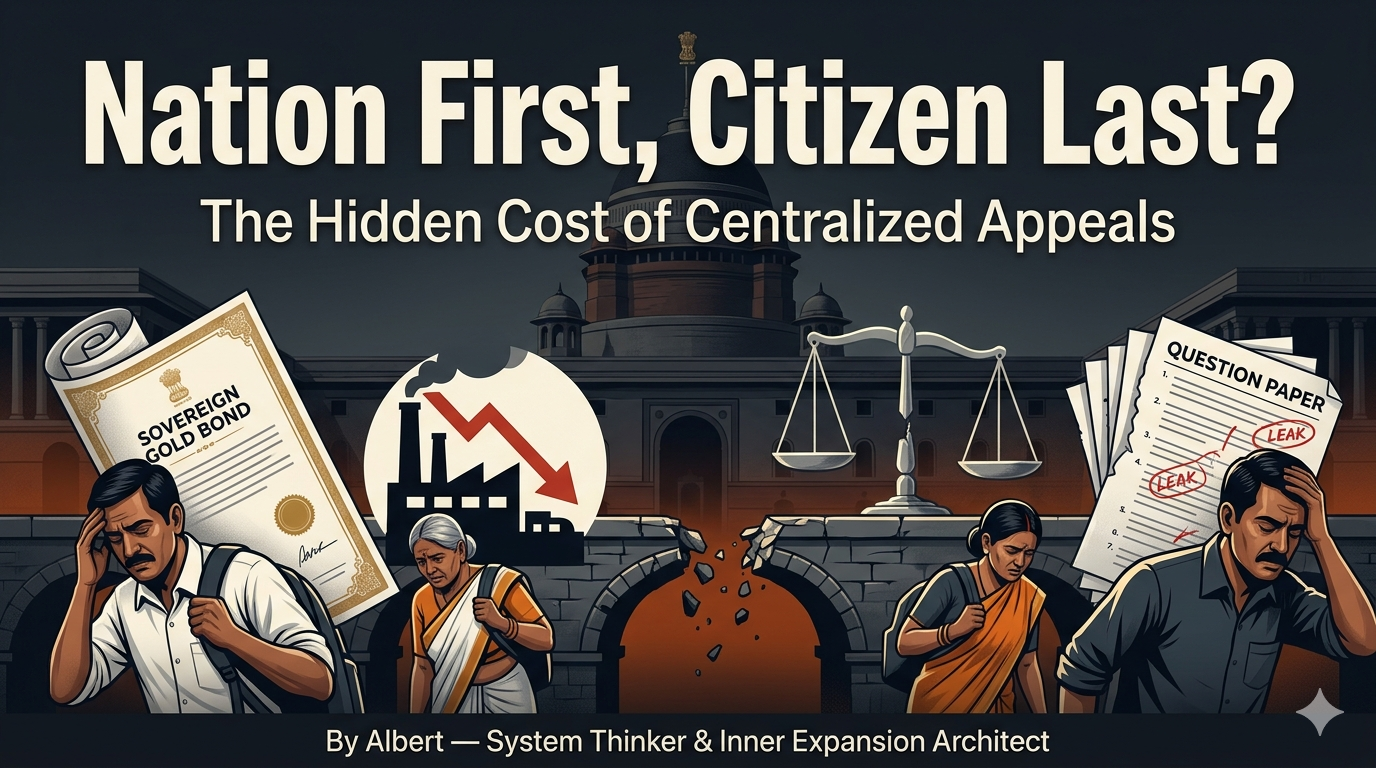
Is PM Modi’s Appeal Justified – Part 2: Who Really Carries The Burden When Systems Fail?
Is PM Modi’s Appeal Justified – Part 2? Gold, Exams, And The Hidden Cost Of Centralization
Part 2 of a systems-level audit of PM Modi’s appeals. From failed manufacturing to SGB tax shocks and NEET paper leaks, who really pays when the system fails – citizens or the state?
When a Prime Minister asks you to stop buying gold and postpone foreign travel, it sounds like patriotism.
When the same state quietly changes gold bond tax rules after citizens follow its advice, and cancels national exams after years of paper leaks, it stops being patriotism and starts looking like design failure.
This is Part 2 of the question nobody in power wants you to ask – who really carries the burden when systems fail?
Is PM Modi’s Appeal Justified – Part 2: Gold, Exams, And The Burden–Shift State
When citizens obey appeals, they expect systems to do their part.
Instead, India is watching a pattern where policy failures are socialised onto families while gains are kept by the state.
From broken manufacturing bets to gold bond tax flip–flops and exam leaks, this is not just about Modi.
It is about a governance architecture that keeps shifting the bill to the same people who already paid.
If a government can ask you to sacrifice today, change the rules on your savings tomorrow, and still blame you when exams collapse, what exactly is “Nation First” protecting – the nation, or the system that failed it?
CONTEXT + PROBLEM
What began as a single televised appeal to drive less, buy less gold, and cancel foreign vacations has now opened a much larger fracture line.
Part 1 of this series focused on fuel taxes, oil import dependence, and the constitutional contract the state keeps breaking.
Part 2 goes deeper into three specific arenas where the same pattern repeats.
Manufacturing, where India had every structural advantage, yet watched Vietnam walk away with the “China plus one” opportunity.
Gold, where the state pushed citizens toward Sovereign Gold Bonds to save forex, then changed the tax rules retrospectively when the bill came due.
Exams, where paper leaks and the cancellation of NEET 2026 shattered the futures of lakhs of students while institutions escaped structural accountability.[web:20][web:21]
On the surface, all three look like separate stories.
A missed industrial policy window.
A technical tweak to a niche financial product.
A cheating scandal in a stressful medical entrance exam.
From a systems lens, they are one story: a centralised state that repeatedly fails at its own responsibilities, then reaches for the easiest lever it knows – citizen sacrifice.
The pain points are not abstract.
Families who trusted SGBs as a “Nation First” way to hold gold now wake up to find that if they bought from the secondary market, their gains at maturity will be taxed, even though earlier communication and common understanding suggested that holding till redemption made capital gains tax free.[web:16][web:19]
Students who studied for years now find NEET 2026 cancelled and rescheduled because the system could not protect a question paper, even after years of warnings from earlier leaks.[web:31][web:34]
Workers and small entrepreneurs who could have been part of an export engine like Vietnam instead remain trapped in low–productivity jobs because the environment for manufacturing never reached its potential.[web:15][web:24]
This is the real crisis.
Not crude prices.
Not gold imports.
Not student protests.
The real crisis is an architecture that centralises power while decentralising the cost of its failures.
FIRST PRINCIPLES BREAKDOWN
Let us strip the emotion out and go back to first principles.
First principle 1: A state’s primary economic duty is structural, not moral.
Its job is to design and maintain systems that reduce vulnerability, expand opportunity, and protect long–term sovereignty.
Appeals to sacrifice are secondary tools, not primary strategies.
First principle 2: A contract is only legitimate when both sides keep their part.
Citizens commit taxes, compliance, and time.
The state commits predictable rules, fair processes, and competent systems.
When one side keeps shifting terms after the fact, trust collapses.
First principle 3: Risk and reward must be aligned.
If citizens shoulder the risk – of volatile fuel prices, of exam chaos, of policy flip–flops – they must also see clear, predictable benefits.
Without this alignment, “Nation First” becomes a slogan that hides a one–way transfer of risk from state to society.
Now apply these principles to three domains.
Manufacturing
India has scale, a young workforce, and a large domestic market.
Vietnam has a far smaller population, yet in 2024 its total exports slightly edged past India, with about 405–430 billion dollars in goods shipped against India’s roughly 430 billion in merchandise exports and a heavier share of high–tech manufacturing.[web:15][web:24]
Vietnam’s hi–tech manufacturing share stands near 40 percent of manufactured exports, while India hovers in single digits.[web:23]
This was not destiny.
It was design.
Sovereign Gold Bonds
When SGBs were launched, the promise was clear.
Help the nation by shifting from physical gold to paper gold and you get tax–free gains at maturity.
For years, investors and advisors repeated that as long as you held the bond until RBI redemption, capital gains were exempt, regardless of whether you bought in the primary issue or on the exchange.
Budget 2026 changed that understanding.
Now only original subscribers who hold till maturity enjoy tax–free redemption.
Secondary market buyers who followed the spirit of the scheme will see their maturity gains taxed as capital gains from April 1, 2026 onward.[web:16][web:19]
Intent may be to close a “loophole.”
The effect is a retrospective rule change that punishes trust.
Exams and NEET 2026
For years, leaks have haunted high–stakes exams like NEET and UGC–NET.
In 2024, the Supreme Court acknowledged that a NEET–UG paper leak occurred in Hazaribagh, yet the exam was not cancelled nationwide.[web:29]
In 2026, the National Testing Agency went further – cancelling NEET–UG 2026 and ordering a re–exam after allegations of a leaked “guess paper” that closely matched the actual test, triggering protests and a CBI probe.[web:31][web:33]
Ask yourself the simplest first–principles question.
If an exam system repeatedly fails to keep its own question paper secure, who exactly should carry the cost – the institution or the 23 lakh students who rearranged their lives around a date the system could not respect?
SYSTEMS THINKING ANALYSIS
Systems thinking asks us to map loops, incentives, bottlenecks, and leverage points.
Here is what emerges when we put manufacturing, SGBs, and NEET on the same systemic canvas.
Loop 1: Centralization – Reward Capture – Burden Shift
Power and decision–making concentrate at the Union and a thin layer of central agencies.
Rules and schemes are designed top–down – Make in India, SGBs, national–level testing – with strong messaging and weak ground architecture.
When things go well in headline terms (export targets, gold mobilization, exam turnout), central actors claim credit.
When structural gaps surface – manufacturing still trailing Vietnam, SGB outlay looking expensive, papers leaking – the consequences are pushed outward.
Manufacturing shortfalls become a reason to keep labour informal and wages low.
Gold bond costs become a reason to narrow tax benefits for investors who believed the earlier narrative.
Exam leaks become a reason to cancel or re–conduct tests, forcing students and families to absorb stress, cost, and time loss.[web:16][web:28][web:31]
The system survives.
The citizen pays.
Loop 2: Design Failure – Trust Erosion – Compliance Fatigue
Each time the state changes rules mid–game or fails to protect process integrity, something subtle but powerful erodes – trust.
Investors who once saw SGBs as a “safe, tax–efficient patriotic gold option” will now think twice before trusting long–term government promises.[web:16]
Students who see NEET cancelled after months of denial about leaks will not automatically believe future assurances from NTA or the Ministry.[web:30][web:31]
Workers who watched manufacturing opportunities flow to Vietnam while hearing “Make in India” speeches will quietly downgrade their belief that policy slogans translate into real jobs.[web:15][web:23]
As trust weakens, voluntary compliance becomes harder.
Appeals for sacrifice begin to sound like emotional blackmail, not shared responsibility.
The state responds with more control – surveillance, stricter rules, high–stakes tests, complex tax codes.
The loop reinforces itself.
Loop 3: Accountability Inversion In Practice
The most dangerous loop is the accountability inversion that has now become normal.
In manufacturing, policy and regulatory complexity, slow land and logistics reforms, and inconsistent incentives made India less attractive than Vietnam for fast–moving global value chains.
Yet when jobs do not materialise, the narrative often blames “labour attitudes,” “low productivity,” or “lack of skills” among Indian workers.[web:23][web:26]
In SGBs, the state mispriced long–term gold exposure and under–estimated the cost of a product it itself designed.
Instead of owning the miscalculation, it narrowed tax benefits on existing bonds for a subset of investors.
Citizens who followed the macro–narrative now absorb the adjustment.[web:16][web:19]
In NEET, security failures, weak vendor oversight, and fragmented exam governance allowed leaks to persist.
The institutional response is to cancel the exam, order a re–test, and refund fees – cosmetic relief for students who cannot refund time, stress cycles, or lost opportunities.[web:31][web:34]
In every case, the system creates the vulnerability and the citizen pays the bill.
7. DESIGN THINKING APPLICATION
Design thinking begins with empathy.
Not for the institution, but for the human being trapped inside the system.
Meet three people.
Ravi, the Secondary SGB Believer
Ravi is a middle–class professional in Kochi who never trusted speculative trading.
When the government promoted SGBs as a way to “own gold without importing it,” he decided to shift part of his family’s jeweller–based savings into bonds.
He bought several tranches on the secondary market at a small discount, believing that as long as he held them till maturity, capital gains at redemption would be tax free, just as countless articles and explainer videos claimed.[web:16][web:19]
Then Budget 2026 arrived.
Now, if he holds to maturity beyond April 1, 2026, his gains will be taxed as capital gains because he purchased in the secondary market.
The state got exactly what it wanted – less pressure on physical gold imports and more rupee–denominated gold savings.
Ravi gets a moving goalpost.
Meera, The Aspirant Doctor
Meera is a first–generation NEET aspirant from a tier–3 town.
Her parents took loans to pay for coaching.
She lived on a schedule that revolved entirely around a single exam date.
In 2024 she watched seniors protest an alleged leak that the system first denied, then partially acknowledged, then moved past without a full cancellation.[web:29]
In 2026 she sat for an exam that was later scrapped after evidence of a “guess paper” that matched the real paper closely.[web:31][web:34]
The same system that demands her discipline could not guarantee a sealed envelope.
Now she must sit again, carry the emotional fatigue, and compete in a more polarised and angry environment.
The institution issues statements.
She loses months of life.
Arun, The Almost–Manufacturer
Arun is an entrepreneur who wanted to set up an electronics assembly unit in Gujarat.
He discovered that global brands were choosing Vietnam for speed, predictability, and trade access while he faced complex local approvals, higher indirect costs, and patchy logistics.
He could service domestic demand, but exports – the real forex cushion – remained a distant dream.
By 2024, Vietnam’s exports had slightly overtaken India’s and a much larger share of its basket came from manufacturing and electronics.[web:15][web:23][web:24]
Arun does not show up in macro slides.
He shows up in the gap between potential and reality.
Design thinking asks a different question.
What would an SGB scheme, an exam system, and a manufacturing policy look like if they were designed first from Ravi’s, Meera’s, and Arun’s journeys – not from the optics of fiscal and political comfort?
THE 5 PROFOUND INSIGHTS
Insight 1: Behaviour Change Without Rule Stability Is Manipulation, Not Governance
You cannot invite citizens to shift from jewellery to gold bonds, from private savings to state paper, then alter the tax logic after the shift has happened without damaging the moral foundation of future appeals.[web:16][web:19]
If the rules can change when it becomes expensive for the state, citizens rightly conclude that the risk is asymmetric.
Over time, they stop trusting “patriotic” products and move back to hard assets they control.
Insight 2: Manufacturing Failure Is Not Just An Economic Miss, It Is A Forex And Dignity Crisis
When Vietnam, with about seven percent of India’s population, reaches roughly similar or higher export levels and far higher high–tech manufacturing share, it is not simply “competition.”[web:15][web:23][web:24]
It is a signal that India’s governance ecosystem made it easier to import phones than to manufacture them at scale.
The cost is not only lost dollars.
It is lost dignity for millions who could have been skilled industrial workers instead of precarious gig labour.
Insight 3: Exam Paper Leaks Are A Governance X–Ray, Not A Local Scam
Every NEET or UGC–NET leak is treated as an isolated scandal in one centre or state.[web:29][web:30]
From a systems lens, repeated leaks across years reveal weak vendor controls, poor encryption practices, lack of real–time monitoring, and minimal consequences for institutional failure.
Cancelling an exam or ordering a CBI probe after the fact is damage control.
True accountability would mean redesigning the exam architecture so that leaks are structurally hard and very costly for insiders.
Insight 4: Centralisation Without Capacity Becomes A Blame–Export Machine
A centralised system that cannot reliably secure papers, anchor manufacturing, or honour long–term promises will, by default, export its failures onto citizens.
Appeals to “Nation First” become a psychological tool to convert institutional risk into household burden.
Until power is matched with commensurate capacity and transparent responsibility, centralisation will keep using citizens as shock absorbers.
Insight 5: Trust Is The Ultimate Strategic Reserve
India’s real strategic reserve is not just crude in underground caverns.
It is citizen trust in the idea that if they play by the rules, the rules will not betray them.
Every retrospective tax tweak, every preventable exam fiasco, every broken manufacturing promise depletes that reserve.
Once depleted, no amount of speeches can refill it.
Only visible, structural redesign can.
THE NEW SOLUTION MODEL
So what does a different architecture look like – one where appeals are rare, and systems quietly do their job?
Let us sketch a New Solution Model across the three domains.
Pillar 1: Manufacturing As Sovereignty Infrastructure
Treat manufacturing capacity the way we treat defence capability – as a sovereignty asset, not merely a GDP line.
Simplify land, logistics, and compliance for genuine producers instead of betting mainly on headline mega–investments.
Target MSMEs and mid–sized firms that can plug into global supply chains, not just global giants.[web:23][web:26]
Benchmark key indicators – export processing time, port turnaround, approvals – against Vietnam and other competitors and publish them quarterly.
Tie incentive schemes to hard outcomes like export growth and technology depth rather than announcements.
Pillar 2: SGB 2.0 – A Trust–First Gold Architecture
If the state insists that citizens shift gold behaviour for macro stability, then the state must anchor the trust architecture.
Guarantee that any change to tax treatment on SGBs will only apply to new issues, not retrospectively to existing holdings, and lock this principle in law.[web:16][web:28]
Create a simple, one–page citizen charter for all long–term state–promoted instruments that lists what cannot be changed mid–way.
Offer a one–time exit window for secondary market SGB holders before the new tax regime comes into full effect, instead of quietly squeezing them.
Pillar 3: Exam Systems Designed Like Critical Infrastructure
Treat NEET, JEE, and other national exams as critical infrastructure, not administrative rituals.
Move to encrypted, just–in–time question paper generation and printing at exam centres, as multiple expert panels have already recommended, rather than transporting static sets that can leak upstream.[web:33][web:35]
Create an independent Exam Systems Authority with forensic, technological, and audit powers that investigates institutions, not just individuals.
Guarantee that when an exam is cancelled due to system fault, affected students get tangible compensation – extra attempt windows, age relaxation, and support for mental health – not just a press note and fee refund.
Pillar 4: Participatory Federalism As The Spine
Underneath all of this lies the same answer as Part 1 – participatory federalism.
Give states and local bodies genuine fiscal and regulatory space to attract manufacturing tailored to their context.
Let citizen platforms and associations sit on oversight committees for exams, public investments, and long–term financial schemes.
Move from an architecture where citizens are treated as a “target audience” to one where they are design partners.
STEP–BY–STEP ACTIONABLE GUIDE
This is not only a policy conversation.
It is a civic practice.
Here is a seven–step arc you can use in your own context.
Step 1: Awareness
Map how these three patterns – manufacturing gaps, SGB rule changes, and exam leaks – show up in your life or region.
Read beyond headlines into data on exports, tax circulars, and exam reports.
Step 2: Diagnosis
Ask systemic questions.
Where are decisions concentrated?
Who benefits from opacity?
Where are feedback loops broken – for investors, students, entrepreneurs?
Step 3: Reframing
Shift conversations in your circles from personality debates (“Modi right or wrong?”) to architecture debates.
What kind of system would make such appeals and such failures rare instead of monthly news?
Step 4: Intervention
For SGBs, engage with your advisor or association and consider making representations to the Finance Ministry about retrospective impact.
For exams, support student groups demanding structural reform of NTA and exam processes, not just re–tests.
For manufacturing, back local business associations that push for simpler, transparent rules instead of only new slogans.
Step 5: Feedback
Use RTI, public hearings, and digital platforms to demand clear data on exam security audits, SGB holdings, and manufacturing policy outcomes.
Share that information in accessible language so others can act.
Step 6: Iteration
Support pilot experiments.
A district–level exam body that adopts encrypted, local printing.
A cooperative SGB advisory cell that educates savers.
A city that streamlines clearances for small manufacturers and tracks results.
Refine what works, discard what does not.
Step 7: Scaling
Connect local wins into state or national networks.
When one state adopts better exam security, or one city proves a manufacturing fast–lane works, tell that story everywhere.
Scaling systems reform is less about a single national law and more about many local proofs stitched into a new baseline.
REAL–WORLD EXAMPLE
We have already seen glimpses of what works.
Vietnam’s manufacturing rise is not magic.
It is the cumulative effect of stable export incentives, predictable trade policy, focused infrastructure around ports, and aggressive integration into global supply chains.[web:15][web:23][web:24]
Companies like Samsung shifted large parts of their phone manufacturing there because they could trust time lines, logistics, and policy consistency.[web:26]
In exams, several countries facing leak scandals moved decisively to technology–backed, encrypted delivery and sharply improved integrity.
India’s own exam reform committees have recommended similar shifts after UGC–NET and NEET controversies, but implementation remains uneven.[web:30][web:33]
On gold, other nations design long–term saving instruments where rule changes apply prospectively, not retroactively, precisely to avoid a collapse of trust in state–backed savings.
India knows this logic when it suits it.
It forgets it when short–term fiscal pressure bites.
These are not perfect models.
They are proof that when systems treat citizens as partners rather than shock absorbers, resilience improves.
FUTURE IMPLICATIONS
If nothing changes, the pattern will harden.
Each new crisis will produce a new appeal – use less, buy less, trust more – layered over older, unresolved failures.
Savers will move further into private, opaque instruments.
Students will see exams as lotteries rather than meritocratic filters.
Entrepreneurs will aim first to arbitrage rules, not build enduring capacity.
The language of “Nation First” will keep getting louder as the lived experience of being citizen–last quietly spreads.
If systems evolve, a different trajectory opens.
Manufacturing can absorb millions into dignified work.
Gold can remain a store of value without becoming a permanent forex leak or a trust minefield.
Exams can once again be stressful but predictable rites of passage, not governance horror stories.
Most importantly, appeals from the Prime Minister or any leader can regain moral weight because citizens will know – when the system asks, the system also gives.
CONCLUSION
So, is PM Modi’s appeal justified – in Part 2 of this story?
As a narrow macro sentence – “please reduce import–heavy consumption in a crisis” – it remains understandable.
As a governance pattern, it is deeply compromised.
A state that failed to land the manufacturing window, that changed gold bond tax rules after citizens stepped into the scheme, and that could not secure NEET papers has work to do before it can credibly ask families, savers, and students for more sacrifice.
Nation First cannot mean policy first, optics first, or central comfort first.
It must mean citizen trust first.
Citizen capability first.
System integrity first.
Until we redesign the architecture so that power and responsibility travel together, every new appeal will feel less like a call to courage and more like a familiar invoice – addressed, once again, to those who already paid.
CALL TO ACTION
What do you think?
Would you still buy an SGB in the secondary market after Budget 2026?
Would you sit for an exam run by an agency that has not structurally fixed its leak problem?
Would you build a factory if you knew the rules could move faster than your machines?
Comment below and I’ll send you the community link.
Tag someone who needs to read this before repeating “Nation First” as a reflex.
Follow for more insights on systems, governance, and human flourishing.
By Mr. Albert, A System Thinker and Inner Expansion Architect
Leave a Reply